

Overview
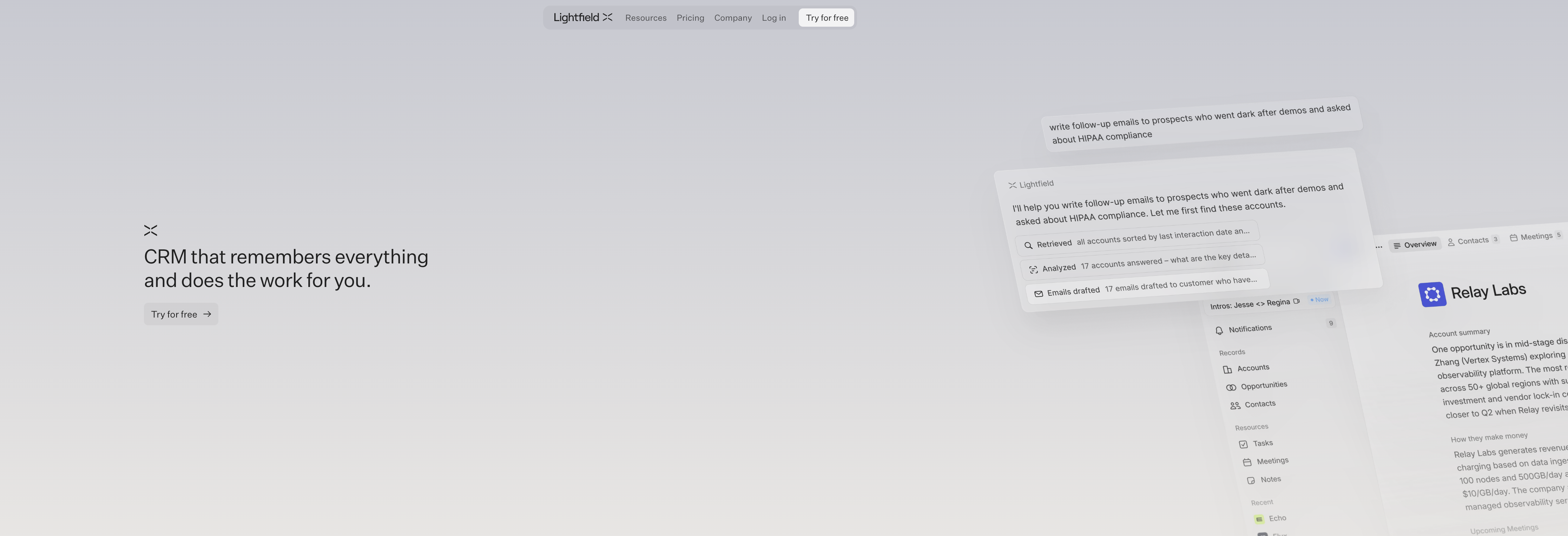
- Eliminate manual CRM data entry and setup by connecting your email and calendar, as Lightfield auto-creates accounts, contacts, and opportunities from every interaction.
- Build a searchable, continuous memory of every customer relationship by stitching together emails, meeting transcripts, and notes into a single history per account.
- Get precise, cited answers to business questions—like which objections come up in demos—by asking an AI agent that analyzes your actual customer conversations.
- Automatically update CRM fields, extract action items, and draft personalized follow-up emails that reference exact words from conversations after every meeting.
- Revive stale deals that have gone quiet by having Lightfield identify promising prospects and draft tailored revival emails for each one.
- Enable bulk, personalized outreach at scale by slicing across structured fields and unstructured conversation data to tailor messages based on past discussions.
- Provide engineers and product teams with direct customer context by letting them search what customers actually said, not filtered summaries.
Pros & Cons
Pros
- Simplifies complex CRM tasks
- Automates standard CRM tasks
- Logs customer interactions
- Drives next steps
- Provides business operation answers
- Analyses emails and meeting transcripts
- No upfront configuration needed
- Allows data model evolution
- Enables personalized emails at scale
- Provides insights for product development
- Updates CRM data based on conversations
- Revives stale deals
- Fills in missing CRM data
- Gives holistic view of customers
- Performs meeting preparation
- Captures and summarizes meetings
- Allows bulk pipeline editing
- Suggests personalized customer outreach
- Provides comprehensive customer history
- Offers contextual understanding
- Serves as a smart assistant
- Helps proactive customer engagement
- Assists in product development
- Manages pipelines based on actual conversations
- Improves work efficiency
- Fast access to crucial customer information
- Understands full customer context
- Automated meeting updates
- Captures conversation records shared
- Understands company, product, market context
- Performs business-related questions answering
- Enables bulk personalized emails
- Provides stronger customer insights to engineers
- Revives dormant deals
- Enriches accounts or contacts data
- Offers built-in call recorder
- Furnishes answers with original conversations citations
- Sends personalized outreach based on discussed content
- Performs mass updates based on spoken conversations
- Automates tailoring revival emails
- Structured fields and unstructured data contextual query
- Supports mass record exports
- Improved workflow triggers
- Enhanced LifeField record data pushing
- MS Outlook integration
- Supports International phone numbers
- Improved global search reliability
- Improved tasks and record updates suggestions
- Customizable meeting recorder appearance
Cons
- No upfront configuration
- Dependent on data quality
- Requires JavaScript
- Lack of explicit privacy measures
- Not suitable for established companies
- Possible misinterpretation of customer interactions
- Possibility of overlooking stale deals
Reviews
Rate this tool
Loading reviews...
❓ Frequently Asked Questions
The main function of Lightfield CRM is to automate and simplify the complex task of managing customer interactions. Among its capabilities are logging and remembering all the details of customer interactions, automating standard CRM tasks, driving next steps, and providing answers about business operations.
Lightfield integrates AI by analyzing data from various sources including emails and meeting transcripts to build an exhaustive record of a company’s interactions with its customers. The AI develops an understanding of the company, its products, and market, which provides a comprehensive context for customer relations.
Lightfield's AI system enables sending personalized emails at a large scale. It does this by analyzing structured fields and unstructured conversation data, which allows customized outreach based on what’s been discussed in past interactions.
Data model evolution in Lightfield refers to the capability of the system to capture information from the first day without any upfront configuration. Over time, businesses can evolve their data model based on the growing understanding of their customer interactions and business requirements.
Lightfield assists in reviving stale deals by identifying prospects who went quiet after showing positive interest. It then drafts tailored revival emails for each one, thus helping to bring stale deals back to life.
Lightfield's AI builds its data analysis capability by examining data from various sources such as emails, meeting transcripts, and other conversation records. It compiles an exhaustive history of customer relationships, thereby enabling better customer understanding and business decision making.
Lightfield aids in understanding the target market by developing a contextual understanding of the company, product, and market. Agents are then equipped with comprehensive context when they answer questions or perform tasks, aiding market understanding.
Lightfield ensures personalized marketing by allowing the slicing across structured fields and unstructured conversation data, then tailoring outreach based on what’s been discussed in past customer interactions.
Yes, Lightfield does offer a free trial as indicated on their website.
Lightfield helps with business automation by taking over many standard CRM tasks, thereby alleviating the administrative burden. It automates processes including logging and remembering all the details of customer interactions, driving next steps, and answering operational questions.
Lightfield's startup tools feature assists in capturing and analyzing everything about the customer, automating various CRM tasks, and providing a more holistic view of customer interactions. This allows startup teams to focus more on operations and strategy than straight administration.
Lightfield aids in customer interaction management by leveraging AI to read, record, and remember every customer interaction, provide full customer context, answer business-related queries, and drive subsequent steps, thereby facilitating more personalized and effective customer interactions.
For product development insights, Lightfield allows users to ask questions like 'which customers asked for this feature, and why?'. Such insights from actual customer feedback equip the team with better context for improved product development.
Lightfield analyzes conversations by reading emails, meeting transcripts, and other records shared with it. It then compiles this information to provide an exhaustive history of a company's customer relationships.
The data completion feature of Lightfield fills in missing data across the entire CRM. If additional customer information is needed, Lightfield can enrich accounts or contacts with the required data.
Lightfield can provide a comprehensive understanding of customers by recording and analyzing every interaction with them, thereby achieving a more holistic view of customers and allowing for more personalized and effective communications.
Lightfield extracts and uses information from sources like emails and meeting transcripts through its AI system, which reads and analyzes this data to compile an exhaustive record of a company's interactions with its customers.
Lightfield is designed around the principles of artificial intelligence by utilizing it to analyze various data sources, including emails and meeting transcripts, to infer a comprehensive understanding of the company's customer interactions, products, and market, thus providing a context for customer relations.
The key benefit of using Lightfield for early-stage teams is its ability to automate various standard CRM tasks, thereby simplifying customer interaction management. It begins capturing information from day one without any upfront configuration, thus allowing these teams to focus on their core operations.
No, Lightfield does not require any upfront configuration. It starts capturing information from day one, with the option for businesses to evolve their data model over time.
Lightfield is a customer relationship management system that utilizes the principles of artificial intelligence. It is designed to simplify the complex task of managing customer interactions, particularly for early-stage teams. Lightfield automates several standard CRM tasks and can answer questions about your business by analyzing customer interaction data. It can send personalized emails at scale, provide critical insights, update CRM data based on conversations, and fill in missing data in your CRM.
Lightfield uses AI to automate standard CRM tasks such as logging and remembering customer interaction details, driving next steps, providing business-related answers, and updating CRM data based on actual conversations. These automation features lighten the administrative burden associated with managing customer relationships.
Lightfield analyzes data from a variety of sources to understand customer interactions. These sources include emails and meeting transcripts among other forms of conversation records.
Lightfield uses collected data from customer interactions and business operations to develop an understanding of a company and its products. By analysing this data, it gains a contextual understanding of your company, product, and market, providing agents comprehensive context when they engage with customers or perform tasks.
No, Lightfield does not require upfront configuration. It's designed to start capturing information from the first day and allows the data model to evolve over time.
Unique features of Lightfield as a CRM tool include preparation, capture, and summary of meetings; answering business-related questions; sending personalized emails in bulk; providing engineers with stronger customer insights; allowing for mass editing of the pipeline; reviving dormant deals; filling in missing data across the CRM; and offering a comprehensive record of customer interactions for a complete context.
Lightfield applies its AI capabilities to sift through structured fields and unstructured conversation data, personalizing outreach based on previous discussions. This allows for the sending of personalized emails at scale.
Lightfield can answer questions like "which customers asked for this feature, and why?" This provides engineers with the context they need to build better products, thereby offering insights for better product development.
Lightfield updates CRM data based on actual conversations by analyzing emails, meeting transcripts, and other conversation records. It uses this data to update fields, log notes, and drive next steps.
'Reviving stale deals' refers to Lightfield's ability to identify prospects who have gone quiet after exhibiting a positive signal. Lightfield can draft tailored revival emails for each one, thereby bringing stale deals back to life.
Lightfield fills in missing data across your entire CRM by enriching accounts or contacts with any necessary data to better serve customers.
Lightfield creates an exhaustive record of a company's customer interactions by reading and analyzing emails, meeting transcripts, and other conversation records shared with it. It compiles and stores this data as comprehensive customer interaction history.
'Evolution of data model' in relation to Lightfield refers to its ability to adapt and grow with your business. Lightfield is designed to capture everything from the onset, whether structured or unstructured data, allowing for modification and evolution of your data model over time.
Yes, Lightfield offers a holistic view of customers to the agents. It provides comprehensive context of customer interactions and business operations, enabling agents to have more personalized and effective communications with the customers.
Lightfield prepares, captures, and summarizes meetings through its built-in call recorder. Following the meeting, it automatically updates itself with the summary, providing the next steps and offering answers to potential questions that may arise.
Lightfield assists in answering business-related questions by analyzing across calls, emails, and notes. It provides answers with citations to the original conversations providing a clear and specific response.
Lightfield allows for mass editing of the pipeline by reassessing accounts, updating stages, or tagging segments based on what was actually said in conversations, and not just fields. This feature proves beneficial, particularly when numerous accounts need adjustments.
Lightfield provides engineers with stronger customer insights by answering questions related to customer behavior and needs. For instance, a question like "which customers asked for this feature, and why?" gives engineers a clear vision of user requirements, informing better product development.
Lightfield assists in proactive customer engagement by suggesting personalized outreach based on previous discussions. This feature enables efficient targeting and communication, leading to increased customer engagement and satisfaction.
Lightfield can be utilized to structure product development by providing customer insights drawn from actual conversations. These insights can answer critical product-related questions, offering the necessary context to build better products that meet customer requirements.
Pricing
Pricing model
Free Trial
Paid options from
$36/month
Billing frequency
Monthly
Related Videos
Agent code execution in Lightfield
Lightfield•5 views•Feb 16, 2026