

Analytics Model
Overview
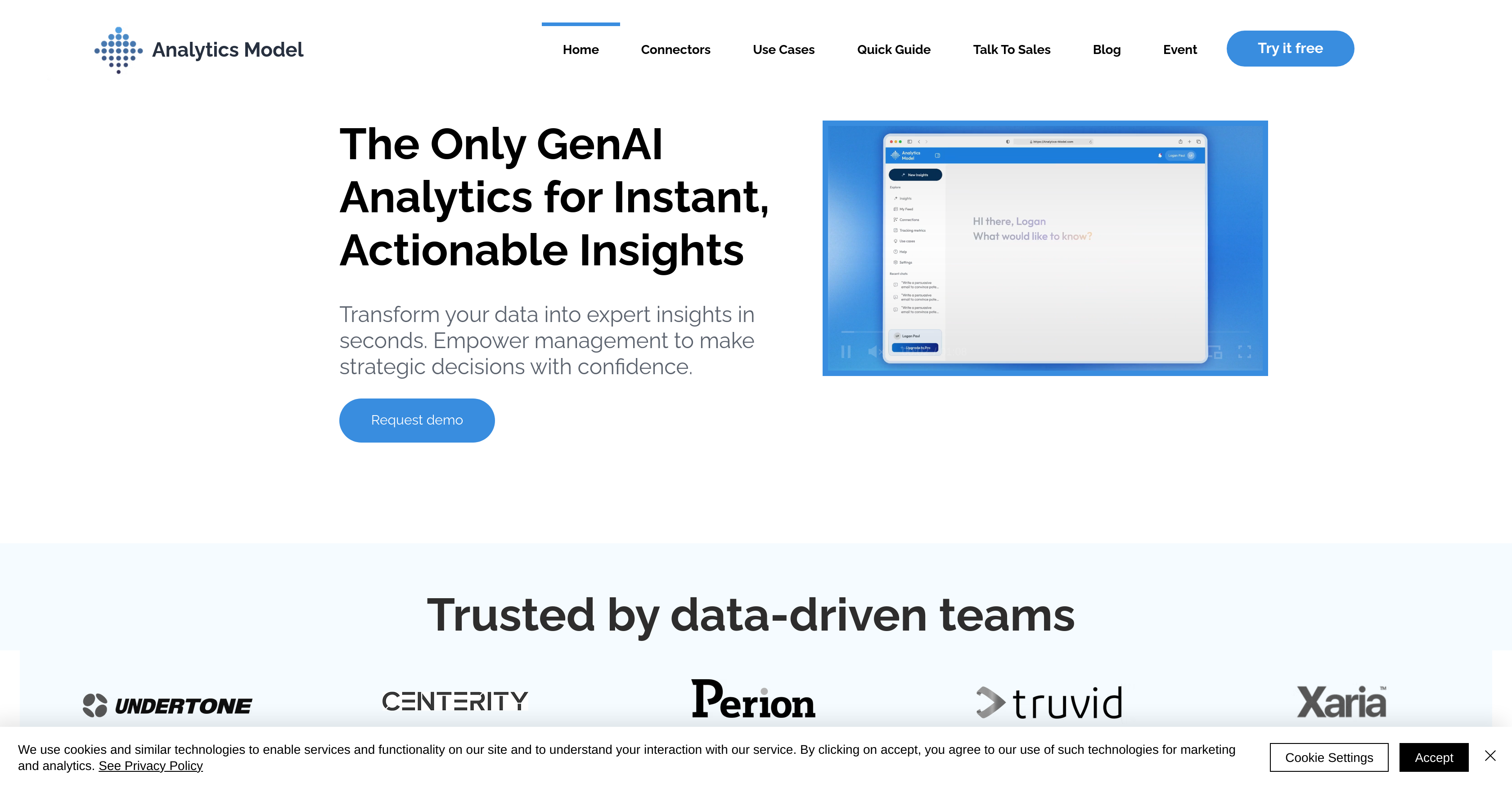
- Ask any data question in plain English and get immediate answers through conversational AI
- Create compelling data visualizations with custom charts and designs tailored to your specific needs
- Unify all your business data by connecting to 500+ analytics tools, databases, and marketing platforms
- Calculate customer lifetime value and perform cohort analysis to optimize marketing and retention strategies
- Track SEO performance by monitoring keyword rankings, backlinks, and site health metrics
- Map complete customer journeys to identify touchpoints and improve customer experience
- Embed advanced analytics directly into your existing platforms and workflow environments
- Analyze sales performance using revenue, conversion rates, and deal size metrics to identify growth opportunities
Pros & Cons
Pros
- Conversational interface
- Real-time insights
- Variety of data visualizations
- 500+ data source integrations
- Analytics embedding support
- Diverse use cases
- Comprehensive help center
- Supports natural language processing
- Sales performance analysis
- Customer journey mapping
- SEO performance tracking
- Customer LTV calculation
- Supports Big Data
- Flexible visualization options
- Personalized actionable insights
- Enables data-driven decision making
- User-friendly analytics
- Marketing performance tracking
- Instant expert insights
- Complex data transformation
- Seamless data integration
- Unified data platform
- Integrates with cloud services
- Visual appealing data presentations
- Supports scientific inquiry
- Product value enhancement
- Database connectors available
- LTV Cohort Analysis
- Market Basket Analysis
- Handles large datasets
- Conversational data interaction
- Visually appealing interface
- Tailored business needs
- Advanced analytical capabilities
- High customer engagement
- Trusted by data-driven teams
- Streamlined data processes
- Transform data into insights
- Seamless platform integration
- Informed decision-making facilitation
- Business insight unlock
- Data source connection guide
- Visualization customization
- Advanced analytics exploration
- Operational efficiency improvement
- Business process transformation
- SaaS platform integration
- Data workflow integration
- Productivity maximization
Cons
- Limited language comprehension
- Overwhelming for new users
- Limited customization for visualizations
- No offline mode
- Risk of misinterpreting data
- No multi-language support
- Potential compatibility issues
- Data privacy concerns
- May be resource-intensive
Reviews
Rate this tool
Loading reviews...
❓ Frequently Asked Questions
Analytics Model is an AI-driven analytics platform designed to transform complex data into actionable insights, facilitating informed decision-making. It employs a conversational interface for user interactions, enabling users to query their data using natural language and receive intuitive, articulate responses in real-time.
Analytics Model employs advanced AI technologies to consistently generate insights from data. The AI techniques interpret natural language inquiries, analyze integrated data sources, and immediately provide valuable insights. These generated insights can then be used to make data-driven decisions.
Yes, Analytics Model supports interaction via natural language, allowing users to ask any question they have about their data to receive real-time responses. The natural language interaction capability offers a more intuitive and articulate way of addressing analytical needs.
Analytics Model provides responses in real-time. It's designed to answer any question about the user's data right away, enhancing the convenience and efficiency of data analysis.
Analytics Model enables the creation of diverse data visualizations. It allows for various chart types, styles, and designs that can be drawn from the data. Users can tailor visualizations to present their data in the most effective and appealing manner.
Analytics Model integrates with over 500 data sources. It can combine data from analytics tools, databases, marketing platforms, and cloud services into a unified platform, simplifying integration and streamlining processes.
Yes, Analytics Model supports embedding into other platforms. Its AI analytics solution is deployable within the user's existing environment, thereby enhancing user experience and adding advanced analytical capacities to their existing system.
Use cases for Analytics Model span across various sectors and involve various techniques such as calculating customer Lifetime Value (LTV), analyzing sales performance, tracking SEO performance, and mapping customer journeys to various others.
Analytics Model allows calculating customer Lifetime Value (LTV) based on user data, registration date, payment date, and revenue. This analysis aids in understanding the long-term value of different customer segments, which can inform marketing, sales, and retention strategies.
For sales performance analysis, Analytics Model uses key metrics such as revenue, conversion rates, deal size, and sales cycle length. It uses user data such as lead sources and purchase history to identify high-performing segments and areas for improvement, enabling data-driven decisions to optimize sales strategies.
Analytics Model assists in tracking SEO performance to optimize search rankings and drive organic traffic. It monitors metrics like keyword rankings, backlinks, and site health. This data helps to refine SEO strategies for improving visibility and attracting more visitors.
Analytics Model supports decision-making processes by transforming complex data into easy-to-understand, actionable insights. It provides real-time responses to user queries, highlights key insights from data, and allows for creating powerful visualizations - all of which can inform and facilitate strategic decision-making.
A comprehensive help center is available for Analytics Model. Here, users can find guidance on integrations, troubleshooting, and other platform features. The resources provided can assist users in maximizing the utility of the platform.
Using Analytics Model, businesses can map customer journeys to identify touchpoints and improve customer experiences. It visualizes the entire customer journey from the initial contact to post-purchase, assisting businesses to optimize each interaction to enhance satisfaction and build long-term loyalty.
Actionable insights are created by Analytics Model through transforming intricate data into understandable and valuable information. It does this in real-time and in response to any question posed in natural language. These insights are then visualizable in a range of chart types, styles, and designs, enhancing their applicability and usefulness.
For analyzing marketing performance, Analytics Model calculates the performance of different channels to provide a clear view of what drives the highest ROI. This allows for optimized budget allocation and more effective strategies. It also helps identify underperforming channels, enabling targeted improvements to maximize overall campaign success.
The interface of Analytics Model is highly user-friendly. It employs a conversational interface that allows users to ask questions and receive answers in natural language, making the exploration of data and generation of insights more intuitive and convenient.
For big data visualization, Analytics Model features an efficient approach. Users can create custom charts, employ pivot tables, and drag and drop data to design personalized visualizations that handle large datasets without any effort.
Yes, the insights provided by Analytics Model can be personalized based on the user's specific needs. It allows users to articulate their visualization or insight types effortlessly in plain language. Then, the platform understands the request and generates the desired insight and visualization from their data.
Yes, Analytics Model provides cohort analysis tools. For example, it can calculate customer cohort Lifetime Value (LTV) based on user data, registration date, payment date, and revenue. This analysis helps businesses to understand the long-term value of different customer segments.
Pricing
Pricing model
No Pricing