
Overview
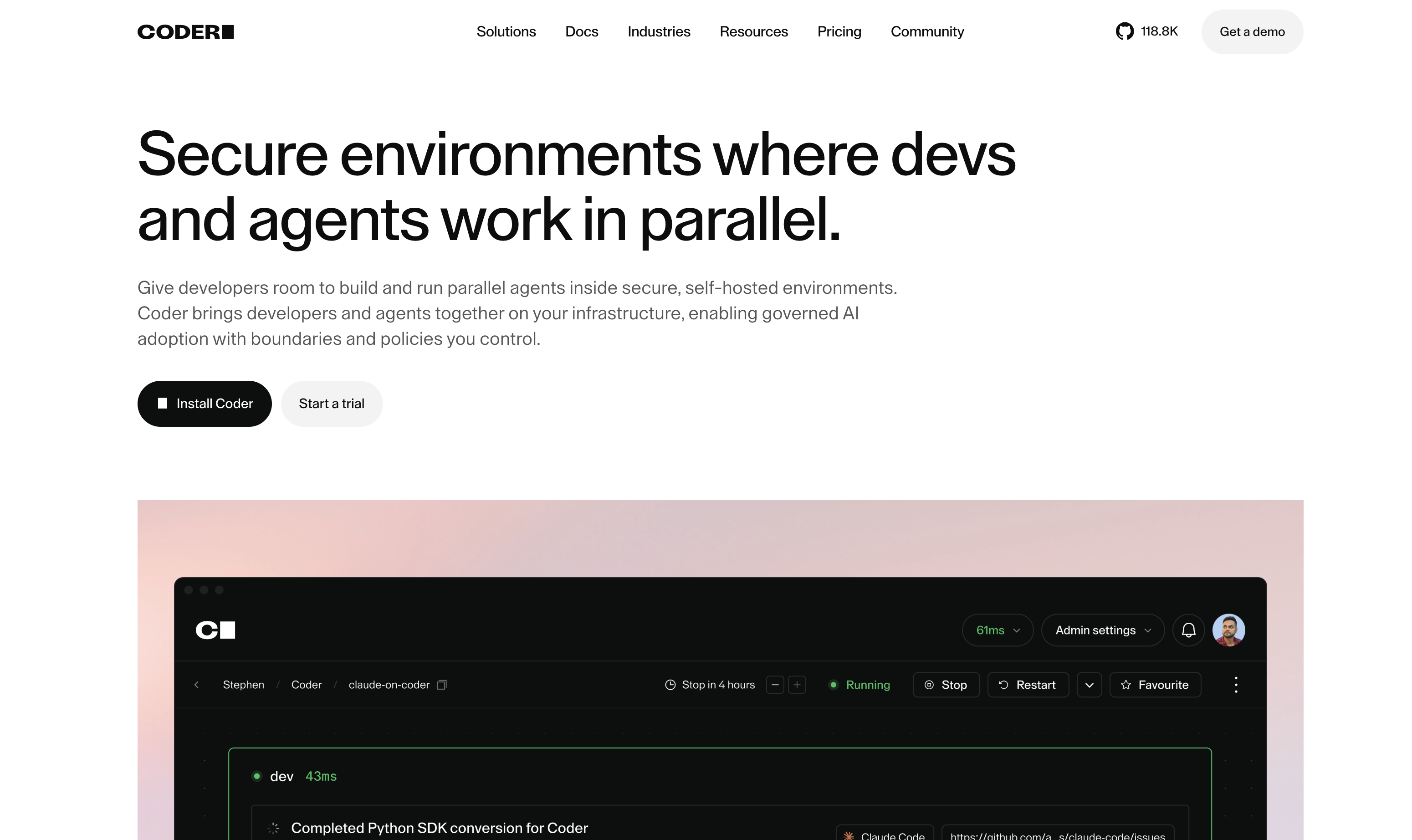
- Run AI coding agents at scale with full security and governance using self-hosted development environments provisioned through Terraform.
- Achieve tighter compliance across cloud and on-premise infrastructures through a centralized gateway that observes and controls LLM tool usage.
- Enable faster builds by allowing developers and AI coding agents to work in parallel within consistent, self-hosted workspaces.
- Maintain secure source code with granular control over compute, access, and context without exposing sensitive systems.
- Integrate AI development seamlessly with existing toolchains including AWS, Google Cloud, Azure, Kubernetes, Docker, GitHub, GitLab, Jupyter, and VSCode.
Pros & Cons
Pros
- Strong governance solutions
- Self-hosted development environments
- Controlled language model tool usage
- Customizable boundaries and policies
- Platform integrations: AWS, Azure...
- Supports Terraform provisioning
- Audit logging feature
- Agent permissions control
- Dedicated workspaces for developers
- Tight compliance enforcement
- VSCode and Jupyter support
- Applicable in automotive, finance, government...
- Designed for key industries
- Integration with GitHub, GitLab
- Self-hostable on various infrastructures
- Containerization with Docker, Kubernetes
- OpenShift integration
- On-premise or cloud deployment
- Defined environments as code
- GDPR, DORA compliant
- Low latency at scale
- Offloads compute-heavy tasks
- Air-gapped infrastructure compatibility
- Operates on all classification levels
- Supports all IDEs, tools, languages
- Complete control over compute, access
- Context control for security
- Fast, consistent developer onboarding
- Reduce Developer VDI Costs
- Centralized ATO compliance
- Increased developer productivity
- Collaboration-friendly environment
- Streamlined developer onboarding
- Adaption without losing control
- Supports globally-distributed teams
- SOC 2 Type II Certified
Cons
- Requires self-hosted environment
- Focused on established policies
- Potential Terraform dependence
- Heavy integrations could overwhelm
- No lightweight version mentioned
- Not optimized for beginners
- Might overly secure environments
- No stated support for lesser-known tools
- Limited to specific industries
- Needs infrastructure setup knowledge
Reviews
Rate this tool
Loading reviews...
❓ Frequently Asked Questions
Coder serves a range of industries including automotive, finance, government, and technology.
Coder ensures security in AI development by creating secure environments where both developers and AI coding agents can operate in parallel, each within their own secure, consistent workspaces, provisioned through Terraform. It maintains tight compliance and supports seamless AI adoption.
Coder supports integration with a variety of platforms like AWS, Google Cloud, Azure, Kubernetes, Docker, Openshift, Terraform, Github, Gitlab, Jupyter, and VSCode.
Terraform plays a vital role in Coder's operation by provisioning secure and consistent workspaces where developers and AI coding agents operate.
Coder facilitates compliance in AI development by creating a centralized gateway for the observation and control of language model tool usage across environments. It also provides a secure environment where developers and AI coding agents follow the established boundaries and policies.
Yes, Coder's work environment can be self-hosted.
The main features of Coder involve creating self-hosted development environments that allow AI coding agents to run at scale, enforcing compliance, monitoring language model tool usage, and facilitating seamless AI adoption.
Coder controls language model tool usage across environments through a centralized gateway that provides observability and control.
Yes, Coder is designed to support large-scale AI coding. It provides developers with a secure, governed environment that allows AI coding agents to be run at scale.
Coder uses a centralized gateway to observe and control language model tool usage across different environments for AI governance.
AI adoption is facilitated by Coder through the provision of a secure and governed environment that allows developers to work with AI coding agents at scale, while observing and controlling language model tool usage.
Coder aids in establishing boundaries and policies in an organization's infrastructure by providing a secure environment where developers and AI coding agents operate, following the predefined boundaries and policies.
'Coder Workspaces' refers to the secure, self-hosted development environments created for developers and their AI coding agents.
Coder can be self-hosted on an organization's infrastructure in the cloud or operating on-premise in an air-gapped environment.
Yes, Coder workspaces are provisioned consistently through Terraform.
Yes, Coder allows developers and AI coding agents to work in parallel within secure, self-hosted environments.
Through its secure and governed infrastructure, Coder aids in secure source code by providing control over compute, access, and context, without exposing sensitive systems.
There are no stated limitations on Coder's ability to integrate with other platforms. It integrates with a variety of tools including AWS, Google Cloud, Azure, Kubernetes, Docker, Openshift, Terraform, Github, Gitlab, Jupyter and VSCode.
Coder offers substantial benefits for all serviced industries including automotive, finance, government, and technology by providing a secure, governed environment for running AI coding agents at scale, enabling faster builds, tighter compliance, and seamless AI adoption in enterprise-grade cloud environments.
Coder handles audit logging and agent permissions by providing a secure, governed environment where developers and AI coding agents work together on an organization's infrastructure under established boundaries and policies.
Pricing
Pricing model
No Pricing
Related Videos
Transforming Development Workflows with Coder: A DevOps Must-Have
Coder•5.1K views•Apr 18, 2025