

Overview
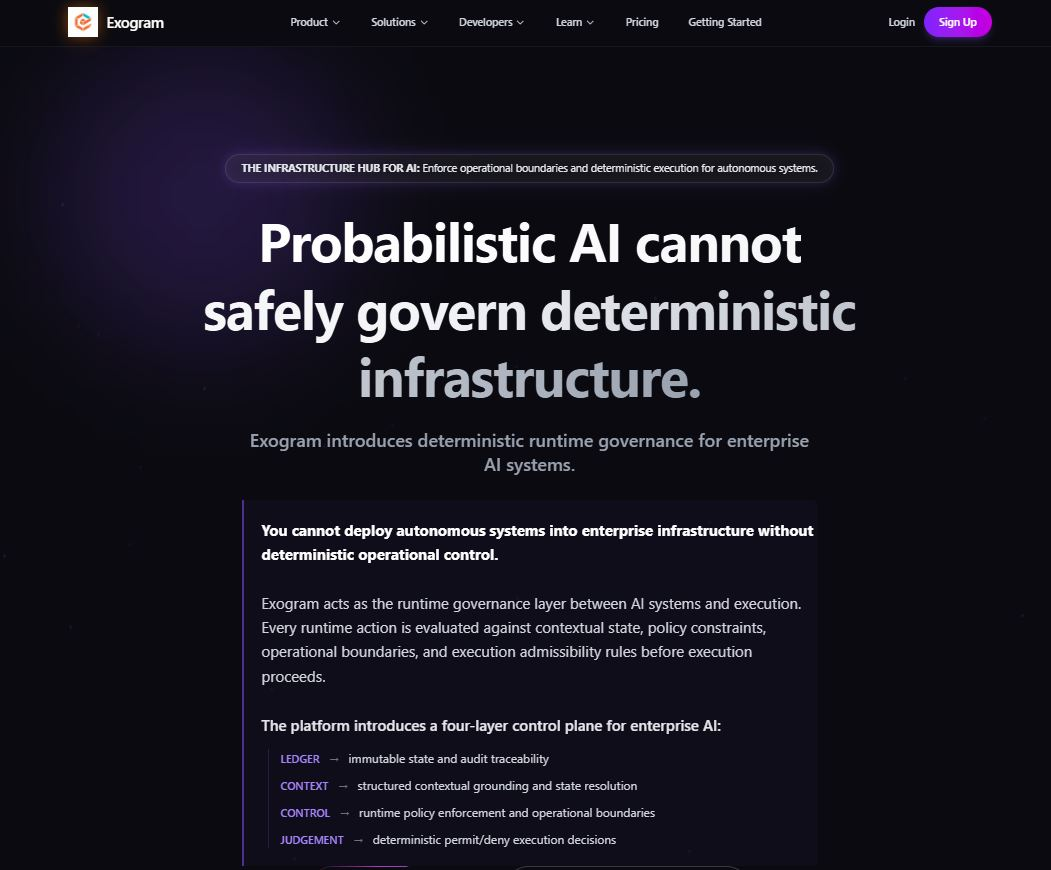
- Eliminate infrastructure risk from hallucinated runtime actions by intercepting and evaluating every proposed agent action against hard-coded operational boundaries before execution reaches your systems.
- Achieve full AI auditability with cryptographically signed trust ledgers that record every state transition and API call, providing verifiable provenance for autonomous systems.
- Stop session amnesia across agent interactions through persistent structural memory that maintains a unified, infinite ledger of state and context across all sessions.
- Prevent hallucination drift entirely by grounding probabilistic LLM outputs against a factual graph using deterministic inference, ensuring outputs stay aligned with accurate data.
- Enforce non-bypassable security barriers with hard-coded security matrices that physically block unauthorized actions, giving administrators precise control over what agents can execute.
- Deploy safe AI agents in FinTech, Healthcare, SaaS, and Legal environments with runtime admissibility controls that assess actions in real-time against policy constraints and state-aware rules.
- Scale governance across existing workflows seamlessly through integration with MCP, REST APIs, and enterprise AI frameworks without replacing your current orchestration layer.
Pros & Cons
Pros
- Runtime governance layer
- Intercepts agent actions
- Evaluates against policy constraints
- State-aware rule evaluation
- Blocks unsafe operations
- Governs execution and infrastructure
- Bounded execution policy enforcement
- Append-only audit trails
- Runtime admissibility controls
- Integration with agent frameworks
- Control-plane architecture
- Persistent memory functionality
- Execution Authority Layer
- Operational Boundaries
- Real-time action evaluation
- Fintech, Healthcare, SaaS, Legal applications
- Protocol (EAAP) Integration
- Database Governance
- CLI including Terminal commands
- State verification features
- Controls execution
- Allows or blocks requests
- Execution boundary enforcement
- Resolving Action Admissibility
Cons
- Complex setup
- Limited integrations
- No autonomous action generation
- Difficulties with large-scale implementation
- Requires extensive technical knowledge
- No orchestration capabilities
- Could disrupt workflow transitions
- Strict execution boundaries
- Fails to plan tasks
- Only deterministic logic supported
Reviews
Rate this tool
Loading reviews...
❓ Frequently Asked Questions
Exogram is an Execution Authority Layer designed for enterprise AI applications with an aim to prevent system failures within a deterministic infrastructure. By providing a 4-layer control plane, it maintains persistent structural memory and supports deterministic inference which helps to prevent common issues encountered in LLM-dependent companies, such as session amnesia and hallucinatory drift. It also enforces operational boundaries and trust ledgers to increase the safety, security, and control of AI applications.
Exogram combats session amnesia in AI through its Persistent Structural Memory layer. This layer creates a unified ledger of state and context across all agent interactions, effectively solving session amnesia by keeping track of what's happening across different AI sessions.
The function of the 4-layer control plane in Exogram is to establish a structural memory, apply deterministic inference, create operational boundaries, and maintain trust ledgers. These layers work together to combat typical issues found in LLM-dependent companies such as session amnesia and hallucination drift, establish hard-coded security barriers, and create cryptographically signed audit trails.
Exogram eliminates hallucination drift in AI by grounding the LLM's probabilistic output against a factual graph. This deterministic inference layer helps to align the outputs generated by AI with a predetermined set of accurate, factual data, thus completely eliminating the possibility of hallucination drift.
In Exogram, operational boundaries are hard-coded security matrices that physically prevent AI agents from executing unauthorized actions. These boundaries ensure that the AI can't take actions that haven't been pre-approved. Trust ledgers, meanwhile, are cryptographically signed audit trails of every state transition and API call, ensuring true provenance as systems become autonomous.
Exogram ensures safety and security in AI applications through its operational boundaries and trust ledgers. Operational boundaries physically stop unauthorized actions, providing security, while trust ledgers document all APIs calls and state transitions, thus creating a trustable and verifiable audit trail, thus enhancing safety.
Yes, Exogram can be utilized widely across different enterprise AI applications such as FinTech, Healthcare, SaaS, and Legal. Its ability to maintain persistent structural memory, enforce operational boundaries, and keep a record of all state transitions and API calls using trust ledgers makes it suitable for these applications.
Exogram maintains a unified ledger of state and context through its Persistent Structural Memory. It keeps track of each interaction, providing a holistic overview of state and context across all agent interactions. This enables the platform to effectively mitigate the common issue of session amnesia in AI systems.
AI systems that are LLM-dependent or those relying on Large Language Models require Exogram for their functionality. It provides deterministic inference and maintains a unified ledger of state and context across all agent interactions, which solves session amnesia and hallucination drift, typical problems for such AIs. Furthermore, it provides execution authority ensuring only explicit actions to be performed.
Exogram assists in stopping AI hallucinations against the enterprise infrastructure by implementing deterministic inference. This functionality grounds the LLM's probabilistic output against a factual graph, which entirely eliminates the potential for hallucination drift, effectively stopping the formation of any AI hallucinations.
Exogram enforces operational boundaries via hard-coded security matrices. These matrices physically prevent agents from executing unauthorized actions or hallucinated tools. This strategy allows Exogram to ensure that the AI only performs actions that have been explicitly approved, enhancing security.
The 'Execution Authority Layer' in reference to Exogram is a protective measure that evaluates and decides on proposed AI actions. It is the feature that provides the ultimate permission only to explicitly-approved actions to be executed, ensuring a gap between probabilistic decision and deterministic execution. It adds a layer of safety and security to AI applications.
Exogram differentiates itself from other AI tools by offering a 4-layer control plane that combats session amnesia and hallucination drift, enforces operational boundaries, and maintains trust ledgers. The tool's ability to evaluate and make decisions on proposed actions by an AI, which allows only explicitly allowed actions to get executed, sets it apart from the competition.
Exogram ensures AI Auditability through its Trust Ledgers layer. Trust ledgers are cryptographically signed audit trails of every state transition and API call. By keeping track of and auditing these ledgers, Exogram supports transparency and accountability in autonomous AI systems, thereby ensuring auditability.
Exogram contributes to AI Control by providing operational boundaries and trust ledgers. The operational boundaries give a level of control to the developers and administrators over what the AI can do, while trust ledgers provide control over auditing and transparency, thus ensuring a controlled AI system.
Exogram's relationship with deterministic infrastructure is symbiotic. As an Execution Authority Layer, Exogram aims to reduce system failures within deterministic infrastructures used by AI systems. It provides a 4-layer control plane for ensuring persistent structural memory and deterministic inference, in addition to enforcing operational boundaries and trust ledgers.
Provenance assurance plays a significant role in Exogram's functionality. Through cryptographically signed audit trails of every state transition and API call, also known as trust ledgers, Exogram ensures true provenance, keeping a verifiable record of the provenance of data and information process within the AI system.
Exogram aids in preventing system failures in AI by managing several issues usually found in LLM-dependent AI systems. It combats session amnesia and hallucination drift by maintaining persistent structural memory and providing deterministic inference. It also establishes operational boundaries which prevent AI from making unauthorized actions, thereby alleviating the risk of system failure.
Yes, Exogram does support integration with other platforms or tools. It can be used either through its API, as an extension or as a plugin in enterprise AIs. Additionally, integration options like MCP, ChatGPT, REST API are mentioned specifically on their website.
Exogram contributes to AI governance in an enterprise setting through its structural memory maintenance, deterministic inference provision, operational boundaries enforcement and trust ledgers assurance. These functionalities help corporations to trust, audit and control their AI systems, thereby providing a comprehensive governance infrastructure.
Exogram is a runtime governance and policy enforcement layer for enterprise AI systems. It acts as the Execution Authority Layer for AI in enterprises, providing a control plane that scales Language Models (LLMs) by facilitating persistent memory and structured inference. It addresses issues such as amnesia and hallucinatory drift, and ensures the safety and reliability of AI systems.
Exogram enforces operational boundaries, which are hard-coded security matrices that prevent AI agents from executing unsafe or unauthorized actions. The platform intercepts proposed agent actions before execution and evaluates them against policy constraints, execution boundaries, and state-aware rules. Any action that doesn't comply with the defined criteria is forbidden, thereby preventing unsafe operations before execution.
Yes, Exogram has the capacity to govern tool execution and infrastructure access through its control-plane architecture. This feature helps ensure that AI agents don't overstep their bounds and access infrastructure components without proper authorization.
Exogram enforces bounded execution policies for AI agents through the concept of Operational Boundaries. Operational Boundaries are hard-coded security matrices that effectively restrict an AI agent's potential actions, preventing them from executing tasks outside of their authorization. This ensures that all AI actions align with an enterprise's governance policies and security protocols.
Exogram provides an append-only audit visibility for evaluated actions, keeping cryptographically signed audit trails of all state transitions and API calls. This feature, also known as Trust Ledgers, is vital to verifying the provenance of autonomous AI systems and ensures full visibility of all actions, aiding in accountability and reliability.
Exogram introduces runtime admissibility controls into autonomous workflows by assessing proposed AI actions in real-time, prior to their execution. It checks the action against pre-defined operational boundaries or rules. If an action isn't explicitly allowed, it is blocked, thereby controlling the admissibility of actions at runtime.
Exogram can integrate with various existing agent frameworks and orchestration layers through its control-plane architecture. This includes tools like MCP, ChatGPT, and it also offers REST API endpoints for integration, providing a boost to execution governance and authorization.
Exogram employs a two-layered approach, Persistent Structural Memory and Deterministic Inference, to prevent AI hallucinations in enterprise infrastructure. Exogram maintains an infinite ledger of state and context across agent interactions, eliminating amnesia, and grounds the output of the Language Models against a factual graph for precision, eliminating hallucinatory drift.
State Transition Tracking in Exogram is facilitated through Trust Ledgers, which are cryptographically signed audit trails of all state transitions and API calls. By tracking state transitions, Exogram verifies the provenance of autonomous AI systems and ensures that all actions align with the specified rules, maintaining integrity and accountability in AI operations.
Exogram contributes to AI reliability by separating AI action proposal and execution, which mitigates execution risks. It ensures that operations only execute if they fall within defined operational boundaries and follow deterministic rules. Moreover, Exogram solves issues such as amnesia and hallucinatory drift in AI systems, making them more reliable.
Yes, Exogram demonstrates integration capabilities with various tools, including MCP and ChatGPT. This is made possible via its control-plane architecture that encourages scalable execution governance and authorization.
Exogram uses Persistent Structural Memory to maintain a unified, infinite ledger of state and context across all agent interactions. This mechanism effectively solves the issue of session amnesia common in Language Models, ensuring that the system retains all relevant information from one task to the next.
Deterministic Inference is Exogram's approach to grounding the Language Model's output against a factual graph. This effectively eliminates hallucinatory drift - a common discrepancy in AI where models lose accuracy and fabricate data over extended runs.
Operational Boundaries in Exogram constitute hard-coded security matrices that prevent AI agents from executing unauthorized actions. They serve as the effective control mechanisms for ensuring that all AI operations remain within the permitted scope, enhancing the safety and reliability of the system.
Trust Ledgers in Exogram are cryptographically signed audit trails of every state transition and API call. They are instrumental in ensuring true provenance as AI systems become autonomous, maintaining accountability, and achieving a high level of transparency and trust.
Exogram plays a vital role in the evaluation of AI-generated actions. As the controlling authority, Exogram assesses proposed AI actions in real-time, pre-execution. It verifies that the actions align with defined operational boundaries and policy constraints. Actions that fail to meet the criteria are not executed, ensuring reliable and compliant system operation.
Exogram can benefit a broad array of industries that depend heavily on AI technology. Its use cases span across sectors such as FinTech, Healthcare, SaaS, and Legal. It bolsters AI governance and ensures deployable AI systems that enterprises in these industries can trust.
Exogram mitigates execution risks through the separation of AI action proposal and execution. It evaluates proposed actions in real time, only allowing execution of those actions that comply with the defined operational boundaries and deterministic rules. This deterministic nature of the execution prevents system malfunctions and potential oversteps.
Exogram can be compared with AI tools like Guardrails on various factors. Exogram goes beyond simple orchestration and prompt management. It serves as the foundational layer ensuring proper execution by controlling what is allowed to execute and enforcing non-bypassable constraints. While the Explicit information on direct comparisons with other tools like Guardrails is not extensively provided, Exogram emphasizes robust control mechanisms, deterministic execution, and mitigation of AI shortcomings like amnesia and hallucination.
Exogram addresses the issue of amnesia in AI systems through its implementation of Persistent Structural Memory. It maintains an infinite ledger of state and context across all agent interactions, eliminating the problem of session amnesia. This means the system retains all relevant information from one task to the next, providing an efficient and uninterrupted flow of processes.
Pricing
Pricing model
Free Trial
Paid options from
$99/month
Billing frequency
Monthly
Refund policy
No Refunds