

Overview
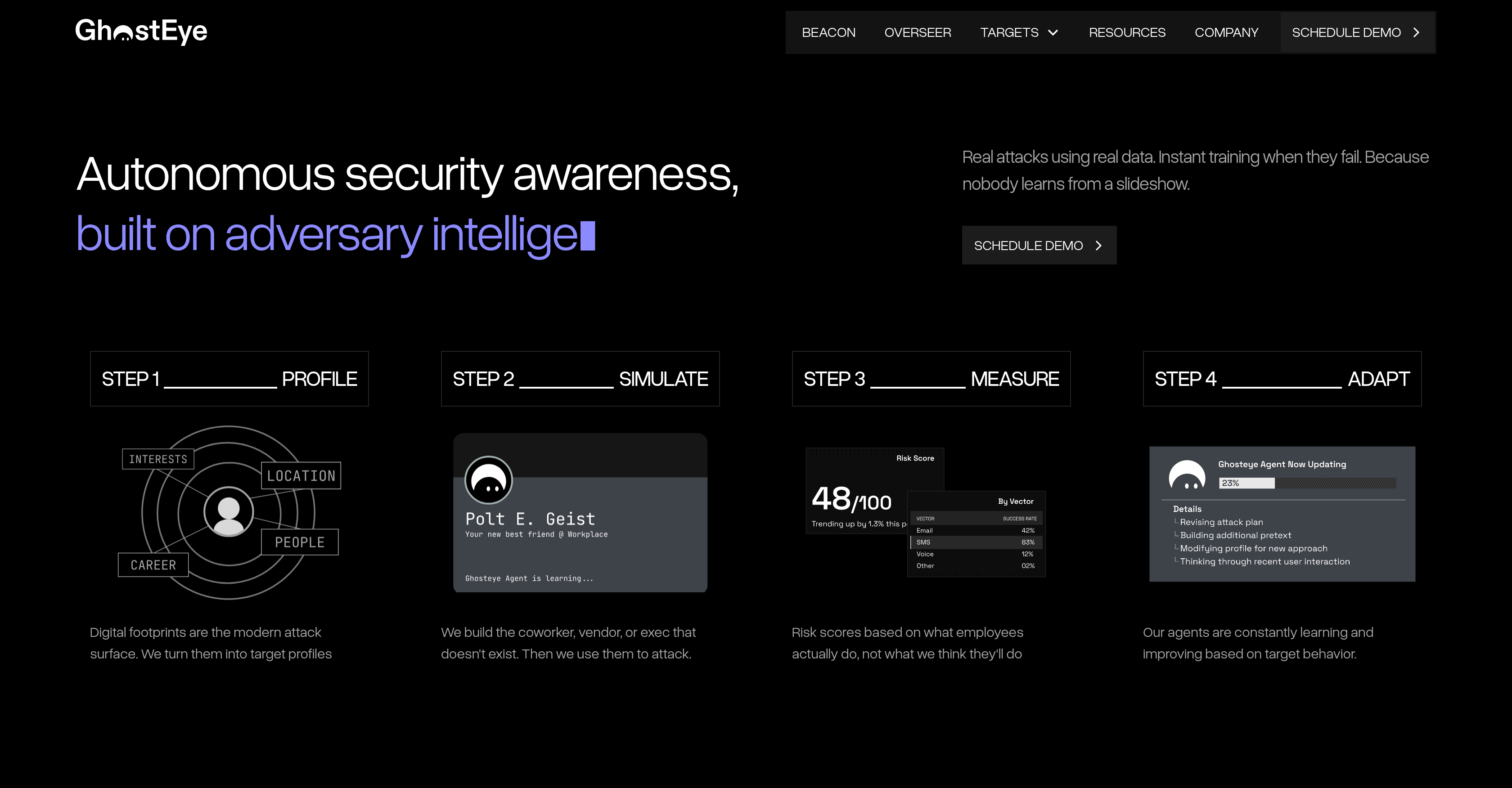
- Transform abstract security policies into muscle memory with AI-generated attack simulations that mirror real-world hacker tactics, using your organization's actual digital footprint and behavior patterns.
- Proactively identify your most exploitable security gaps before attackers do, through continuous vulnerability assessment powered by the IRIS digital exposure mapping suite.
- Test and harden human-centric defenses like your help desk against social engineering, using AI voice agents that simulate realistic password reset requests and other common intrusion attempts.
- Receive security training that automatically adapts in real-time to each user's risk level and learning pace, thanks to autonomous adaptive agents that modify simulation difficulty and guidance.
- Eliminate outdated training modules with Generative Training that creates context-aware security scenarios which evolve continuously based on observed organizational behavior and emerging threats.
- Pinpoint specific employee behaviors that create risk through detailed analysis of human interaction patterns, enabling targeted remediation that strengthens your overall security posture.
Pros & Cons
Pros
- Real-life attack simulations
- Practical response tactics education
- Creates target profiles
- Personalized attack simulations
- Adapts and refines simulations
- Security infrastructure vulnerability assessment
- IRIS feature for digital exposure mapping
- Generative Training for realistic scenarios
- Real-time autonomous adaptability
- Help desk security testing
- Password reset simulation feature
- Proactive breach identification
- Risk management based on digital footprints analysis
- User behavior analysis for autonomous learning
- Personalized security training
- Real attacks using real data
- Risk scores based on realistic tactics
- Avoids surface-level and recycled simulations
- IRIS creating human exposure map
- Creates durable habits through spaced repetition
- Adjusting simulations according to risk signals
- Identifies potential intrusion points
- Assesses human employees for security awareness
- Autonomous operation of adaptive agents
- Evaluates external help desk security
- Simulates requests to bypass MFA
- Simulates requests for granting access
- Offers insights into security weak spots
- Adaptive and configurable agents
- Simulates caller-ID spoofing
- Autonomy to increase/decrease simulation difficulty
Cons
- Potential privacy concerns
- Depends on digital footprints
- Possible false positives
- Possibly intrusive simulations
- Potential increase in anxiety
- Over-emphasis on autonomous learning
- IRIS feature not customizable
- Limited functionality helpdesk testing
- Lacks clear vulnerability remediation
Reviews
Rate this tool
Loading reviews...
❓ Frequently Asked Questions
Ghosteye is an AI-powered platform designed to enhance organizational security awareness. It focuses on conducting real-life attack simulations to educate users about practical response tactics. Through the utilization of digital footprints, Ghosteye creates target profiles and simulates attacks on those profiles for risk assessment. The tool continually adapts based on user behaviour to modify future simulations. Ghosteye also includes a feature named IRIS which maps an organization's digital exposure and employs Generative Training to create realistic, context-aware security scenarios.
Ghosteye uses AI to enhance organizational security awareness through real-life attack simulations. By capitalizing on digital footprints, it creates target profiles and conducts simulated attacks on these profiles to measure the level of security risk. AI enables Ghosteye to capture human interaction patterns to deliver personalized and illustrative attack simulations. The tool continuously learns and evolves based on user behaviour, being able to adapt future simulations accordingly.
The fundamental difference between Ghosteye's attack simulations and traditional learning modules is the focus on practicality. Ghosteye imparts security knowledge through real-life attack scenarios unlike traditional modules which could be abstract and static. The platform's simulations echo real attacker tactics, considering actual user behaviour and organisational context.
Ghosteye uses digital footprints as the primary source to create target profiles. It uses these profiles to simulate attacks and thereby gauge security risk. These footprints might contain data about the user's activities, interactions or patterns that present potential loopholes for security breaches.
The purpose of Ghosteye’s IRIS feature, which stands for Integrated Reconnaissance and Intelligence Suite, is to create an expansive map of an organization's digital exposure. This involves collating identity fragments, access patterns, and contextual signals to represent an organization's potential security vulnerabilities comprehensively.
Ghosteye uses Generative Training to create realistic, context-aware security scenarios. These scenarios continually adapt on-demand based on observed user behaviour, providing robust and constantly evolving training materials. It eliminates the reliance on static templates, ensuring the utmost relevance of security training.
Ghosteye deploys Adaptive and Configurable Agents, which operate independently to modify simulations, adjust difficulty levels, and provide guidance in real time. This is done on the basis of changing risk signals across different users and environments, ensuring the simulations and guidance remain relevant and timely to individual users.
Ghosteye includes a unique feature for testing help desks' security. It simulates requests for password resets to evaluate an organization's support structure and its susceptibility to such common security threats. AI voice agents are deployed to perform these simulations, offering a realistic test for help desk personnel.
By simulating requests to reset passwords, Ghosteye helps to identify potential security weaknesses within the organization's support structure. It emulates common intruder tactics to ascertain where the help desk breaks in terms of security protocols. This proactive testing can help in revealing vulnerabilities and subsequently taking measures to prevent potential breaches.
Ghosteye utilizes AI to observe and capture patterns of human interaction within a digital environment. This data is then used to deliver personalized and illustrative attack simulations, helping employees prepare for real threats. By continuously learning from user behavior, Ghosteye is able to adapt and refine future simulations to better match the changing behaviour and threat scenarios.
Ghosteye's vulnerability assessment covers a broad range of aspects related to organizational security. These include, but are not limited to, analysis of digital footprints for risk assessment, exposure mapping, and intrusion detection. Simulations are used to identify weak spots in the security infrastructure, with varying methodologies tailored to individual users and environments.
Ghosteye's attack simulation methodologies are constantly evolving. The platform utilizes AI and behavioural data to continually adapt and improve its approach based on observed behaviour, not adhering to a fixed update schedule. This results in ongoing development of context-aware security scenarios.
Ghosteye approaches risk management by employing real-life attack simulations that give an authentic assessment of potential threats. Risk scores are a direct outcome of these simulations, reflecting tangible behaviour rather than presumptions. Adaptability is integral in Ghosteye's approach, adjusting its operations in real time as risk signals change across users and environments.
Ghosteye's user behaviour analysis can greatly assist in enhancing security infrastructure. By examining the patterns and behaviours of the users, Ghosteye identifies the weak points and vulnerabilities which are subsequently fortified. The ever-evolving adaptive learning algorithm allows Ghosteye to refine future simulations based on deviations in the user behaviour, thereby contributing to a secure system.
Ghosteye's primary function is to simulate attacks and educate users about threat response. However, it can help detect potential intrusions indirectly by simulating breaches and identifying vulnerabilities during these simulations. By gauging the robustness of an organization's responses during simulations, potential weaknesses, and hence points for intrusion, can be spotted and rectified.
Creating a digital exposure map requires information related to the digital activities and patterns of an organization’s workforce. Ghosteye’s IRIS feature looks into identity fragments, access patterns, and contextual signals to compile this map, providing a detailed projection of the organization’s potential digital vulnerabilities.
Ghosteye continually adjusts its operations based on changing security scenarios and user behaviours, which enhances its capacity to deal with evolving cybersecurity threats. The platform uses Generative Training to continually create realistic, context-aware security content that is based on observed, real-time behaviour rather than static templates. This continuous adaptation helps in keeping pace with evolving cyber threats.
Yes, Ghosteye allows for autonomy and configurability within its operations. Its adaptive agents can adjust simulations, difficulty, and guidance in real time based on changing risk signals. This adaptability allows Ghosteye to align its simulations as closely as possible with the specific needs of individual users and environments.
Ghosteye's architecture is designed to identify organizational weak spots effectively. It uses AI-powered attack simulations, digital footprint analysis for target profiles, and real-time adaptability based on observed user behaviours. This blend of features enables Ghosteye to pinpoint areas of vulnerability and provide tangible metrics for improvement.
Ghosteye’s primary focus is on practical security risks and real-life simulations rather than compliance. However, its approach of educating users based on real-world attack simulations can enhance overall security posture, which could indirectly contribute to better compliance adherence.
Pricing
Pricing model
Pricing
Paid options from
N/A
Related Videos
Introducing: GhostEye
GhostEye•591 views•Jul 23, 2025