

Honeycomb
Overview
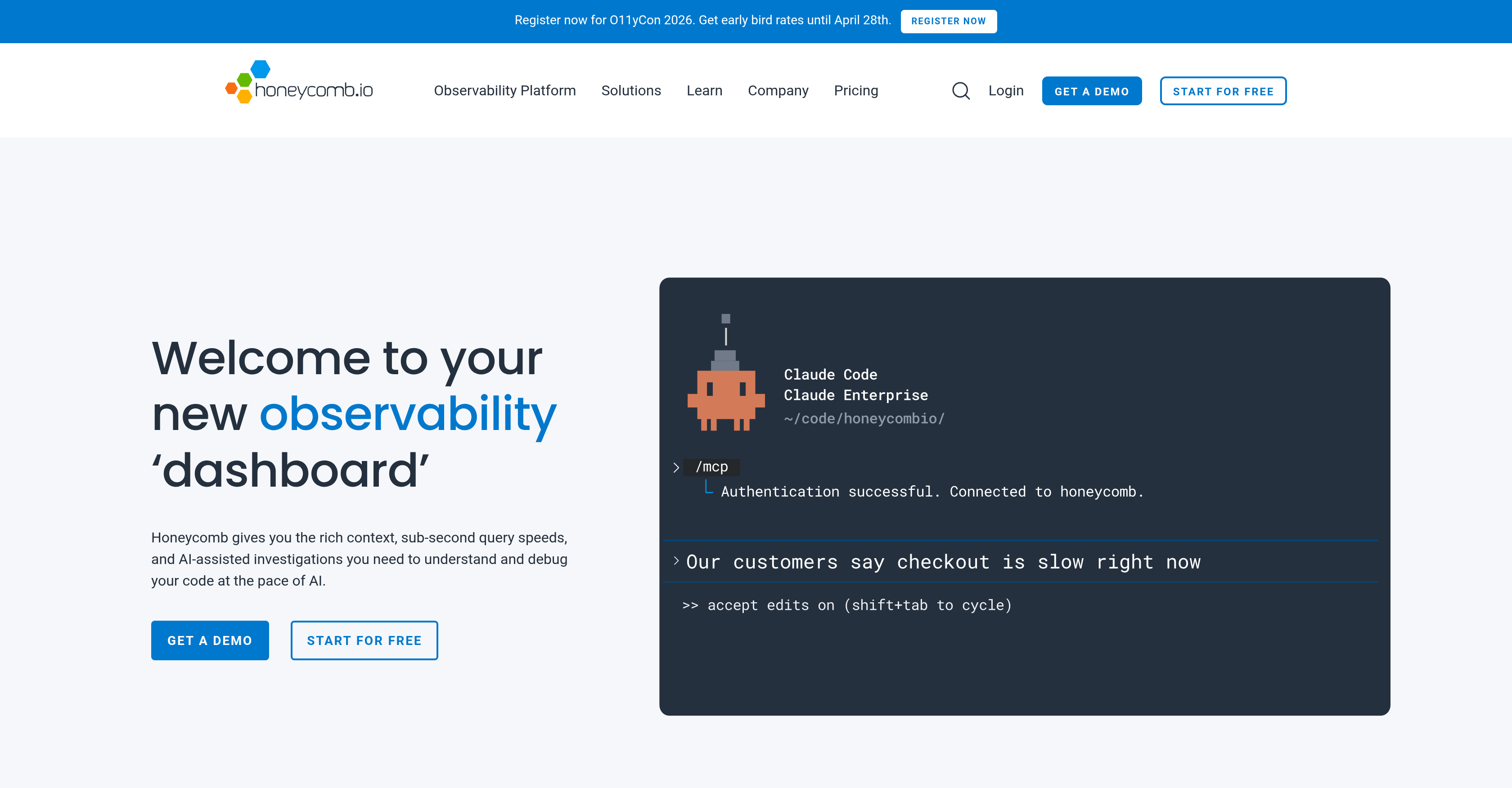
- Move from alert to answer in seconds with Honeycomb's purpose-built columnar data store that executes complex queries at incredible speed across your entire distributed system.
- Debug LLM behavior and low latency microservices directly by tracing every request through Honeycomb's unified telemetry pipeline without switching contexts.
- Investigate anomalies before they impact customers using SLO-based monitoring that automatically detects and surfaces problems in your AI-driven software.
- Access observability data directly from your AI agent IDE via Honeycomb MCP to maintain a streamlined investigative process without leaving your workflow.
- Control telemetry costs while gaining deeper insights by defining custom strategies to collect, enrich, filter, and shape your data before it reaches storage.
- Uncover hidden issues through dynamic, explorable visualizations that let you interact with data in real-time and follow any investigative path without dead ends.
- Integrate observability seamlessly into your existing tech stack with native support for over 60 tools across the full software development lifecycle.
- Enrich every engineer with expert-level investigation guidance through Honeycomb Intelligence's AI-powered insights for instant root cause analysis.
- Process voluminous, complex telemetry from contemporary software systems at scale without compromising query performance or incurring extra charges for business context.
Pros & Cons
Pros
- Swift query speed
- Unified telemetry
- Low Latency Microservices observability
- Columnar data store
- Distributed systems tracing
- Debugging of LLM behavior
- Quick alert to answer transition
- Tech stack integrations
- Over 60 tool accommodations
- Honeycomb Intelligence for instant investigations
- Dynamic, explorable visualizations
- Fast query results
- OpenTelemetry compatibility
- Telemetry data cost control
- Quick troubleshooting strategies
- Deeper insights generation
- Scale for complex telemetry
- Observability data IDE access
- Streamlined investigative process
- SLO based monitoring
- Anomaly detection
- Sub-second query speeds
- Unlimited data sending
- Telemetry data strategies
- Scalable data store
- No extra charge for context
- No extra cost for investigations
- Unlimited fields with OpenTelemetry
- No vendor lock-in
- LLM reliability with SLO monitoring
- Production insight into LLMs
- Real-time model performance improvement
Cons
- Lack of cost information
- Potentially complex setup
- Long data processing time
- Ambiguous troubleshooting tools
- Over-reliance on OpenTelemetry
- May not fit all stacks
- Requires significant telemetry data
- Unspecified observability metrics
- Unclear SLO-based monitoring details
Reviews
Rate this tool
Loading reviews...
❓ Frequently Asked Questions
Honeycomb is an observability platform engineered specifically for AI-driven software. It offers advanced features like swift query speed, unified telemetry, and Low Latency Microservices observability. Users leverage Honeycomb's platform for distributed systems tracing, debugging of LLM behavior, and quick transitioning from alert to answer which aids in tackling complex engineering challenges.
Honeycomb offers AI-driven software observability through a combination of its Honeycomb Intelligence and robust platform. The platform caters to the software observability needs by providing dynamic, explorable visualizations and an incredibly fast querying engine. Honeycomb Intelligence further enhances this by enriching every engineer with expert insights for instant investigations.
Swift query speed in Honeycomb refers to the capability of the platform to execute and return results from complex queries in extremely short timeframes. This speed is integral to Honeycomb's observability promise as it provides engineers with instant access to the data they need for investigations and troubleshooting.
Honeycomb's platform provides Low Latency Microservices observability by enabling the tracing and debugging of LLM behavior. It has highly efficient query functionalities that assist in quickly analyzing and understanding the performance characteristics and behavior of low latency microservices in a distributed system.
Honeycomb's platform is currently being used by a variety of high-profile companies, including Slack, Intercom, and Dropbox.
The columnar data store in Honeycomb's platform is purpose-built to facilitate the tracing of distributed systems and debugging of LLM behavior. It contributes to the rapid transition from alert to answer, enabling users to swiftly tackle complex engineering challenges.
Honeycomb Intelligence is an AI-powered feature of Honeycomb that enriches engineers with expert insights for instant investigations. It is designed to enhance the effectiveness of troubleshooting and investigations by providing expert context and guidance.
Honeycomb integrates seamlessly into existing tech stacks, accommodating over 60 tools across the software development lifecycle. This includes toolsets for incident management, AI-powered investigations, and more, tying observability directly to tools already in use.
Honeycomb enhances visualizations by making them dynamic and explorable. It encourages investigations and insights by allowing users to interact with visual data in real-time, enabling them to uncover limitless insights through their data and no dead-ends.
By offering AI agent integrations, Honeycomb allows users to connect AI agents to their platform. This integration enables AI agents to directly access observability data, simplifying and accelerating the processes of investigation and resolution of software issues.
OpenTelemetry compatibility refers to Honeycomb's ability to integrate with the OpenTelemetry specifications for generating, collecting, and describing telemetry data. This supports interoperability between tools in the software ecosystem and allows for the collection of robust, high-quality telemetry data cost-effectively.
Honeycomb assists in telemetry data management by offering users the capability to define strategies for their telemetry data that control costs and provide quicker troubleshooting and deeper insights. Its comprehensive platform accommodates complex, voluminous telemetry from contemporary software systems.
Using Honeycomb, distributed systems of all sorts can be traced for observability. The platform excels in providing the necessary tools and functionalities needed to deeply analyze and understand the behavior, performance, failures, and dependencies of distributed systems.
Honeycomb's platform promotes Service Level Objective (SLO) based monitoring. This approach assists in detecting and investigating anomalies in AI systems by focusing on maintaining service levels. It can help alert engineers to problems before they impact the customer experience.
Yes, Honeycomb is equipped to aid in detecting and investigating anomalies in AI systems. This is done through a combination of AI-powered insights, SLO-based monitoring, and robust functionalities in its platform that allow for rapid troubleshooting.
Honeycomb allows users to define strategies for their telemetry data that helps in cost-control. Users are given the flexibility to collect, enrich, filter, sample, route, and shape their data for faster troubleshooting, deeper insights, and overall cost effectiveness.
Yes, Honeycomb does support direct observability data access via AI agent Integrated Development Environment. This can be facilitated through Honeycomb's MCP, or Management Control Plan, which maintains a streamlined investigative process.
Honeycomb is engineered to handle the complex, voluminous telemetry data of contemporary software systems. The high processing scale allows for the appending of all necessary technical and business context without incurring any extra charge.
Honeycomb MCP, or Management Control Plan, allows for observability data to be accessed directly with the AI agent Integrated Development Environment. This aids in maintaining a streamlined investigative process and allows users to stay in the flow of their work.
Honeycomb suggests strategies such as leveraging AI integrations, adopting SLO-based monitoring, utilizing the swift query capabilities of their platform and implementing OpenTelemetry for a more streamlined investigative process. These strategies are designed to offer quicker transitioning from alert to answer, deeper insights, and overall improved software observability.
Pricing
Pricing model
Freemium
Paid options from
$130/month
Billing frequency
Monthly
Related Videos
Honeycomb Observability Platform Demo
Honeycomb•7.5K views•Oct 21, 2020