
Overview
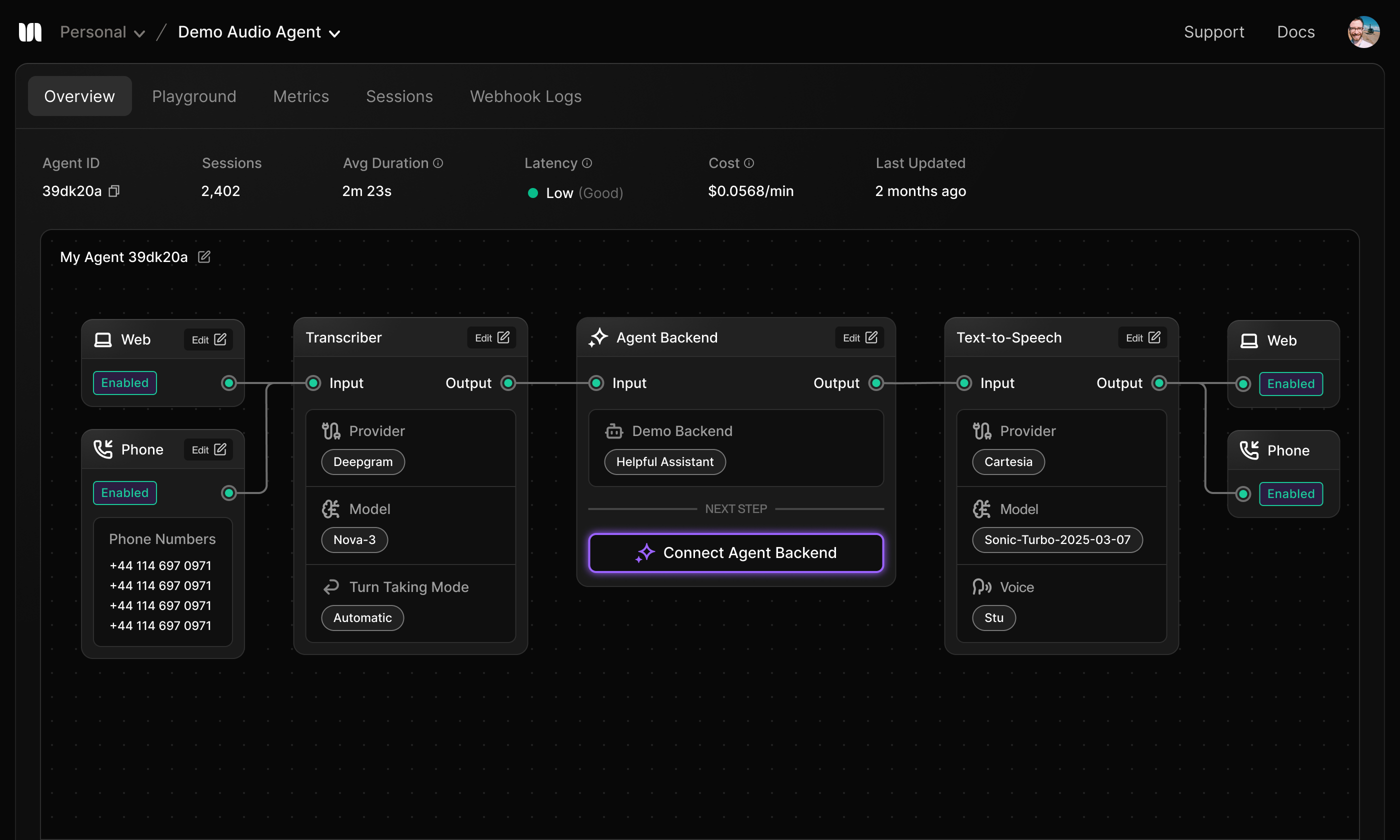
- Ship production-ready voice agents faster with simple CLI setup and webhook integration that connects to your existing LLMs
- Eliminate vendor lock-in by testing and hot-swapping leading voice model providers to always use the best-performing options
- Achieve human-like conversations globally with intelligent turn-taking algorithms and 330+ edge locations ensuring low-latency performance
- Maintain complete control over your agent's backend logic and responses without managing complex real-time audio infrastructure
- Scale affordably from demo to production with true usage-based pricing that only charges when someone is speaking
- Monitor performance precisely with latency analytics and session recordings to review and optimize every conversation
- Build for international users with support for 32+ languages and 100+ text-to-speech voices to match your audience
Pros & Cons
Pros
- Cloud-based platform
- High customization
- Advanced turn-taking algorithms
- Multiple language support
- 100+ different voices
- Scalable from demo to production
- Unique pricing for voice interactions
- Silence does not incur costs
- Switch between voice model providers
- No vendor lock-in
- Complete backend control
- Integration capability
- CLI and SDKs provided
- Supports over 32 languages
- Offers multiple voice options
- Natural turn taking
- Voiced conversation builder
- Efficient session reviewing system
- Latency analytics availability
- Simplified billing for multiple vendors
- Transparency in voice agents' conversations
- Offers templates for common use-cases
- Global edge voice infrastructure
- Easy configuration of STT and TTS models
- No noisy neighbors in sessions
- Instant scalability and no cold starts
- Per-call isolation
- 330+ independent locations
- Avoids performance degradation
- Frontend and backend integration
- Compatible with known LLM and Agent libraries
- Facilitates distributed network design
- Voice agent monitoring and debugging tools
- Avoids single point of failure
- Audio pipelines configurability
- Hot-swap voice and transcription model providers
- Analytics and observability
- Supports browser-based and phone agents
- Sub 50ms voice data processing
- Compatibility with mobile or phone
- Startup program available
- Audio visualization example code provided
Cons
- Charges for voiced interactions
- Limited to certain languages
- Possible complexity for under-experienced developers
- Multiple languages but limited voices
- Requires knowledge of Command Line Interfaces and SDKs
- Dependency on vendor product quality
Reviews
Rate this tool
Loading reviews...
❓ Frequently Asked Questions
Layercode is primarily used as a cloud-based platform for developers to build low-latency, production-ready voice Artificial Intelligence (AI) agents.
Layercode offers high customization options. Users can control how the AI agent sounds and responds. It also provides over 100 different voices to choose from. The platform also allows easy transitions between leading voice and transcription model providers.
Layercode has implemented advanced turn-taking algorithms that ensure a smooth conversational experience. These algorithms enable the AI agents to interact with users in a more natural and human-like conversational manner.
Layercode ensures smooth conversations through its low-latency voice integration. This allows for real-time interaction with the voice AI agents. Additionally, the advanced turn-taking algorithms contribute to the smoothness of the conversation.
Layercode supports over 32 languages, enabling developers to build AI agents tailored to diverse user bases.
Layercode provides a broad choice with more than 100 different voices for developers to choose from.
Layercode is designed with scalability in mind. It is capable of handling the growth of an application from demo phases to full production seamlessly.
Layercode features a unique pricing model where charges are only for voiced interactions. This means if the agent or user is silent, there is no charge. The platform offers 'silence for free'.
Yes, Layercode makes it quite easy to switch between different leading voice and transcription model providers. This allows for testing and evaluation of different providers with ease.
Layercode prevents vendor lock-in by allowing users to easily switch between different voice and transcription model providers. This allows users the freedom to choose the best provider based on their unique requirements without being tied down to a single vendor.
Layercode provides complete control over voice AI agent's backend. This enables users to manage how their agent responds and interacts without having to manage the complexity of building and maintaining the voice infrastructure themselves.
Layercode's integrative capability allows users to blend voice AI with their existing frontend and AI agent backend. This allows for seamless integration and coherent experience across the application.
Voice can be integrated with existing frontend and AI agent backend on Layercode via their Command Line Interface (CLI) and Software Development Kits (SDKs).
Layercode provides Command Line Interface (CLI) and Software Development Kits (SDKs) for integration into existing platforms.
Layercode supports the development of low-latency voice AI agents through its advanced infrastructure, which offers high customization options for developers. The developers have full control over how their voice AI agent sounds and responds, this allows for the creation of AI agents specifically tailored to their needs.
Yes, on Layercode, developers can control how their voice AI agent sounds and responds. They can alter the voice's tone, speed, modulation, and other parameters to achieve the desired conversational experience.
Layercode stands out from low/no-code voice agent platforms by offering complete control over the agent's backend to its users. This means developers are not limited by the constraints of a packaged solution and have the freedom to customize their voice AI according to their needs.
Layercode has been designed to handle the transition from demo phases to full production in an efficient manner. Its scalable nature allows for seamless growth, capable of handling increased user interaction and data processing without compromising on performance.
'Silence is free' approach in Layercode refers to its unique pricing model which only charges for voiced interactions. So, during periods of silence, users are not charged, effectively making 'silence free'.
The 'hot-swap leading providers' feature in Layercode allows users to test and switch between different leading voice and transcription model providers. This ensures that the users are not locked-in with a single provider and have the flexibility to use services per their requirement.
Pricing
Pricing model
Free Trial
Paid options from
$250/month
Billing frequency
Monthly
Related Videos
How to get started with Layercode
Layercode•130 views•Jul 29, 2025