
Overview
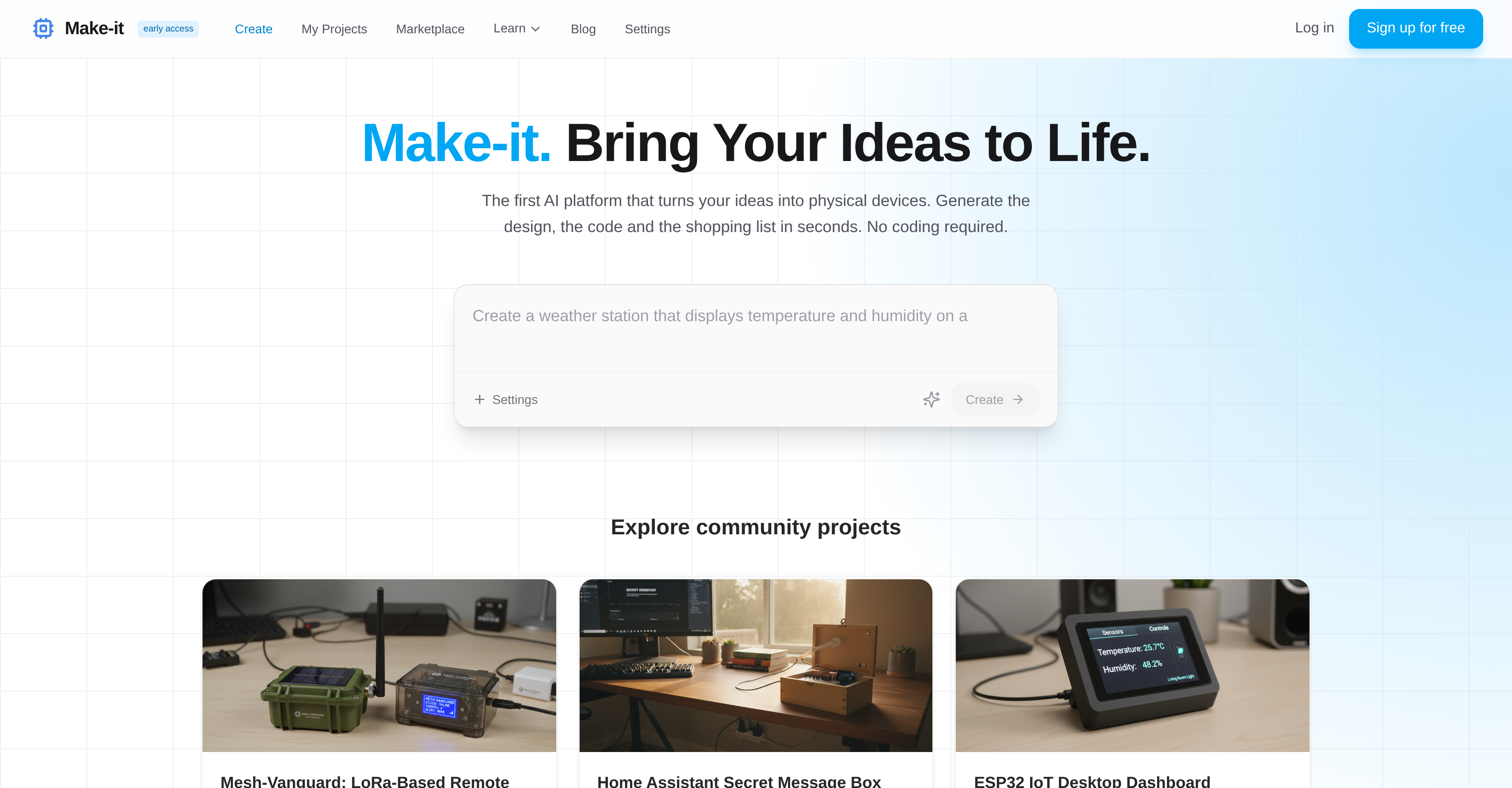
- Transform your plain-English idea into a complete smart device plan in seconds using AI that generates custom designs, code, and a parts shopping list for you.
- Build functional Arduino and Raspberry Pi projects with zero coding skills by following AI-generated diagrams, component lists, and step-by-step instructions.
- Ensure your DIY electronics work forever without outages by using code that runs locally on the device's chip, not on the cloud.
- Keep your projects completely private and under your control with a local computing model that prevents data harvesting and external communication.
- Source all necessary components easily through the integrated marketplace, creating a seamless workflow from idea to physical build.
- Learn electronics at your own pace with access to a dedicated blog, project guides, and a structured learning course for continuous skill development.
- Save significant money compared to buying pre-made smart tech by building custom $200 gadgets for around $30 with no subscription fees or markup.
Pros & Cons
Pros
- Designs Arduino/Raspberry Pi projects
- No coding knowledge needed
- Generates design, code, instructions
- Self-explanatory construction diagrams
- Personalized shopping list creation
- Runs code on chip
- No risk of outages
- Data privacy guaranteed
- Doesn't harvest user data
- Open-standards approach
- Devices function indefinitely
- Built-in guides/services
- In-app electronics course
- Idea generation blog
- Component marketplace provided
- Facilitates DIY mindset
- Promotes cost-saving on electronics
- Turn-key project execution
- Streamlined project planning
- Hardware development focus
- Inclusive learning guide provided
- From idea to physical device
- No subscription fees
- Single-click code flash
- Step-by-step build instructions
- Support for diverse technologies
- Promotes transparency and control
- Optimized for smart devices
- Innovation-friendly platform
Cons
- No support for professional CAD
- No real-time collaboration feature
- No pre-made project templates
- No offline mode
- No IoT cloud integration
- Insufficient troubleshooting features
- Limited hardware compatibility
- No virtual prototyping
- Needs strong internet connection
- Limited marketplace variety
Reviews
Rate this tool
Loading reviews...
❓ Frequently Asked Questions
Make-It is an AI-powered platform designed to help users create their own smart DIY electronic projects without requiring any coding knowledge. This platform focuses on enabling individuals to bring their innovative ideas to life and fosters a 'Do It Yourself' mindset with an emphasis on transparency and control. Users can work with different technologies ranging from Arduino to Raspberry Pi.
Make-It operates in a straightforward manner where the users describe their ideas for a device in plain English. The platform's AI then translates these descriptions into a design, generates the corresponding code, and creates a shopping list for the parts needed for the device. The platform also provides diagrams, component lists, coding methods, and instructions to facilitate the user in building their device.
Make-It supports a variety of technologies but notably includes Arduino and Raspberry Pi.
As far as the information available, there is no specific criteria for exactly how detailed your idea needs to be. It merely states users can describe their idea in plain English. Precise information about specific details or technical requirements needed for the AI to comprehensively understand the idea isn't mentioned.
For each project, Make-It's AI will generate a range of materials including a device design, the applicable code for the device, and a shopping list for sourcing parts required. In addition, Make-It also provides diagrams, component lists, various coding options, and step-by-step instructions.
The code generated by Make-It runs directly on the chip of the device that has been constructed, not on any cloud-based platforms. This eliminates risks associated with outages and reduces dependencies on continuous internet connectivity.
Make-It ensures data privacy by running the code locally on the device itself, rather than in the cloud. This means the device only communicates with the user, and user data is not harvested or collected.
Make-It is a staunch supporter of an open-standards approach. This approach ensures that the devices created by users with the help of Make-It will continue to function indefinitely. The idea behind this is to provide users with the freedom to build electronic devices that are not controlled by a single entity or bound by proprietary rules.
Make-It offers an array of learning resources for users. These include guides for different DIY electronics projects and an electronics course aimed at supporting users in their learning process. Additionally, they also maintain a blog populated with ideas and guides for DIY electronics.
Yes, apart from technical design and code generation, Make-It also houses a marketplace where users can source the required materials for their projects.
Make-It is designed to foster the 'Do It Yourself' mindset through its comprehensive, plain-English, project-based guidance. By generating designs, code, and components list based on a user's idea, Make-It simplifies the building process, providing users with the transparency, control, and tools to bring their ideas to life autonomously.
Absolutely, one of the key features of Make-It is that it requires no prior coding knowledge from the users. Through its AI, it auto-generates the code necessary for the proposed DIY electronic project.
Though the specifics of the project types are not listed, based on the information, any project that involves smart DIY electronics would be plausible. This includes, but may not be limited to, smart devices, hardware development and smart home projects built with Arduino, Raspberry Pi and similar technologies.
While it's not explicitly detailed, Make-It mentions that users can flash the code with a simple one-click process following the instructions provided.
The contents of Make-It’s blog are not enumerated explicitly, but it is mentioned that it provides DIY electronics ideas and guides. This likely includes project inspiration, conceptualization, and practical implementation tips.
No, Make-It stresses the fact that there are no subscription fees. The aim appears to be cost-saving, with Make-It claiming you can build a $200 gadget for $30, with no markup cost.
Make-It prevents outages by running the code on the device's chip rather than on a cloud platform. This approach ensures that the device remains operational even when there's no internet connection, thereby eliminating any potential cloud-related outages.
While the primary use of Make-It is to facilitate the creation of smart DIY electronics projects, learning and educational opportunities also exist. Users can benefit from the platform's guides, courses, and blog posts to expand their knowledge and understanding of DIY electronics and various technologies like Arduino and Raspberry Pi.
The procedure to turn ideas into physical devices on Make-It involves the user conveying their idea in plain English to the platform's AI. The AI then generates a design, code, and the shopping list for parts required to make the device. Afterward, the user can follow the provided diagrams, component lists, code, and instructions to build their device.
Make-It ensures that devices built using the platform continue to function indefinitely by adhering to an open-standards approach. This triumphs over proprietary rules and single entity control, ensuring the tech built today is not obsoleted by changes in company policy or support.
Yes, Make-It does support Arduino and Raspberry Pi projects. Its range of supported technologies includes these widely-used platforms, making it versatile and suitable for a broad spectrum of DIY electronics projects.
Make-It's AI mechanics handle the generation of a design and code. You start by describing your idea in plain English. Based on this input, the AI then translates your idea into a design complete with diagrams and a component list, and creates the necessary code for the device to function as you described.
Make-It minimizes the risk of outages as the code generated runs on the device's chip itself, not in the cloud. This local computing model ensures that your device can operate independently of any external cloud servers, thereby eliminating the risk of outages.
Make-It ensures user privacy through its local computing model where the code runs on the device's chip, not on a cloud. By not running on the cloud, the platform ensures enhanced privacy as user data is not harvested or exposed to potential external breaches.
Make-It's stance on data harvesting is very clear: it doesn't participate in this practice. The platform is focused on privacy, emphasizes that it doesn't harvest user data, and ensures that the devices built communicate with the user only.
The term 'open standards' refers to Make-It's adherence to universally accepted protocols and standards. This means that the devices users build with Make-It are not locked into proprietary ecosystems. They can function independently and will continue to work indefinitely without being affected by updates or changes to proprietary systems.
Yes, Make-It provides educational resources for electronics. The platform includes a comprehensive electronics course and step-by-step guides, supporting users throughout their learning process in electronics and DIY project building.
The Make-It marketplace is a part of the platform where components and materials necessary for the projects can be sourced. Specific items available would depend on current stock and variety, but generally, it caters to providing all the parts you'd need for your DIY electronics projects.
Yes, built with a focus on open standards, the devices you create with Make-It are designed to function indefinitely. They are not tied to specific software or hardware ecosystems that may become obsolete, ensuring their longevity and sustained operation.
Yes, Make-It provides extensive guides for creating DIY electronics. These guides, which can be found on Make-It's blog, cover a range of topics from electronics theory to specific project walkthroughs.
Make-It's local computing model ensures that the code generated for the DIY projects runs on the chip of the device itself, rather than on the cloud. This ensures there are no outages and it significantly enhances privacy as no user data is harvested.
For the project planning process, Make-It assists by translating the user's plain-English description into a concrete project plan. This includes generating a design, code, and a shopping list for the necessary components. Make-It also provides diagrams, a parts list, coding methodologies, and instructions.
By stating 'Don't buy smart tech, build it', Make-It is promoting the idea of creating your own devices rather than purchasing pre-made ones. The platform advocates for understanding, controlling, and customizing the technology you use, eliciting the value of learning, creativity, and self-reliance.
With Make-It, users can build a wide range of DIY electronic projects. These can range from the simple to the complex and can include devices that would typically utilize technology platforms like Arduino and Raspberry Pi.
Make-It turns your ideas into physical devices through its AI technologies. You start by describing your idea in plain English, thereafter, Make-It's AI produces a design for the device, generates the necessary code, and even creates a shopping list for the components required to build the device.
Make-It provides extensive instructions for building a device. This includes diagrams, and a list of components, along with how to code and construct the device. The user then follows these instructions to build their device and makes it function using the generated code.
Yes, Make-It does provide ideas for DIY electronics projects. You can find various DIY electronics ideas and guides on the Make-It blog. This supports users in sparking creativity and assists in the learning process of electronics and project construction.
Pricing
Pricing model
Free
Paid options from
Free