

Menlo Security
Overview
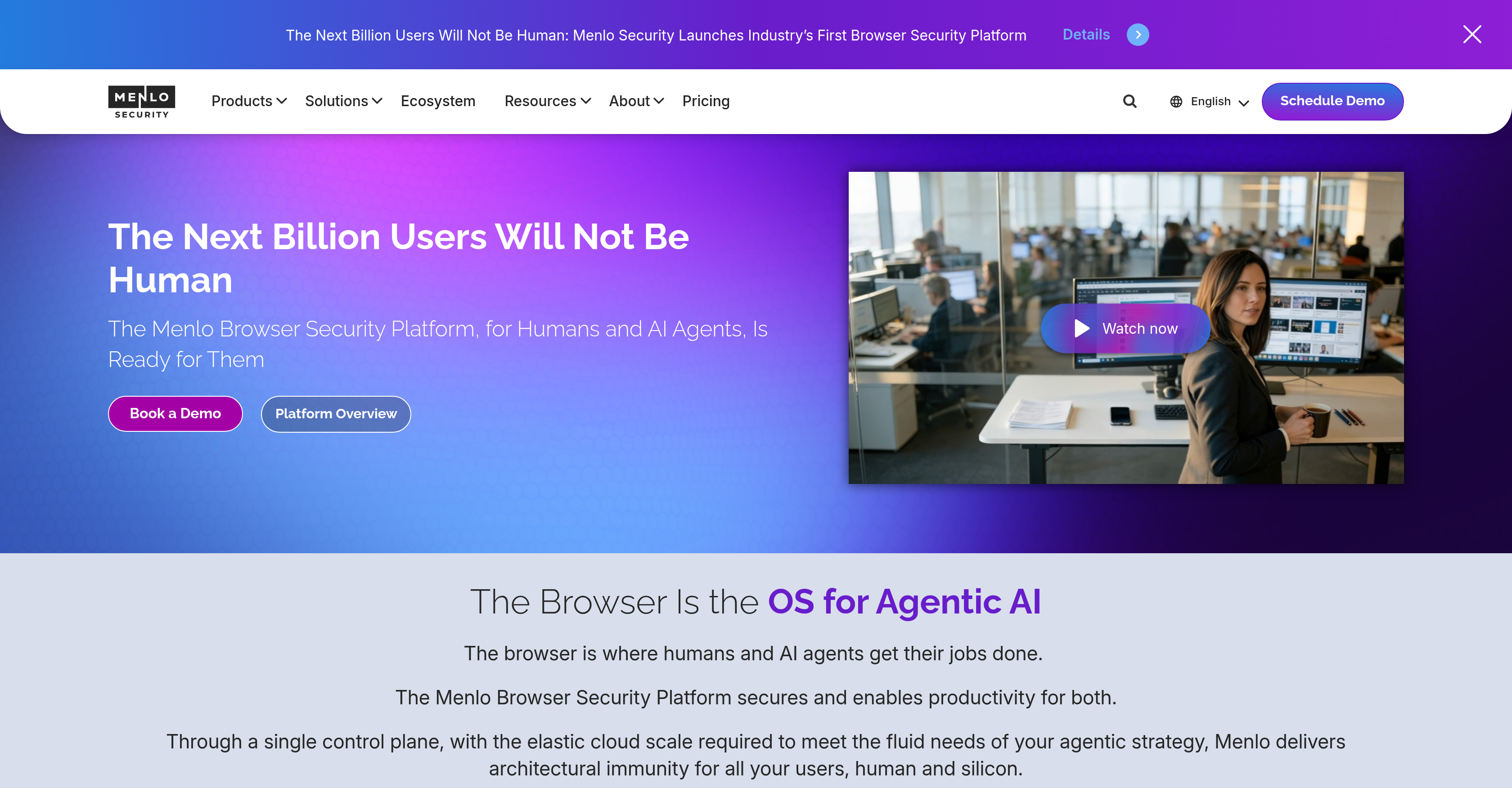
- Stop zero-day threats before they execute, not after detection, with an AI-based adaptive system that structurally prevents exploits at the browser level
- Secure sensitive enterprise data from unauthorized access or exfiltration using AI adaptive DLP that automatically adapts to evolving threat landscapes
- Empower AI agents to safely connect to enterprise data and legacy applications lacking modern APIs, without security blind spots, through comprehensive session control and visibility
- Maintain productivity while eliminating browser-based risks—high-risk browsing is automatically routed to the Menlo Cloud for threat isolation, so users never encounter malware
- Gain architectural immunity against cyber attacks by enforcing security inside the browser—the actual work location—not just the network pipe or endpoint device
- Scale security elastically to match dynamic enterprise demands without performance trade-offs, thanks to a hybrid architecture combining local controls and cloud protection
Pros & Cons
Pros
- Secure browsing features
- Agent security
- Zero-day threat prevention
- Implements security in-browser
- Access, file, data protection
- Balances productivity and risk
- Accommodates dynamic enterprise needs
- Elastic cloud scale
- Offers architectural immunity
- Hybrid architecture with cloud-based protection
- Intelligent Local Controls
- Automatic routing for high-risk browsing
- Connects workflows to deficient APIs
- Comprehensive session control
- Provides visibility into interactions
- Reduces security blind spots
- Accommodates agentic enterprises
- Adaptive to trusted sites and applications
- Single control plane
- Observability for consistent security
- Prevents prompt injection, spoofing, credential theft
- Disables LLM connections
- Applies input restrictions
- Supports legacy applications and data
- Unified browser security
- Tailored security policies
- Immediate ROI from legacy infrastructure
- Resolves 'Agentic Paradox'
- Eliminates modernization debt
- Preventing 'agentic data starvation'
- Navigates through complex web UIs
- Protects enterprise data from external LLMs
Cons
- Limited to browser protection
- Depends on cloud access
- Potential latency issues
- Requires modern browser support
- Must trust third-party cloud
- Lack of endpoint security
- Excluded non-web applications
- May ignore local threats
- Reliance on elastic cloud scale
- Unique hybrid architecture creates learning curve
Reviews
Rate this tool
Loading reviews...
❓ Frequently Asked Questions
Menlo Browser Security Platform is a comprehensive security solution designed to protect human and AI end users from cyber threats. Its unique hybrid architecture combines local security controls with cloud-based protection, helping to maintain a secure environment.
Menlo aids in secure browsing by implementing security measures directly inside the web browser, allowing both human and AI users to carry out their tasks securely. It accommodates dynamic enterprise needs with its elastic cloud scale and architectural immunity, offering a balance between productivity and risk management. It also automatically routes high-risk browsing activities to the Menlo Cloud for threat elimination.
AI plays a pivotal role in the Menlo Browser Security Platform. It employs an AI-based adaptive DLP mechanism and agent security to ensure secure access, data protection and predictable prevention of zero-day threats. Additionally, it can securely link AI workflows to applications and data sources that otherwise lack modern APIs.
AI Adaptive DLP, or Data Loss Prevention, is an AI-based system that Menlo uses to prevent the loss of data through unauthorized access or data breaches. It adapts to various threat landscapes and uses smart mechanisms to thwart attempts to siphon or corrupt data.
Menlo handles risk management by striking a balance between productivity and security. It safeguards the work location - the browser - where both human and AI agents operate, rather than just securing the pipe or machine endpoint. It automatically routes high-risk browsing activities to the Menlo Cloud for threat elimination, thus mitigating browser-based threats.
'Architectural immunity' in the context of Menlo Security refers to its capability to make the environment resistant to threats, not by merely responding to detected threats, but by structurally preventing them at the foundational level.
Menlo's hybrid architecture amounts to the symbiotic implementation of local security controls and cloud-based security measures. It has Intelligent Local Controls for user interactions with trusted sites and applications, while high-risk activities are instantly sent to the Menlo Cloud for risk mitigation.
Menlo identifies and automatically routes high-risk browsing activities to the Menlo Cloud where these threats are effectively nullified. This approach provides an extra layer of security and prevents potential data breaches or cyber attacks.
Yes, Menlo Browser Security Platform can securely connect AI workflows to applications and data sources that lack modern APIs. It does so while maintaining comprehensive session control and providing visibility into user interactions, thereby addressing security blind spots.
Intelligent Local Controls is a feature of Menlo Security that manages user interactions with trusted sites and web applications. These controls act as a local security layer ensuring safe navigation and usage for users.
Menlo installs security measures directly within the browser where the work takes place, be it for humans or AI agents. Conventional security solutions, on the other hand, focus on securing the transport layer (pipe) or device (machine endpoint). Menlo's unique approach allows it to control and secure where the actual work occurs, thus offering more effective and context-aware security.
Elastic cloud scale refers to the platform's ability to adjust to the varying demands and size of a business, specifically its need for security resources or capacity. Menlo Security is highly agile and capable of accommodating the dynamic requirements of enterprises, offering them scalable services while ensuring robust threat management.
Menlo addresses the threat of unprotected sensitive enterprise data by implementing rigorous access, file and data protection controls. It extends AI Agent Security to the browser agent, controlling and pre-filtering what can be accessed, thereby minimising the risk of data loss and malware uptake.
Agent security pertains to securing AI agents that interact with the browser to perform tasks. Menlo ensures agent security through the Menlo Browser Security Platform by securing agent workflows and bridging the gap to enterprise data, making agents instantly safe and productive.
'Session control' refers to the process of monitoring and managing user interactions in a session. Menlo's framework provides comprehensive session control, which contributes to the visibility and overall command of user interactions, ensuring the sessions are secured.
Zero-Day Threat Prevention is a security measure to protect against unidentified threats that exploit unknown vulnerabilities in software or hardware. Menlo Security addresses Zero Day Threats by leveraging its AI-based adaptive system, providing a robust defense against such unpredictable threats.
Having visibility into user interactions means being able to monitor and understand user activities and behaviours on the platform. This allows Menlo Security to identify potential threats or unusual patterns, thereby enabling proactive steps in preventing malicious activities.
The Menlo Cloud is an integral part of Menlo Security's architecture, used to isolate and eliminate threats from high-risk browsing activities. It prevents potential cyber threats from escalating by instantly routing dangerous tasks to the cloud for secure handling, reducing the risk of attacks.
Secure access in the context of Menlo security means providing both human and AI end-users with a safe and secure browsing environment. It ensures that user interactions, data access, and transfers occur in a secured ecosystem thereby preventing unauthorised access and protecting essential data.
Data Loss Prevention (DLP) is a strategy to ensure that end-users do not send sensitive or critical information outside of the corporate network. Menlo Security handles DLP by using AI-based mechanisms, that adapt to various threat landscapes, to prevent data loss through unauthorized access or data breaches.
Pricing
Pricing model
No Pricing
Related Videos
Menlo Security Web Isolation Demonstration
Menlo Security SE - Tech Clips•1.3K views•Apr 5, 2022