

Overview
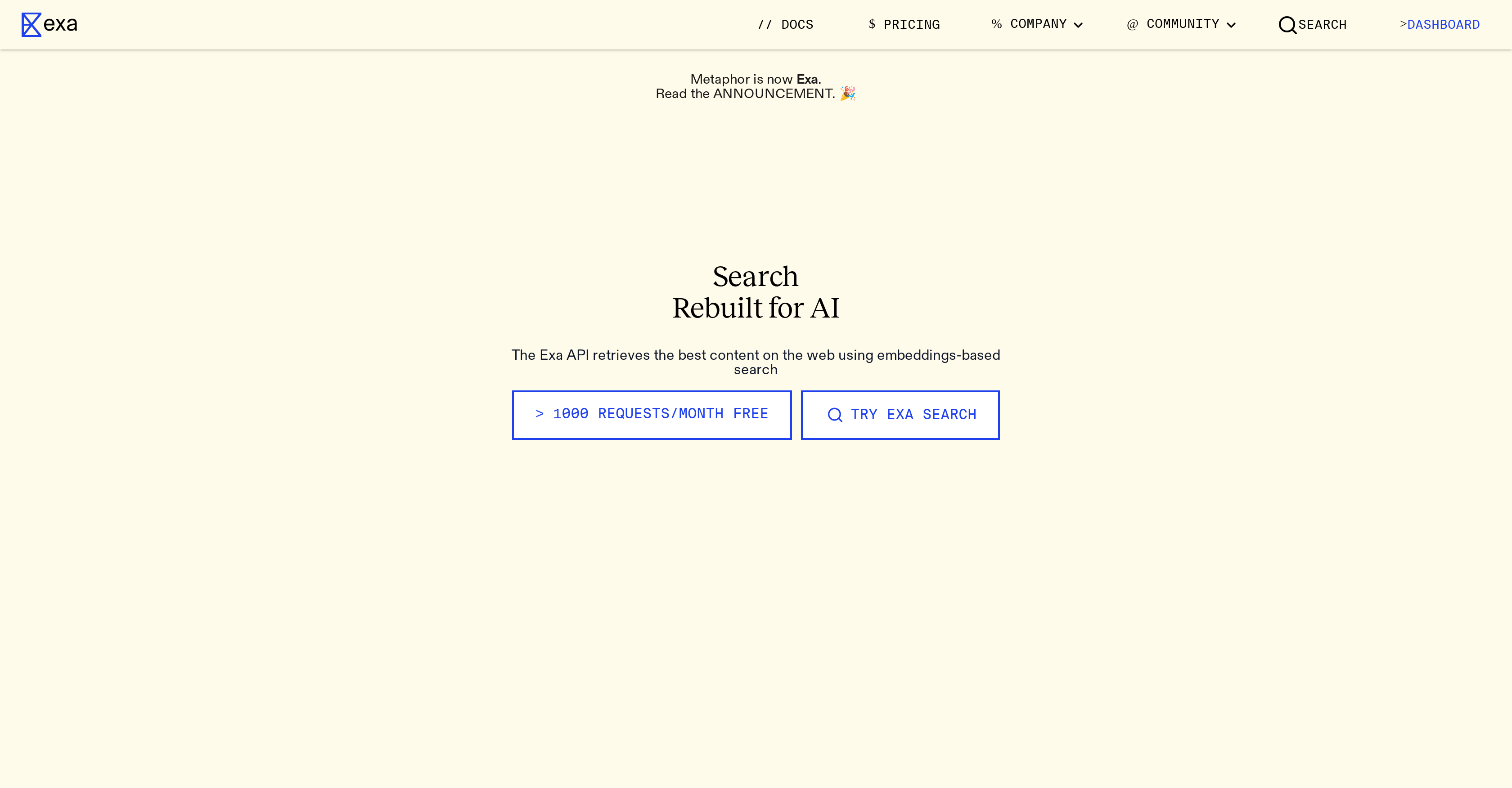
- Discover highly relevant websites and resources through natural language prompts that understand your intent, powered by semantic search technology
- Find research papers, blog posts, and technical documentation for complex topics like quantum mechanics and AI algorithms using link prediction
- Get personalized book recommendations based on conversational prompts about specific learning topics like drawing or economic history
- Locate startup websites and demo projects in specialized fields through expressive searches that go beyond keyword matching
- Access music recommendations and creative content discovery by describing your preferences in natural language rather than specific artist names
Pros & Cons
Pros
- Predicts links not text
- Trained on diverse resources
- Capability to provide recommendations
- Understand expressive language inputs
- Able to predict variety of results
- Flexible with language models
- Can generate resource directories
- Inclusive of creative results
- Helpful prompts included
- User-initiated search capability
- Conducive to template-guided browsing
- Providing startup-based search results
- Understands GPT-3 prompts
- Personalized search prompts
- Designed for complex query inputs
- Specialized queries for physicist profiles
- Search results including blog suggestions
- Supports research paper predictions
- Skillful in identifying instructional resources
- Educational resource finding ability
- Advanced resource prediction capabilities
- Discord integration for sign in
- Expression of search query variety
Cons
- Limited to links prediction
- May not understand complex queries
- Dependent on included templates
- Potential bias towards certain resources
- Predictive accuracy may vary
- Cannot generate non-web content
- Sign-in required via discord
- No customization controls
- Dependent on JavaScript enabled
Reviews
Rate this tool
Loading reviews...
❓ Frequently Asked Questions
Metaphor stands out from traditional search engines because it is powered by a language model that makes sense of language in a more expressive and creative manner. Unlike its predecessors, Metaphor is designed to understand and respond to prompts, akin to GPT-3 prompts, by predicting the most relevant link that may come after.
The operative core of Metaphor is a language model, similar to the GPT-3 model, that is trained to predict and provide link-based solutions to user prompts.
Metaphor is capable of providing a wide array of results, including blog posts, Wikipedia pages, resource directories, demos, startups, books and papers. It can also suggest music and yield other creative outcomes.
Prompts in Metaphor work in a way similar to GPT-3. Users type their query or statement in a creative and expressive manner, and Metaphor uses its language model to predict the most fitting link that could follow the prompt.
Metaphor can help you find a diverse range of content. Particularly, it can guide you to resources relevant to AI, including languages and classic AI algorithms. It can also lead you to music, blog posts, papers, demos, startups, books, and much more.
Yes, Metaphor can indeed recommend music. It is trained to predict links to a wide variety of outcomes, including music recommendations.
Metaphor presents an advantage for AI-related research by being more equipped to navigate and understand AI-related contexts. It can provide resources on programming languages and classic AI algorithms, which would be particularly useful for researchers and learners in the field of AI.
Metaphor comprehends language via the form of prompts. Powered by a language model similar to GPT-3, it processes the expressive and creative language used in the prompts and predicts the links that are most likely to match the input.
Predicting links instead of text allows Metaphor to provide users with relevant resources directly. Instead of just giving a text-based response to a query, Metaphor will suggest a link that leads to more detailed, useful, and comprehensive information.
The templates in Metaphor serve to familiarize users with the search engine. They demonstrate how to leverage the power of Metaphor through prompts and show the vast range of results that the tool can yield.
Metaphor caters to creative searches through its in-built language model. It intakes elaborate and creative prompts and predicts an assortment of results, from blog posts and Wikipedia pages to demos and music recommendations.
The need to sign in with Discord to use Metaphor could be to create an user-friendly environment where users can easily access and use the AI-powered search engine. Additionally, it could assist in maintaining user safety and data protection.
Yes, Metaphor can help in finding resources for learning philosophy. It is trained to lead users to an extensive range of resources, including directories for diverse learning fields such as philosophy.
Metaphor aids in locating blog posts or papers by predicting links related to the input prompt. Users communicate their search inquiry in the form of creative prompts, and Metaphor responds with the most fitting links.
Yes, Metaphor has the ability to provide recommendations for websites or startups. It can predict links that lead to the websites of startups, especially those working on AI and related fields.
Yes, Metaphor can assist you in finding a book based on a conversation. When giving Metaphor a creative prompt worded as a dialogue, it uses its language model to anticipate and provide a fitting link, which can be a book recommendation.
With its robust language model, Metaphor is equipped to assist in finding resources for intricate topics, such as quantum mechanics. It can suggest links to foundational papers and other related resources on the subject.
Yes, Metaphor possesses a feature that recommends popular blogs. By predicting links related to prompts, it can yield the addresses of favored blogs and other similar resources.
Metaphor addresses requests for explanations of complex algorithms by predicting a link that would ideally offer a detailed explanation. This accelerates the process of finding specific, in-depth information on the required algorithms.
Metaphor is equipped to suggest books on specialized learning topics, such as drawing or the history of the American economy. Users can simply insert a creative prompt about their learning interest, and Metaphor will predict and provide relevant links, including book recommendations.
Pricing
Pricing model
Freemium
Paid options from
$50/month
Billing frequency
Monthly
Related Videos
This AI Search Engine Is My New Go-To for Content Discovery | Metaphor App Review
IntelliGen•366 views•Aug 9, 2023