
Microsoft Foundry
Overview
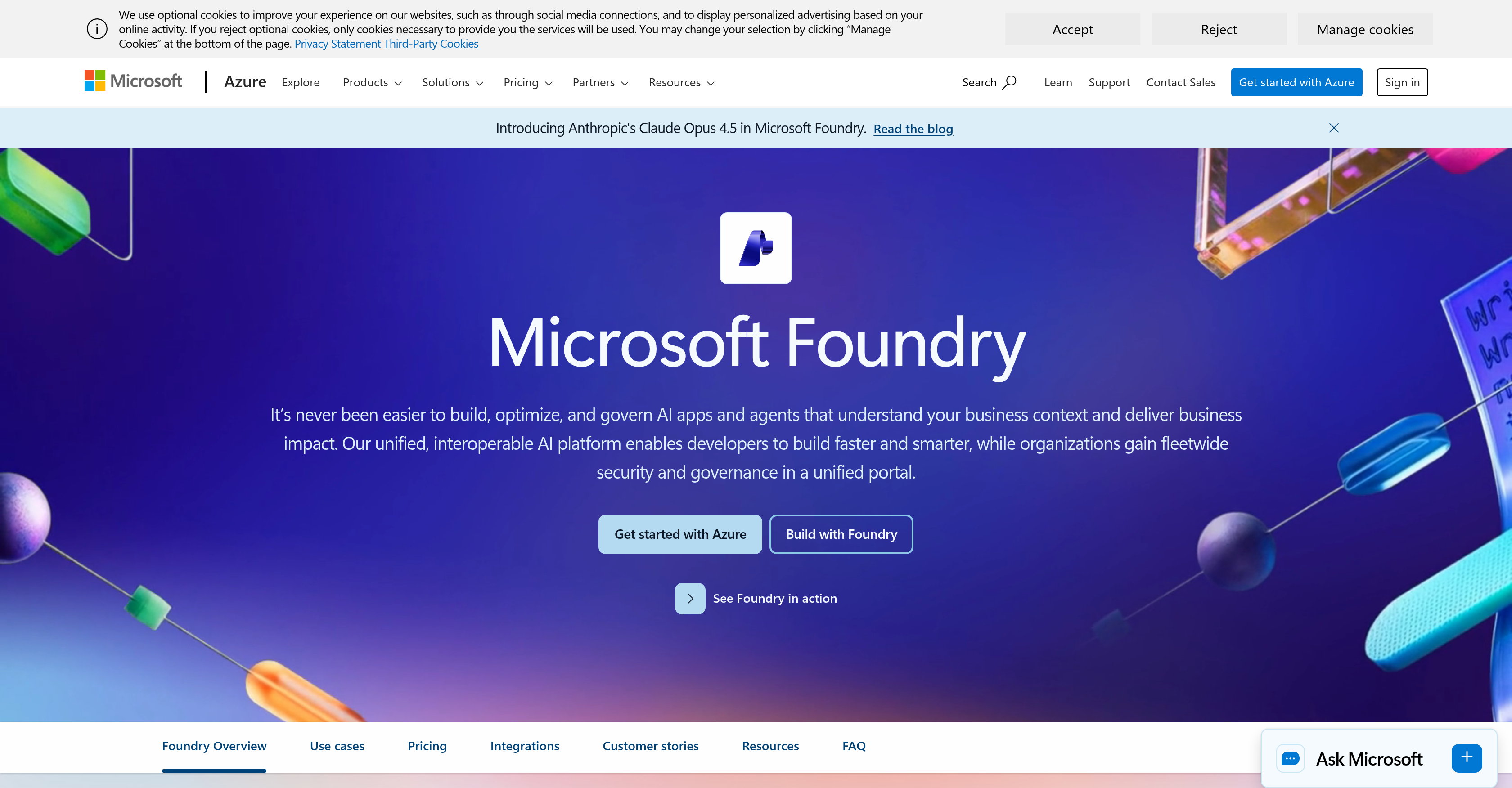
- Accelerate AI-driven, cloud-native development from concept to deployment with a unified, interoperable platform that integrates all necessary Azure services.
- Select and benchmark the optimal AI model for each application from a curated library of foundational, open, reasoning, and multimodal models.
- Deploy enterprise-wide AI solutions with confidence using fleetwide security measures and governance controls managed from a single portal.
- Create AI apps and agents that understand specific business contexts to drive tangible impact, streamlining the entire development lifecycle.
- Simplify AI management and optimize development initiatives through a centralized interface designed for efficiency and control.
Pros & Cons
Pros
- Interoperable with Azure
- Fleetwide security measures
- Data and workflow protection
- Wide selection of models
- Model benchmarking and comparison
- Enabled with Azure services
- Hosts foundational, open, reasoning, multimodal, industry-specific models
- Optimal business impact potential
- Azure Content Understanding integration
- Azure Speech integration
- Azure Machine Learning integration
- Cloud-native development support
- Unified portal for governance
- Part of Microsoft Azure
- Empowers intelligent building
- Serverless container support
- Event-driven functions integration
- Real-time model routing
- Easy model customization and upgrade
- Automated complex business processes
- Broad language support
- Support for open-source frameworks
- Seamlessly integrates with enterprise systems
- Supports many pre-built customizable tools
- Customer data secure grounding
- Intuitive monitoring dashboards
- Flexible consumption-based pricing
- Fleet-wide accessibility
- Integrated with GitHub for automated workflows
- Wide industry application
- High scalability
- Integrated with Model Context Protocol (MCP)
- Provides actionable insights
- Automatic model routing
- Seamless CI/CD integration
- Offers real-time threat protection
- Offers enterprise-grade data security
- Observability in a unified portal
- Microsoft Defender and Entra ID integration
Cons
- Limited to Microsoft Azure
- Could be complex for beginners
- Potentially expensive
- Inefficient for small scale projects
- Dependent on Microsoft ecosystem
- Limited pre-built models
- Minimal customizability
- Overhead for managing services/features
- Closed source
Reviews
Rate this tool
Loading reviews...
❓ Frequently Asked Questions
Microsoft Foundry is a comprehensive, integrated, and interoperable AI platform, and is part of Microsoft Azure. Designed to greatly speed up AI-driven, cloud-native development across various industries, it provides developers the ability to build intelligently and efficiently. Microsoft Foundry facilitates the creation of AI apps and agents that understand business contexts and can deliver significant business impact. This central AI hub offers a unified interface for optimizing and managing AI development initiatives.
Microsoft Foundry is deeply integrated with several Azure services. This includes Azure AI Search, Azure OpenAI, Azure Content Understanding, Azure Speech, and Azure Machine Learning. These services enhance the capabilities of Microsoft Foundry, working in combination to provide an end-to-end AI solution.
Microsoft Foundry implements extensive security measures to safeguard data and workflows. These include fleetwide security measures and governance in a unified portal, which simplifies AI management and ensures the protection of data.
Microsoft Foundry hosts a wide range of AI models. These can include foundational, open, reasoning, multimodal, and industry-specific models. This diverse selection allows developers to choose the most suitable models for their applications.
Yes, Microsoft Foundry allows developers to benchmark and compare models for each application. This feature provides a more efficient way to select the most suitable models for various business contexts and applications.
Microsoft Foundry is designed to significantly speed up AI-driven, cloud-native development. Its tightly integrated and interoperable platform enables developers to build AI applications and agents efficiently and smartly. Being part of Microsoft Azure, it utilizes various Azure services for enhanced functionality.
Microsoft Foundry acts as a factory for AI apps and agents. It allows developers to create comprehensive AI solutions that understand business contexts. The platform streamlines the process of AI app and agent creation, driving significant business impact.
Yes, Microsoft Foundry provides a unified interface for managing AI development initiatives. This interface streamlines the optimization and management of AI development, ensuring a centralized control over various development tasks.
Microsoft Foundry enables the creation of AI apps and agents that understand specific business contexts. This deep understanding of business contexts helps in achieving strategic goals and deliver substantial business impact.
Definitely. Microsoft Foundry offers an end-to-end solution, from model selection to application deployment and management. This allows it to be used for enterprise-wide AI solution deployment in a secure and governed environment.
Microsoft Foundry utilizes various Azure services, which enhance its capabilities and functionality. These services include Azure AI Search, Azure OpenAI, Azure Content Understanding, Azure Speech, and Azure Machine Learning.
Microsoft Foundry facilitates the creation of AI apps and agents that are tailored to understand specific business contexts, which could lead to substantial business impact. The platform streamlines the entire development process, enabling developers to build solutions that intelligently deliver business results.
Yes, Microsoft Foundry provides a complete end-to-end solution. The platform aids developers through the entire AI solution development process, from model selection to application deployment and management, all in a secure and governed environment.
Microsoft Foundry offers extensive features for data and workflow security. The platform provides fleetwide security measures and governance in a unified portal. This not only simplifies AI management but also ensures data and workflows are effectively protected.
Microsoft Foundry is designed to accelerate AI-driven, cloud-native development for numerous industries. The specific industries aren't mentioned on their website, however, since it's a versatile and adaptive platform, it's reasonable to infer that it can cater to a wide variety of sectors.
Microsoft Foundry utilizes several specific Azure services. This includes Azure AI Search, Azure OpenAI, Azure Content Understanding, Azure Speech, and Azure Machine Learning.
Definitely. Microsoft Foundry offers a unified interface for managing and optimizing AI development initiatives. This allows developers to streamline their workflow and create efficient, effective AI apps and agents.
Yes, Microsoft Foundry provides a unified portal for AI management. It unifies all the necessary AI management tools and capabilities, ensuring a convenient and effective method for managing AI development.
Yes, Microsoft Foundry allows users to manage the creation of AI Apps and AI Agents. The platform offers a host of features designed to simplify and streamline the process of creating AI solutions.
Microsoft Foundry provides a range of features for AI optimization and management. This includes a unified interface for AI development, capabilities for model benchmarking and comparison, and security measures for data and workflow. In addition, it hosts a variety of models to cater to different application needs.
Pricing
Pricing model
Pricing
Paid options from
N/A
Related Videos
What is Azure AI Foundry? (Now Microsoft Foundry) | 1 Minute Overview
Azure Innovation Station•23.1K views•Feb 13, 2025