
Overview
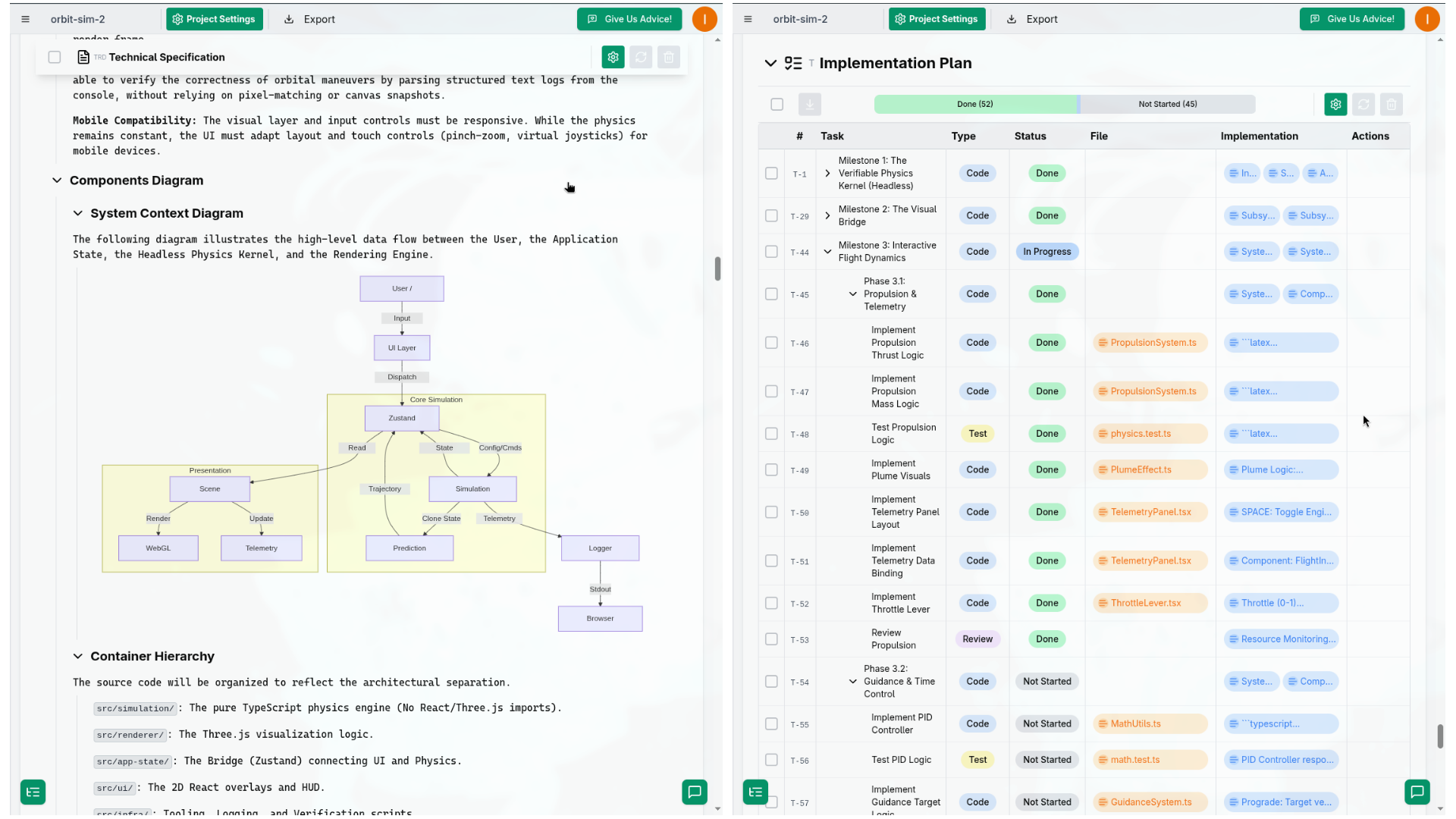
- Eliminate constant clarification loops and manual fixes by providing your AI coding agents with a detailed, structured plan to follow, powered by AI-guided requirements capture that interviews you to extract your product vision.
- Generate coherent, production-ready system architecture and technical specs automatically, ensuring your application's foundation aligns perfectly with your requirements and constraints.
- Maintain a single source of truth with visual diagrams and living documentation, keeping your entire team aligned and drastically reducing the need for status meetings.
- Auto-generate complete implementation plans including file structures and task breakdowns, giving your coding agents a clear roadmap instead of forcing them to improvise.
- Integrate directly with Claude Code, Cursor, and other agents via MCP protocol, allowing them to consume your project's living specifications from within their native IDE environment.
Pros & Cons
Pros
- System Architecture Design
- Automated Implementation Planning
- Coding Agent Integration
- Enhances development processes
- Comprehensive product requirement documents
- Detailed technical specifications
- Intelligent context management
- Visual Diagrams
- Living Documentation
- Unified Workspace for requirements
- Enables Team Collaboration
- Mobile-friendly design
- Autonomous Implementation Guidance
- Streamlined development process
- Seamless connect with development tools
- Supports Claude Code, Cursor, OpenCode
- Facilitates Structured coordination
- Interactive previews
- Single Source Of Truth
- Coding Agents' consistent and predictable results
Cons
- No offline functionality
- No version control functionality
- Lack of real-time collaboration
- No free trial for Pro+
- Lacks user role management
- No built-in code editor
Reviews
Rate this tool
Loading reviews...
❓ Frequently Asked Questions
Nautex AI is an artificial intelligence-driven tool designed specifically for managing specifications and requirements in development projects. It enhances the work of Coding Agents and product builders by bridging the context gap between Product Teams and Coding Agents, focusing on specification-driven development and autonomous implementation guidance.
Nautex AI supports several platforms for Coding Agents including Claude Code, Cursor, OpenCode, and OpenAI Codex.
The purpose of Nautex AI's specification-driven workflow is to guide users through the process from capturing project requirements to implementation and testing. This structured, step-by-step approach ensures nothing is overlooked and aligns product vision with technical execution.
Nautex AI's Information Architecture is metaphorically illustrated as a tree. The 'roots' symbolize the product vision, the 'trunk' aligns architecture and requirements, and the 'crown' grows into maintainable code.
Nautex AI aims to eliminate micromanagement of Coding Agents by offering comprehensive Product Requirement Documents (PRDs), technical specs, and codebase maps before the coding phase begins. This provides Coding Agents with a detailed plan to follow, eliminating the need for constant guidance and instruction.
Nautex AI conveniently provides comprehensive Product Requirement Documents (PRDs), technical specifications, and codebase maps prior to the coding phase, giving Coding Agents a clear and structured plan to follow, reducing errors and enhancing overall efficiency.
The 'Single Source of Truth' offered by Nautex AI is a repository where visual diagrams and living documentation are maintained. This central source ensures all team members have access to the latest and most accurate project information, circumventing the need for numerous and frequent team meetings.
Nautex AI is currently developing an integration feature, making use of the MCP protocol to facilitate seamless connectivity with development tools. This will enable Coding Agents to easily and directly access project requirements from their IDE via Nautex AI.
Nautex AI enhances team collaboration by offering a unified workspace where requirements, architectural diagrams, and interactive previews can be managed in one place. This facilitates real-time or asynchronous feedback and ensures all team members are aligned.
Yes, Nautex AI does provide mobile accessibility. By installing Nautex AI on a mobile device, users can conveniently brainstorm ideas on the move.
Nautex AI helps manage project specifications by enabling users to capture and clarify requirements into a living specification. It offers a spec-driven workflow that guides the process from capturing requirements to implementation and testing.
In Nautex AI's metaphorical tree representation of its Information Architecture, the 'roots' symbolize the product vision, the 'trunk' represents the alignment of architecture and requirements, and the 'crown' signifies the maintainable code resulting from the process.
Nautex AI plays an integral role in bridging the context gap between Product Teams and Coding Agents by providing autonomous, AI-driven guidance. It achieves this by ensuring that comprehensive Product Requirement Documents, technical specs, and codebase maps are made available before the coding phase, providing clarity and context to Coding Agents.
Yes, Nautex AI is designed to interface with OpenAI Codex as well as other coding platforms such as Claude Code, Cursor, and OpenCode. This allows for seamless connectivity and collaboration with a wide range of development tools.
Nautex AI aids in maintaining technical specs and codebase maps by autonomously generating these comprehensive documents before the coding phase starts. This proactive approach ensures that Coding Agents have a detailed plan to follow, streamlining the development process and minimizing the risk of errors.
Nautex AI helps reduce unnecessary team meetings by maintaining a single source of truth with visual diagrams and living documentation. This makes it easier for Coding Agents to stay aligned with real-time project updates, thereby eliminating the need for frequent team meetings.
Nautex AI's unified workspace allows users to manage requirements, architectural diagrams, and interactive previews all in one integrated platform. This not only enhances team collaboration but also facilitates easier and more efficient project management.
Yes, Nautex AI supports visual diagrams and living documentation. It maintains a single source of truth where all these documents are updated real-time, ensuring that everyone has access to the most current and accurate project information.
The purpose of autonomous implementation guidance in Nautex AI is to provide AI-driven guidance to Coding Agents throughout the development process. This autonomous approach eliminates the need for constant manual intervention, resulting in a more efficient and streamlined workflow.
Nautex AI supports mobile accessibility, enabling users to brainstorm on the move. By facilitating idea capture away from the traditional office environment, Nautex AI ensures that creative thought and project development can continue regardless of location.
Nautex AI enhances and accelerates development processes by co-designing applications with detailed specifications. Its primary function revolves around capturing and structuring product vision into living specifications, generating coherent system architecture, planning implementation, and integrating coding agents to consume these specifications directly.
Nautex AI helps coding agents by providing well-structured project specifications. By creating a cooperative environment where both the product team and Coding Agents operate in aligned context, it avoids inconsistencies and constant manual fixes in code produced without clear directives. This way, Nautex AI caters to a more advanced, faster, and less frustrating code generation process.
The key features of Nautex AI include AI-Guided Requirements Capture, System Architecture Design, Implementation Planning, and Coding Agent Integration. Additional features include AI-Powered Guidance, AI Native Task Management, a unified workspace for managing requirements, architectural diagrams, and interactive previews. It supports team collaboration and offers a mobile-friendly design. An upcoming feature is Integrating Coding Agents for seamless connection with development tools.
Nautex AI manages specifications and requirements by initiating an interview-style process called AI-Guided Requirements Capture. This method extracts and structures the product vision into comprehensive specifications, which then drive the system architecture design and implementation planning. It achieves effective context management, producing consistent code and maintaining a single-source-of-truth with living documentation.
Nautex AI supports various coding agents like Claude Code, Cursor, OpenCode, and OpenAI Codex. Integration with these coding agents is done via the MCP protocol, allowing them to consume specifications directly.
The AI-Guided Requirements Capture in Nautex AI works through an interview-style process aimed at extracting and structuring the product vision into comprehensive living specifications. This approach ensures clarity, precision, and coherence in capturing requirements, setting the stage for every subsequent step of the development process.
Yes, Nautex AI is equipped to auto-generate system architecture design. It creates coherent technical architecture that aligns with product requirements and constraints, ensuring a robust and appropriate basis for the coding phase.
MCP or Message Control Protocol is a communication standard utilized in Nautex AI. It enables seamless connection between Nautex AI and various coding agents like Claude Code, Cursor, OpenCode, and OpenAI Codex. With MCP, these coding agents can directly access and consume the specifications from Nautex AI, facilitating straight-lined and efficient workflow.
Yes, Nautex AI can auto-generate implementation plans. It does so by automatically creating file structures, modules, and task breakdowns mapped to requirements. This feature enables a methodical and well-structured approach to the implementation process.
Nautex AI ensures coding agents deliver more advanced code faster by providing well-structured and comprehensive specifications. This reduces inconsistencies, requiring less manual fixes and reruns. Moreover, it keeps everyone aligned, enabling coding agents to follow structured plans instead of improvising, resulting in a more streamlined, fast-tracked code generation process.
The 'Specificationdriven steps from idea to implementation' concept in Nautex AI refers to its workflow revolving around translating an initial idea into a final implementation through a well-defined sequence of steps. These include capturing and clarifying requirements, designing the system, planning the creation of files, setting tasks, connecting the coding agent, and finally, overseeing implementation and testing.
Nautex AI tackles issues of context loss and inconsistent code by maintaining a single source of truth via visual diagrams and live documentation. With intelligent context management features, it assures consistency and coherency in code produced. It aids in clarifying and demystifying specifications and architectural structures, reducing the likelihood of producing inconsistent code.
AI-native project management is a feature in Nautex AI designed to facilitate structured coordination for AI-driven development. It employs structured roadmaps and integration protocols, building incrementally with clear review checkpoints. This is crucial as traditional project management approaches often don't work well with autonomous Coding Agents.
AI-Powered Guidance in Nautex AI assists in defining comprehensive Product Requirements Documents and Technical Requirements Documents. This feature ensures that no critical information or requirements are overlooked, thereby maintaining the integrity and efficiency of the development process.
Yes, Nautex AI does support team collaboration. Teams or contractors can refine the product vision with real-time or asynchronous feedback, facilitating a more efficient and comprehensive development process.
Yes, Nautex AI is mobile-friendly and can be accessed from anywhere. This feature allows users to work efficiently irrespective of their location and ensures that their ideas and workflow aren’t constrained by their physical presence at an office.
Nautex AI offers multiple pricing tiers to cater to different user requirements. It has a free tier that offers Specifications Implementation Plans and Coding Agents guidance with a limit on AI credits. The Pro tier costs $20 per month and offers all basic features plus increased AI credits. The Pro+ tier, priced at $100 per month, hosts all basic features and an even greater number of AI credits. An Enterprise plan is also available, offering custom features like daily communication digesting, on-premise deployment, advanced security controls, and more.
Nautex AI can support comprehensive product requirement documents (PRDs), technical specifications, and codebase maps. These form the basis for developing an application, and the tool assures that these are well-structured, detailed, and cater to the specific needs of the project.
Yes, Nautex AI has an upcoming feature of Coding Agents Integration which will allow seamless connection with development tools. This feature will allow developers to access requirements directly from their IDE via Nautex, further improving the workflow and efficiency of the coding process.
Pricing
Pricing model
Freemium
Paid options from
$20/month
Billing frequency
Monthly