

ParseCrate
Keep sensitive documents on infrastructure you control with a free, open-source, self-hosted document processing API that runs locally and processes local files offline once models are available.
Listing not yet reviewed by our editors · How we check
Overview
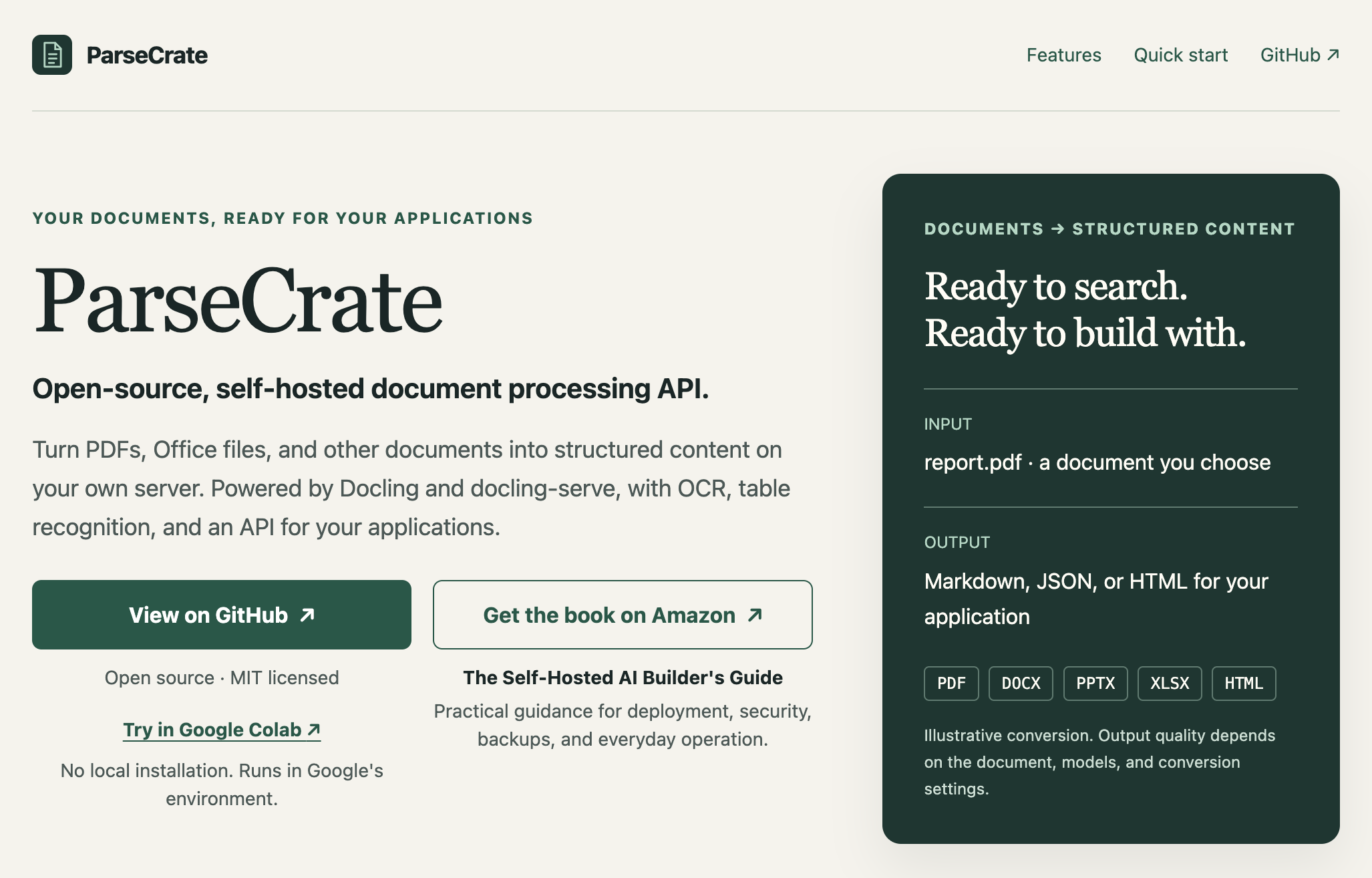
- Keep sensitive documents on infrastructure you control with a free, open-source, self-hosted document processing API that runs locally and processes local files offline once models are available.
- Turn PDF, DOCX, PPTX, XLSX, HTML, and Markdown files into clean Markdown, JSON, HTML, or plain text through a single document conversion API built on Docling and docling-serve.
- Pull usable data out of scanned PDFs, images, and complex tables with combined OCR, layout analysis, and table recognition that preserves document structure.
- Feed retrieval pipelines with ready-to-index content using hierarchical and hybrid chunking endpoints designed for RAG applications and semantic search.
- Process large batches without blocking your application by choosing synchronous or asynchronous conversion and submitting either file uploads or source URLs.
- Go from zero to running parser in one step with a Docker deployment for CPU on amd64 or arm64, or faster GPU document extraction through the NVIDIA CUDA image, with default conversion models already bundled.
- Avoid repeated model downloads and restrict access to your endpoint with persistent model caching and API-key authentication.
- Test conversion output visually before writing integration code using the optional web playground UI or the Google Colab demo.
- Build commercial and internal products without licensing friction under the MIT-licensed codebase, with no signup required and the option to run standalone or inside Self-Hosted AI Stack.
Pros & Cons
From the listing; not yet checked by our editors.
Pros
- Document processing on your own infrastructure
- Free, open-source project under the MIT license
- PDF, Office, HTML, and other supported document inputs
- OCR, layout analysis, and table recognition
- Markdown, JSON, HTML, and plain text output
- Synchronous and asynchronous REST API
- Hierarchical and hybrid chunking for RAG preparation
- Included default conversion models and offline conversion support
- CPU or NVIDIA GPU deployment
- API-key authentication and persistent model caching
- Optional web playground and Google Colab demo
Cons
- Self-hosting requires setup and ongoing maintenance
- Extraction quality varies with document layout and scan quality
Alternatives to ParseCrate
Tools that share the most tags with ParseCrate.
- AI Formatter.net
Pass automated resume screening systems with ATS-optimized templates that ensure your application gets seen by recruiters
Free trial · from $16.67/month
$16.67/month
Not yet checked
- Format Magic
Create professional-looking documents in seconds without design skills using AI-powered template selection
Freemium · from $4.95/month
$4.95/month
Not yet checked
- Scanned.to
Get perfectly formatted, editable Word documents from any scan or PDF, thanks to neural network OCR that preserves original layouts, fonts, and tables.
Free trial · from $5/unit
$5/unit
Not yet checked
- Unstract
Trust every extracted field before it reaches production: LLMEval runs two independent LLMs, one extracting and one validating, and returns confidence scores for each result.
Not listed
Not listed
Not yet checked
- Upstage Studio
Turn messy, complex documents into clean, validated data ready for downstream systems: AI agents parse, extract, and validate content for end-to-end intelligent document processing.
Freemium · from $20/month
$20/month
Not yet checked
- Datalab.to
Feed downstream systems clean, production-ready data instead of messy files by converting PDFs, spreadsheets, and slides into structured markdown, HTML, and JSON.
Freemium · from $400/month
$400/month
Not yet checked
Reviews
Rate this tool
Loading reviews...