

Overview
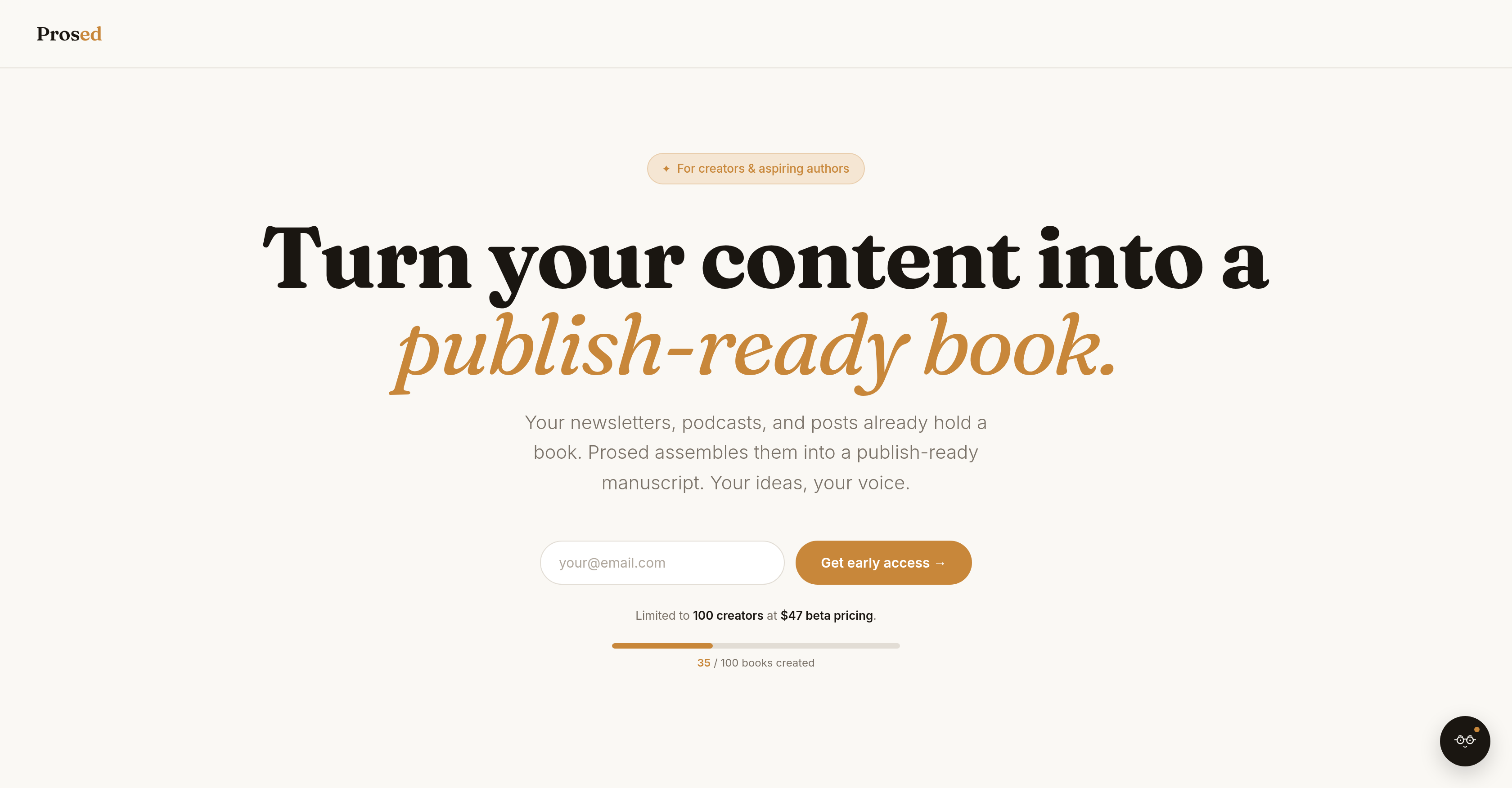
- Publish a book from your existing content without starting from scratch by feeding newsletters, podcasts, blog posts, or online articles into a multi-stage pipeline modeled on patterns from over 150 successful nonfiction books.
- Maintain your unique voice and brand language across every chapter with Typo, the built-in AI editorial reviewer that checks for voice consistency, story flow, chapter cohesion, and brand alignment.
- Get a clear roadmap to a bestseller with quality scores that compare your manuscript against criteria from successful nonfiction books, showing exactly where your book stands.
- Sell your finished book on Amazon or directly to your audience by exporting a print-ready PDF, ePub, or DOCX that requires no additional formatting.
- Keep full creative control over your manuscript by reading each chapter, leaving comments, and requesting rewrites through an interactive portal that lets you shape every page.
- Convert podcast episodes or YouTube transcripts into a coherent book by feeding links, which are automatically transcribed, restructured, and edited into a publish-ready manuscript.
- Turn years of Substack newsletters or long-form blog posts into a structured book that distills your best ideas into a cohesive, chapter-by-chapter narrative.
Pros & Cons
Pros
- Assembles various forms of content
- Multi-stage pipeline
- Interactive editing process
- Voice consistency and brand alignment
- User-customized writing style
- Multiple export file formats
- Quality score comparisons
- Designed for various user types
- Transcribes video and audio content
- Content restructuring and connection
- Distraction-free reading environment
- Consistent output style
- Pattern modeling from successful books
- Providers user's private portal
- End product is publication-ready
- Offers editorial assistance
- Can incorporate unique speaking styles
- Supports multiple content monetization methods
- Ideal for first-time authors
- Ideal for domain knowledge Experts
- Supports eBook export
- Supports print-ready PDF
- Supports DOCX Format
- Shells for Amazon Publishing
- Equipped with grammar check
- Enhances story flow
- Ensures chapter cohesion
- User-friendly interface
- Tailors output to your voice
- Supports long-form writing
- Excellent for newsletter writing
- Designed for content transformation
- Enables creative writing
- Provides manuscript creation service
- Facilitates Substack and Newsletter Writers
- Tailored for Bloggers and Long-form Writers
- Ideal for Podcasters and Video Creators
- Equipped with chapter-level comment feature
- Relevant for users of YouTube, LinkedIn
- Allows content uploading via links
- Automatic content transcription service
- Offers 5 full rewrites included
- Unlimited edits with Typo feedback
- Quality scored against bestsellers
- Allows complete user content deletion
Cons
- Limited to non-fiction
- No voice analysis
- No structure to writing
- Limited editorial review
- Manual project management required
- Limited file export formats
- Pricing concerns
- Lack of personalization
- No automatic transcription
- Limited to 100 creators
Reviews
Rate this tool
Loading reviews...
❓ Frequently Asked Questions
Prosed is an AI-enabled tool that aids creators and aspiring authors in transforming their existing content into a publish-ready book. It caters to various content forms such as newsletters, podcasts, blog posts, and online pieces, restructuring, editing, and enhancing them to form a complete manuscript.
Prosed operates by taking the user's content in various formats and assembles it into a full manuscript utilizing a multi-stage pipeline. Users can interact with this process via their own portal, wherein they can read every chapter, leave comments, and request rewrites. The final product can then be exported in different file formats ready for publishing.
Prosed's multi-stage pipeline functions by building upon patterns drawn from over 150 successful nonfiction books. It restructures, edits and enhances the received content transforming it into a coherent manuscript. The underlying AI, Typo, checks for voice consistency, flow, chapter cohesion, and alignment of brand language.
Yes, Prosed is adept at converting online content into books. Users can feed content from different sources such as online posts, articles, and other digital content. The tool then gathers, rearranges, and polishes the acquired content, assembling it into a complete, publish-ready manuscript.
Prosed can manage and process a diverse range of content forms like newsletters, podcasts, blog posts, transcripts, and notes, and other online contents. Users can feed these diverse contents into Prosed, which then assembles it into a complete manuscript.
In the Prosed portal, users can interact with the process at every stage. They're able to read each chapter as it is formed, leave comments, and request rewrites. The portal provides an interactive and user-friendly interface for users to monitor and engage with the book-creation process.
Typo, an in-built AI editorial reviewer in Prosed, plays an instrumental role in enhancing the manuscript's quality. It assesses the manuscript for voice consistency, flow, chapter cohesion, and correct alignment of brand language. This ensures the resulting manuscript is coherent, structured, and aligns with the user's unique voice and brand.
Yes, users can personalize the writing style in Prosed. They can impart their unique speaking style, favorite phrases, and elements to prevent, to ensure the final draft aligns with their voice. This enables the manuscript to maintain authenticity and originality in its voice.
In Prosed, the final product, which is a complete manuscript, can be exported in multi-file formats. The available file format options include DOCX, PDF, or ePub. This allows the final product to be versatile and compatible with a range of devices for reading.
Yes, the final product or manuscript created with Prosed can be sold on platforms like Amazon. The manuscript is export-ready in various file formats that can be readily submitted to online selling platforms.
Language alignment refers to Prosed's functionality that ensures the written language in the manuscript accurately reflects your voice. That is, it uses AI to maintain consistency with how you talk, the phrases you love, and what to avoid, thus aligning the language with your own.
Prosed ensures brand language consistency through Typo, its integrated AI editorial reviewer. Typo reviews every chapter, evaluating every piece for coherence with the user's unique voice, the flow of content, chapter cohesion, and consistency with the brand's language.
Yes, users can request rewrites in Prosed. This feature of the tool allows users to interact directly with the process. They can read every chapter in their portal, leave comments, and ask for rewrites as they see necessary.
Prosed compares your book with successful bestsellers by providing quality scores based on criteria observed in successful nonfiction books. It helps users understand how their book measures up against renowned and well-received books in the same genre.
The content enhancement feature in Prosed is driven by AI that amplifies the book's quality by focusing on restructuring, editing, and enhancing the received content. It uses recognized patterns from successful nonfiction books to improve and refine the manuscript's quality and readability.
Content restructuring in Prosed is a process wherein it organizes and modifies a user's input content, be it newsletters, podcast transcripts, or blog posts, into a continuous and coherent book format. This is accomplished using its multi-stage pipeline that's modeled on patterns from successful nonfiction books.
Yes, Prosed can convert your podcast into a publish-ready book. Users can feed podcast links to the tool, which then transcribes the podcast episodes into text. This text is then restructured, edited, and enhanced to create a full, publish-ready manuscript.
Yes, Prosed can convert your newsletters into a publish-ready book. Users can feed newsletters or other similar content forms, which is then processed, restructured, and assembled into a complete manuscript.
Prosed effectively uses patterns obtained from over 150 successful nonfiction books in its multi-stage pipeline to bring potential success factors into your manuscript. These patterns facilitate content restructuring, editing, and enhancement, thus improving the manuscript's overall quality and flow.
Prosed uses AI feedback in two ways. First, the editorial reviewer, Typo, provides editorial feedback on voice consistency, flow, chapter cohesion, and language alignment. Second, Prosed computes quality scores, comparing the user's book with successful bestsellers — this comparison feedback serves as a roadmap to achieve a successful book.
Prosed is an AI-enabled tool that assists creators and aspiring authors in converting existing content into a publish-ready book. It can assemble an array of content types such as newsletters, podcasts, blog posts, and online content into a complete manuscript. The tool utilizes a structured pipeline based on patterns sourced from over 150 successful nonfiction books, to edit, enhance, and restructure the content.
Prosed transforms content into a book using a multi-stage pipeline that is modeled on patterns from over 150 bestselling nonfiction books. It restructures content, connects parts, and shapes it into a book. The users provide their already created content which the tool then restructures, edits and enhances into a complete manuscript.
Yes, users can interact with the content production process on Prosed. On their portal, users can read every chapter of the assembled book, leave comments, and request rewrites as they deem necessary. This allows for hands-on shaping of each chapter.
Typo, the built-in AI editor in Prosed, checks for voice consistency, story flow, chapter cohesion, and brand alignment. It identifies and notes errors, connects readers to the exact passage of the error, providing a review of the entire manuscript for grammar, flow, cohesion, and brand alignment.
Yes, users can customize the voice and style of their book in Prosed. Users are able to impart their unique speaking style, preferred phrases, and elements to avoid to the tool. This helps to ensure that the final draft aligns with their unique voice and style as closely as possible.
Upon completion, users can export their book from Prosed in multiple file formats including DOCX, PDF, and ePub. These formats are ready for publishing on platforms such as Amazon or sold directly to the users' audience.
Yes, books produced by Prosed can absolutely be sold on Amazon. After creating a manuscript with Prosed, users can export the final product in several formats including DOCX, PDF, and ePub. These formats are well suited for selling directly to their audience or on platforms such as Amazon.
Indeed, Prosed allows for voice consistency throughout the book. It features a built-in AI editorial reviewer, Typo, which checks for voice consistency, ensuring that the voice and style are harmonized throughout the book irrespective of the chapter.
Surely, users have the ability to make comments and request rewrites for their book on Prosed. After every chapter is assembled, users can interact with it, leave comments, and request rewrites via their portal as they deem fit. The tool is designed for hands-on shaping and customization at every stage.
Prosed ensures that a book aligns with the user's brand language by offering a dedicated AI editorial reviewer – Typo. Typo checks for alignment of brand language along with other things like voice consistency, flow, and chapter cohesion. It's a crucial component of the tool's editorial process, helping to maintain brand consistency.
Prosed's multi-stage pipeline is a structured process built on patterns from over 150 successful nonfiction books. This pipeline is responsible for editing, enhancing, and restructuring the content to create a manuscript, ensuring that it reads like a bestseller.
Yes, Prosed can indeed convert podcast or video content into a book. Users can feed content such as podcast or YouTube channel links to Prosed. The tool then transcribes, structurizes and assembles everything into a publish-ready manuscript.
Prosed is definitely suitable for first-time authors. Given its functionality of converting a wide range of content into a book, it provides an accessible tool for anyone aspiring to be an author. It aids in minimizing the barriers of entry into authorship.
Prosed is highly versatile in terms of the type of content that can be fed for conversion into a book. It can work with newsletters, podcasts, blog posts, long-form writing, and even online content via links. Users can also drop in transcripts and notes for conversion into a manuscript.
Certainly, users can import their unique speaking style into Prosed. It allows users to share their speaking styles, favourite phrases, and elements that they want the tool to avoid. This helps to ensure the final draft aligns with their unique voice and style.
Currently, Prosed seems to only support the export of the final product in DOCX, PDF, and ePub formats. There is no mention of additional export formats on their website.
Yes, Prosed is adept at handling long-form writing. The AI tool can convert years of long-form content, distill, and structure it into a publish-ready manuscript, ensuring the voice and style are harmonized.
Prosed aids in content monetization by transforming existing content into a publish-ready book that users can sell directly to their audience or on platforms like Amazon. The final product can be exported in a print-ready format, allowing for direct selling and monetizing of the produced content.
Yes, Prosed is highly compatible with Substack and newsletters. It can take content from various sources including Substack and newsletters, and restructure, connect and shape it into a book. This makes the tool great for authors who have been publishing newsletters on Substack or similar platforms.
Prosed is a beneficial tool for a variety of users including authors, bloggers, and podcasters. It can also be useful for video creators, first-time authors, and individuals with extensive domain knowledge. The tool is designed to convert their existing content into well-structured, publish-ready books.
Pricing
Pricing model
Paid
Paid options from
$47
Billing frequency
One-time