

Qypt AI
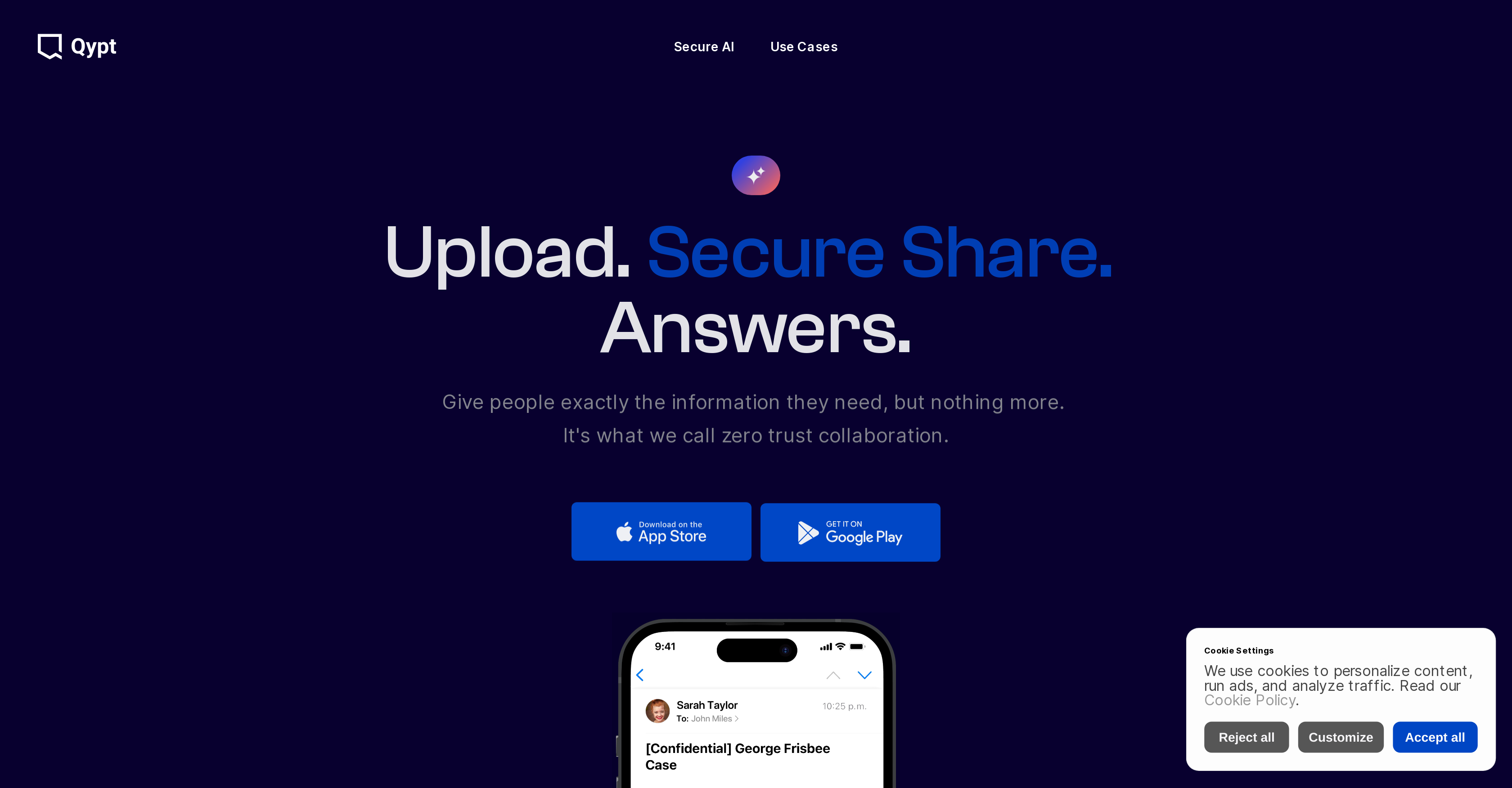
Stop information leaks before a file leaves your control: every uploaded document is protected with end-to-end encryption for secure file sharing.
Listing not yet reviewed by our editors · How we check
Overview
- Stop information leaks before a file leaves your control: every uploaded document is protected with end-to-end encryption for secure file sharing.
- Show each collaborator only the data they need: AI-powered redaction removes the data types you choose, such as personal, financial, or proprietary details.
- Answer outside questions without handing over the full document: invited collaborators query your files through AI prompts, and zero-trust collaboration returns only the relevant information.
- Know who touched your data and why: activity monitoring shows who engaged with each shared document and every question they asked.
- End exposure the moment a deal or partnership changes: revoke access to encrypted documents instantly.
- Run legal audits and due diligence without risking confidentiality: encrypted sharing, data redaction, and controlled document queries keep sensitive records protected throughout the review.
- Start sharing securely within minutes: setup is quick, and encrypted uploads are ready to send right after installation.
Pros & Cons
From the listing; not yet checked by our editors.
Pros
- Prioritizes privacy and security
- Enhanced data confidentiality
- Secure document sharing
- Effective leak prevention
- Controlled data sharing
- Users define shared data
- Zero-trust collaboration approach
- Monitoring of document engagement
- Prompt revoking of access
- Streamlines secure collaboration
- Advanced document management
- Efficient collaboration monitoring
- Secure invitation-based collaboration
- Information leak anxiety reduction
- End-to-end document encryption
- Privacy-preserving query handling
- Easy setup and usage
- Can restrict document queries
- Group collaboration facilitation
- Can revoke access anytime
Cons
- Requires app installation
- Limited data type redaction
- No real-time collaboration
- Dependent on user-defined privacy
- No text search capability
- Limited platform integration
- Revoking access not time-based
- Limited document format support
- No multi-user document edit
- No offline file access
Alternatives to Qypt AI
Tools that share the most tags with Qypt AI.
- AODocs
Automate complex document processes end-to-end with generative AI, eliminating manual tasks and human error
Not listed
Not listed
Not yet checked
- Send AI
Eliminate manual data entry entirely with custom AI models that automatically extract specific entities from your documents
Not listed
Not listed
Not yet checked
- TidyDocs
Find any invoice or receipt in seconds with intelligent search that works as you type, powered by AI that extracts vendor, date, and amount from any document
Freemium · from $19/month
$19/month
Not yet checked
- The Drive AI
Find any document instantly without manual searching through AI-powered content-based file search
Freemium · from $19.99/month
$19.99/month
Not yet checked
- Safe Appeals
Transform scattered files into a coherent project in minutes by dropping PDFs, research papers, and notes into a unified workspace where everything is automatically organized and indexed.
Paid · from $30
$30
Not yet checked
- Bit.ai
Transform scattered documents into a centralized knowledge base that your entire team can access instantly through powerful search capabilities
Freemium · from $8/month
$8/month
Not yet checked
Reviews
Rate this tool
Loading reviews...
Frequently asked questions
What is Qypt AI?
Qypt AI is a security-focused tool designed to prioritize privacy and security in data sharing and collaboration. It utilizes advanced artificial intelligence mechanisms to enhance confidentiality, particularly when sensitive information necessitates robust protection. By enabling users to upload and encrypt documents, Qypt AI safeguards data sharing and ensures that security concerns regarding information leaks are effectively addressed.
What specific features does Qypt AI offer to ensure security?
Qypt AI employs several features to ensure robust security. These include end-to-end encryption for securely sharing files, AI-powered redaction to control the types of information disclosed, and query handling that only reveals necessary data. The platform also allows users to monitor interactions with the shared documents and, if necessary, revoke access to encrypted documents in real time.
How does Qypt AI's encryption work when sharing documents?
Qypt AI employs end-to-end encryption for sharing documents. Users can upload documents, which are then encrypted to secure them. This encryption process fortifies the shared data, mitigating any security concerns relating to potential information leaks.
How can Qypt AI be used for data redaction?
Qypt AI uses AI to redact different types of data, ensuring certain information can be withheld when shared. Users can determine the types of data they want redacted, hence controlling what information will be visible to others.
Can I control what information I want to share using Qypt AI?
Yes, you have complete control over what information is shared using Qypt AI. The platform accomplishes this by leveraging artificial intelligence that allows users to dictate the types of information to be redacted, thereby ensuring the secure sharing of data.
What types of data can Qypt AI redact?
Qypt AI can redact different types of data. This flexibility facilitates users to define the kind of information that is shared, further enhancing the platform's security features.
How does Qypt AI handle document-based queries?
Qypt AI handles document-based queries using AI-driven mechanisms. Collaborators use AI prompts to ask questions related to the document. This approach ensures that only necessary, relevant information is revealed, observing a zero-trust collaboration approach.
What is meant by zero-trust collaboration in the context of Qypt AI?
Zero-trust collaboration, in the context of Qypt AI, refers to the practice of only releasing necessary information during collaboration. It ensures that collaborators only receive the essential data while other sensitive information remains protected, making it a 'trust-nothing' approach.