

Overview
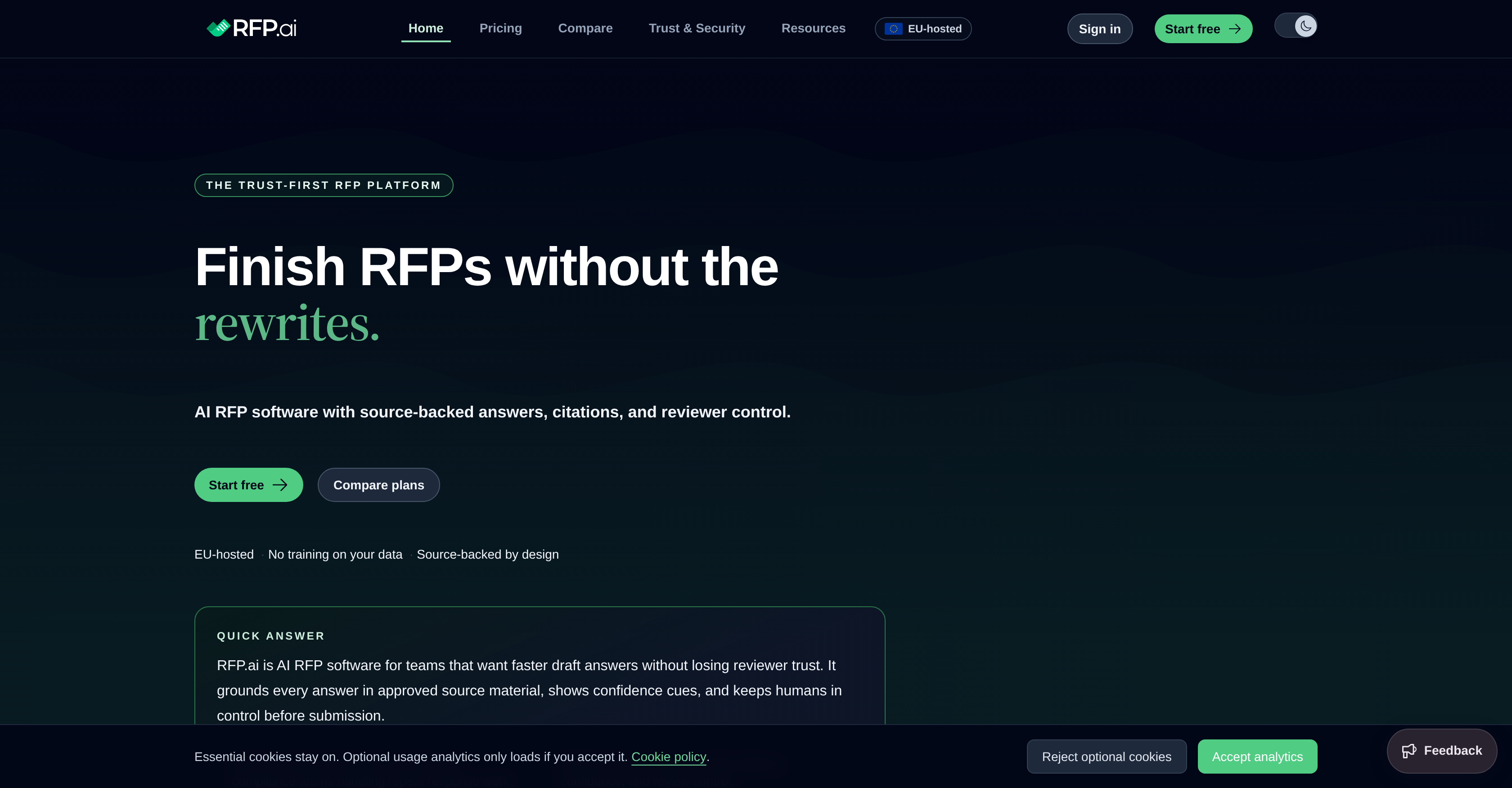
- Respond to RFPs, DDQs, and security questionnaires up to 10x faster by generating draft answers grounded in your approved source materials, with every response citing its origin
- Eliminate black-box risk and build trust with every submission through visible confidence scores that flag low-reliability answers for mandatory human review before sending
- Protect sensitive content and meet GDPR requirements with EU-hosted data handling and a strict policy of never training foundation models on your customer content
- Catch compliance gaps early by running compliance checks directly inside your RFP response workflow, reducing last-minute audit cycles and rework
- Maintain full human control over final submissions by reviewing, editing, and approving each AI-generated draft—no automated send without your sign-off
- Handle any document format without friction—upload PDF, Word, Excel, or image files with OCR, and work seamlessly across portals and Claude Desktop/MCP workflows
- Scale from startup to enterprise with transparent pricing, free initial usage, and an enterprise path that includes Single Sign-On (SSO) for procurement teams
Pros & Cons
Pros
- Automated draft generation
- Includes citations with answers
- Displays confidence cues
- Reviewer control feature
- Answers grounded in approved sources
- Helps compliance, security teams
- Works across documents, portals
- Integrates with Claude Desktop/MCP
- Self-serve startup and enterprise path
- Ensures privacy by not training on customer-content
- EU-hosted data handling
- Audit-response support
- Transparent pricing
- Proposal and presales assistance
- Assists in stopping repetitive response work
- Built-in transparency for trust
- Automatically assigns low-confidence answers to SMEs
- Instigates structured workflow
- Tracks coverage and risk
- Exports in buyer's format
- Automated source material packaging
- Facilitates human review
- Built for high-stakes responses
- Compliance checks inside the workflow
- Offers rule packs for common compliance frameworks
- Context-aware checks on each question
- Reduces last-minute review cycles
- Provides browser extension for web-based response flows
- Works with Claude Desktop, Cursor
- Allows creation of projects, assignment of Q&A through agents
- SME review speed optimization
- Maintains reusable knowledge base
- Reads and processes PDFs, Word, Excel, scanned documents
- Generates low-confidence outputs for easy review
- Supports healthcare, life sciences, and public sector Industries
- BUilt for complex, review-heavy responses
- HIPAA, ISO 27001, NIST compliance
- Claude Desktop integration
- Encryption at rest and in transit
- Maintains org-level data isolation
- Supports multiple upload formats such as PDF, Word, Excel
- Automatically detects fields for fillable forms
Cons
- No native mobile application
- No multiple language support
- Lacks real-time collaboration features
- No automated suggestions
- No API for integrations
- Doesn't support all file types
- Limited citation sources
- Missing workflow customization
- No offline functionality
- Data exclusively hosted in EU
Reviews
Rate this tool
Loading reviews...
❓ Frequently Asked Questions
RFP.ai is an AI-powered software developed by Dutchcode B.V., designed specifically to assist teams in creating draft responses to Request for Proposals (RFPs), Due Diligence Questionnaires (DDQs), and security questionnaires.
RFP.ai assists in draft proposal creation by extracting user questions from approved content available on their website. It then uses its AI to generate draft responses to these questions. The generated draft responses are grounded in the approved source material, providing users with source citations and confidence scores for each response.
RFP.ai is designed to handle a variety of questionnaires including Request for Proposals (RFPs), Due Diligence Questionnaires (DDQs), and security questionnaires.
RFP.ai ensures accuracy and reliability of draft responses by grounding each of its generated responses in approved source materials. The software provides citations for each source used, giving users full transparency of the origin of every response. In addition to this transparency, RFP.ai also assigns confidence scores to each response, offering further credibility to its answers.
RFP.ai's 'trust-first' approach guarantees transparency and reliability by ensuring that all the draft responses are visible and grounded in approved source materials. This approach also includes public trust documents and testable workflows on actual responses, enhancing the trustworthiness of the platform.
RFP.ai protects data privacy by not training its foundation models on user content. It maintains all answers grounded in approved sources, ensuring user data privacy is upheld and no personal or confidential data is used inappropriately.
RFP.ai is typically used by proposal, pre-sales, security, and compliance teams. These teams frequently manage recurring response tasks and benefit from the automation and reliable draft responses offered by this software.
Yes, RFP.ai is suitable for regulated teams. It's specifically designed to assist teams with security questionnaires, compliance reviews, and other audit-intensive response tasks often required in regulated industries.
RFP.ai offers transparent pricing with options for free initial usage followed by self-serve or enterprise plans. The exact pricing structure or plan details are not explicitly mentioned on their website.
RFP.ai integrates human judgment in its system by generating draft responses to user questions and then assigning these responses to users for review. This allows the user to assess responses which require human judgement or expert input, ensuring a human touch is retained even with the automation.
RFP.ai was developed by Dutchcode B.V, a software development company.
Yes, RFP.ai can assist in handling security questionnaires. The platform is tailored for such tasks, helping teams generate draft responses based on approved source material.
RFP.ai determines confidence scores based on the relevancy and accuracy of the drafted response to the user questions. The AI gauges its level of certainty for accuracy and appropriateness of each drafted response and assigns a confidence score accordingly.
RFP.ai uses approved source material to generate draft answers. The source material is uploaded by the user and is approved, ensuring that all responses remain grounded in valid and reliable sources.
RFP.ai is particularly advantageous for teams managing recurrent response tasks such as proposal, presales, security, and compliance teams. The platform's automation and reliability in response drafting ease these tasks for these kind of teams.
RFP.ai ensures transparency in its AI operations by providing source citations for each of its responses, giving a clear view of where the answers originate from. Furthermore, it offers a 'trust-first' approach that includes public trust documents and workflows that can be tested on actual responses, ensuring the process is open and transparent.
Yes, RFP.ai does offer free initial usage as part of their pricing plan, allowing teams to test the service before committing to a paid plan.
Yes, RFP.ai's setup is reviewable, allowing reviews of cited answers and confidence hints. The responses generated can be evaluated before finalizing the draft, ensuring that the responses meet the necessary standards.
In RFP.ai's system, user content is handled with strict data privacy rules. They do not utilize foundation models that are trained based on user content, ensuring all answers remain grounded in approved, non-confidential sources. This practice ensures that the user's data privacy is respected and maintained.
Yes, RFP.ai offers a type of plan that caters for enterprise needs, in addition to a self-serve option. However, the specific features and tools included in the enterprise plan are not explicitly detailed on their website.
RFP.ai's main function is to assist teams in generating quick, draft responses to RFPs, DDQs, and security questionnaires. This platform achieves its objective by grounding the answers in approved source material and displaying confidence cues to maintain human control over the responses before their submission. RFP.ai is designed to cater to proposal, presales, security, and compliance teams who regularly deal with repetitive responses.
RFP.ai assists with responses to RFPs, DDQs and security questionnaires by generating AI-powered drafts that are grounded in approved source material. This allows for faster and more accurate responses. The software also includes confidence cues in every response, which gives reviewers an idea of the confidence level of each answer. This ensures that only high-confidence responses are selected and forwarded, hence avoiding potential misunderstandings or inaccuracies.
RFP.ai ensures the trustworthiness of its responses by grounding every answer in an approved source material which can be verified by reviewers before submission. In addition, the platform includes a confidence score or 'confidence cues' on every response to give a clear indication of the answer's reliability. The score prompts reviewers to double-check any response which has a low confidence score. All these features are aimed at maintaining trust between the tool and the users.
'Source-backed responses' means that every answer generated by RFP.ai is grounded in approved source material. This means that every answer can be traced back to a source document, policy, or other piece of information that has been approved by the user. The source of the answer is cited on the response, giving it a solid grounding and ensuring it’s based on factual, approved information.
Yes, RFP.ai is designed to cater to a wide range of team needs including procurement teams. This includes an enterprise path for procurement needs. This is because it streamlines and speeds up the process of responding to RFPs which is a task that procurement teams often engage in.
Yes, RFP.ai does support Single Sign-On (SSO). This is part of its enterprise path which is intended to meet procurement and SSO needs of larger organizations, provided as part of the overall package to ensure convenient access and enhanced security.
RFP.ai upholds user privacy by refraining from training foundation models on customer content. This way, it ensures that answers remain grounded in the sources approved by the user and do not infringe upon any data privacy or security regulations which might result in exposure of sensitive customer content.
Yes, the RFP.ai platform offers transparent pricing options that cater to both self-serve and enterprise needs. The flexible and clear pricing model is intended to assist both startups and larger enterprises in selecting a solution that best matches their needs and budget.
RFP.ai works across a variety of medium including documents, online portals, and Claude Desktop/MCP workflows. The software is thus able to simplify response generation irrespective of the document or portal format where the user is originally working. This feature enhances the flexibility and scope of the platform's usage across different work modalities.
EU-hosted data in RFP.ai signifies that the application data is stored in EU-region infrastructure, specifically reflecting a privacy-conscious posture towards data handling. This is particularly beneficial for regulated teams dealing with heavy audit-response work. Using EU-hosted data also implies conformity with stringent EU data privacy and security laws, and GDPR by design, which potentially enhances the privacy and security of user data.
In RFP.ai, the manual review process is designed to maintain human control over the generated responses before submission. The platform presents citations and confidence cues to enable the review team to verify the responses. High-confidence answers are approved while low-confidence ones are flagged for further review or revision. This review process ensures the reliability and accuracy of responses before they are sent out.
No, RFP.ai does not train its foundational models on customer content. This is a deliberate approach to uphold user privacy and to ensure that all answers generated are based on user-approved source material, thereby providing accurate and reliable responses without compromising user data.
RFP.ai is indeed capable of managing complex responses efficiently. Being AI-powered, it can handle complex RFPs, DDQs, and security questionnaires by generating draft responses based on approved source materials. Confidence cues and manual review systems further enhance the tool's ability to manage detailed and high-stakes responses while ensuring the quality and accuracy of the responses.
RFP.ai minimizes black-box risk by ensuring transparency and traceability in its AI-driven processes. Each answer generated by the platform includes citation of the source from where it was derived. In addition, confidence cues are presented alongside each response, indicating the AI's level of confidence in the correctness of the given answer. These elements together provide users with visibility into the workings of the AI and reduce the risk of a black-box scenario where the AI's operations would otherwise be unclear.
RFP.ai supports a wide range of document formats for upload. These include the most commonly used business document formats such as PDF, Word, Excel, as well as image files, including those that need to be processed with Optical Character Recognition (OCR). This facilitates a versatile and flexible document handling approach, making the platform adaptable for a variety of business needs.
In RFP.ai, the data extraction process is initiated by AI pulling out the relevant questions, dates, and sections from the documents provided by the user. This presents the team with a structured starting point rather than an unorganized pile of data. The AI then proceeds to generate relevant draft responses, connecting these responses to the original content through sources and confidence cues.
RFP.ai offers features that allow compliance checks to be conducted within the same workflow where the team writes the answers. This enables reviewers to spot any gaps before submission instead of having to amend the responses post submission. This is particularly useful for compliance frameworks and helps in reducing the number of last-minute review cycles.
RFP.ai provides specialized solutions for complex, review-heavy responses in various industries including Healthcare & Life Sciences, SaaS & Enterprise Software, and Government & Public Sector. Depending on the industry type and the specific requirements associated, RFP.ai can handle everything, from HIPAA compliance and ISO 27001 controls to formal documentations and full traceability matrices.
The role of AI in RFP.ai is central to generating draft responses. The AI algorithm scans the knowledge base documents uploaded by the user, pulls out relevant responses grounded in this source material, and generates draft responses. It assigns confidence cues to these responses, which then undergo a review process. This significantly reduces the time and effort required in manually responding to each question in an RFP, DDQ, or security questionnaire.
Pricing
Pricing model
Freemium
Paid options from
$49/month
Billing frequency
Monthly