Translation-API.com
Overview
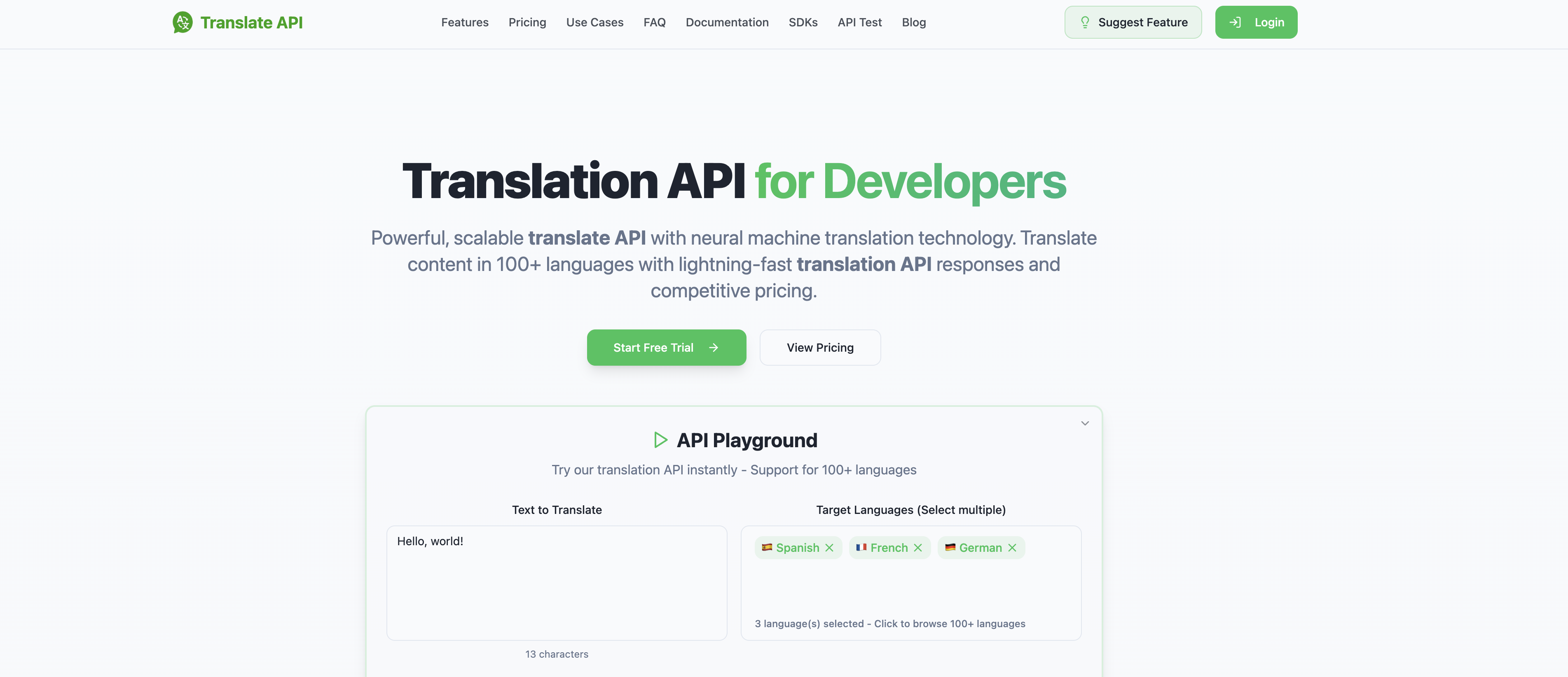
- Instantly make your web or mobile app accessible to a global audience by integrating real-time translation through a single REST API call.
- Choose the best translation quality for your needs by accessing multiple top-tier engines, including Google Translate API for breadth and DeepL API for linguistic precision.
- Eliminate complex integration work with a service designed for seamless compatibility across all major programming languages and existing web services.
- Scale your multilingual capabilities reliably with a subscription-based service that handles high-volume translation through advanced AI and machine learning.
- Dynamically translate entire websites or specific content to create a more inclusive user experience without rebuilding your application from scratch.
Pros & Cons
Pros
- Compiles multiple translation APIs
- Real-time translation capability
- Website translation feature
- DeepL, Google, Cloud APIs
- REST API integration
- Compatible with multiple platforms
- Supports number of languages
- Language recognition capability
- Subscriptions available
- Quality translation selection
- Versatile applications
- Systems translation
- Usage limit flexibility
- Notable linguistic quality
- Supports multi-language capability
- Text conversion feature
- Supports web application translation
- Supports automated translation
- Enables global communication
- Enhances interaction
- Web service integration
- Mobile application compatibility
- Desktop application compatibility
- Developer-friendly
- Business applications
- Makes content accessible
- Best for multilingual products
- Suitable for digital services
- App services translations
Cons
- Subscription-based
- Usage limits
- Difficult for non-developers
- Language quality varies
- Relies on third-party APIs
- REST API required
- Potentially high costs
- Limited advanced features
- Delayed updates
- Reliability depends on provider
Reviews
Rate this tool
Loading reviews...
❓ Frequently Asked Questions
Translation API is a set of software tools created to simplify translation across various languages. It offers access to multiple high-quality translation APIs, designed to enable applications to comprehend and translate text, websites, and other content in real time. It helps in integrating multilingual capabilities into different digital products and services, thus improving global communication and interaction.
Translation API works using advanced AI and machine learning algorithms. It makes use of various high-quality translation APIs like Google Translate API, DeepL API, and Cloud Translation API. These can help applications to understand and translate text, websites, and other content in real time.
Translation API employs several top-tier translation APIs, including but not limited to the Google Translate API, DeepL API, and Cloud Translation API.
Yes, Translation API is adaptable with various programming languages. This compatibility is due to its feature of REST API integration, allowing it to be seamlessly embedded into different applications.
Artificial Intelligence and machine learning play a significant role in the functioning of Translation API. These advanced technologies help deliver high-quality translations by constantly learning and improving the translation quality and accuracy.
While the exact accuracy rate is not explicitly mentioned on their website, the Translation API, with its advanced AI and machine learning algorithms, is designed to deliver high-quality translations.
Yes, Translation API can be used for real-time translation of your website. Its main function is to understand and translate text, websites, and other content dynamically, creating a more inclusive experience for users worldwide.
Yes, Translation API supports REST API integration. This compatibility implies that it can be seamlessly integrated with numerous programming languages and platforms.
Translation API proves beneficial in various scenarios. Developers, businesses, and organizations can use it to make their digital content more accessible and understandable to a wider audience by integrating multilingual capabilities. It is particularly useful for real-time translations of websites and digital content.
'Seamless integration of multilingual capabilities' refers to the ability of the Translation API to easily and efficiently integrate the feature of understanding and translating content into various languages into any digital product or service.
Translation API contributes to global communication and interaction by enabling digital content translation across different languages in real time, thereby facilitating communication between users speaking different languages.
Translation API aids in making digital content more accessible by offering high-quality translations of websites and digital content, enabling users around the globe to understand the content in their preferred language.
Businesses and organizations looking to globalize their digital content and make it more accessible to a broader audience can significantly benefit from Translation API.
Developers can leverage Translation API by integrating it into their applications to add the feature of real-time, high-quality translations, thus making their applications more accessible to a worldwide audience.
Yes, Translation API is a reliable choice for translation services. It utilizes AI and machine learning algorithms to provide high-quality translations, making it an efficient option for translation purposes.
Yes, Translation API can dynamically translate specific website content into various languages, making the site more accessible and inclusive for users globally.
'Language Localization' in the context of Translation API refers to adapting a product's language to meet the language specifications and cultural expectations of a specific target market or region.
The intended users of Translation API are developers, businesses, and organizations that need to render their digital content more accessible by adding multilingual capabilities.
Yes, Translation API is designed to enhance inclusivity in digital products and services. By enabling translation of entire websites or specific website content into various languages, it creates a more inclusive experience for users worldwide.
Without any given comparison data on their website, it's not possible to determine how Translation API stacks against other translation tools or APIs.
The Translation API service provides access to top-notch translation APIs like Google Translate API, DeepL API, and Cloud Translation API.
A wide variety of applications including web applications, websites, and digital systems can use the Translation API service.
Through seamless integration of multilingual capabilities into different digital products and services, Translation API plays a significant role in enhancing global communication and interaction. It can dynamically translate an entire website or specific website content to various languages, thereby making digital content more accessible to users worldwide.
As part of website translation, Translation API allows for dynamic translation of a whole website or specific content into numerous languages, enabling sites to be more user-friendly to a global audience.
Translation API offers a REST API integration making it compatible with several programming languages and platforms. This allows for relatively simple procedure of incorporating it into different applications.
Developers, businesses, and organizations looking to make their digital content more accessible and comprehensible to a broader audience would find the Translation API tool particularly useful.
The AI technology of Translation API relies on advanced machine learning algorithms to deliver high-quality translations, making it a reliable choice for translation services.
For text translation, Translation API offers features such as language recognition and text conversion. It is able to implement top translation APIs effectively for this purpose.
Translation API leverages machine learning and natural language processing technologies to recognize multiple languages and convert text from one language to another, providing a very drilled quality of translation.
Developers can integrate Translation API into their applications or services using RESTful API calls, making it easy to integrate with existing web services.
Google Translate API and Cloud Translation API are known for their large set of supported languages and usage in Google's platforms, while DeepL API is known for its high linguistic quality in translations.
Considerations when choosing between Google Translate API, DeepL API, and Cloud Translation API could include the range of languages to be supported, quality of translation, and cost considerations.
The cost for using Translation API services is typically subject to subscription fees.
Usage of Translation API services may have limits, depending on the subscription plan.
Translation API supports recognition of multiple languages, thereby enabling conversion of text from one language to another.
The quality of translation provided by Translation API is high, as it utilizes sophisticated AI and machine learning algorithms to handle translations.
Yes, Translation API offers a broad language range support, making it a suitable choice for developers looking to support multiple languages in their applications.
Yes, you can use Translation API if you're building a mobile app. It offers REST API integration, thereby making it compatible with various platforms, including mobile.
Yes, Translation API services are subscription based and can have usage limits depending on the plan chosen.
Pricing
Pricing model
Paid
Paid options from
$15/month
Billing frequency
Monthly
Refund policy
No Refunds