

Overview
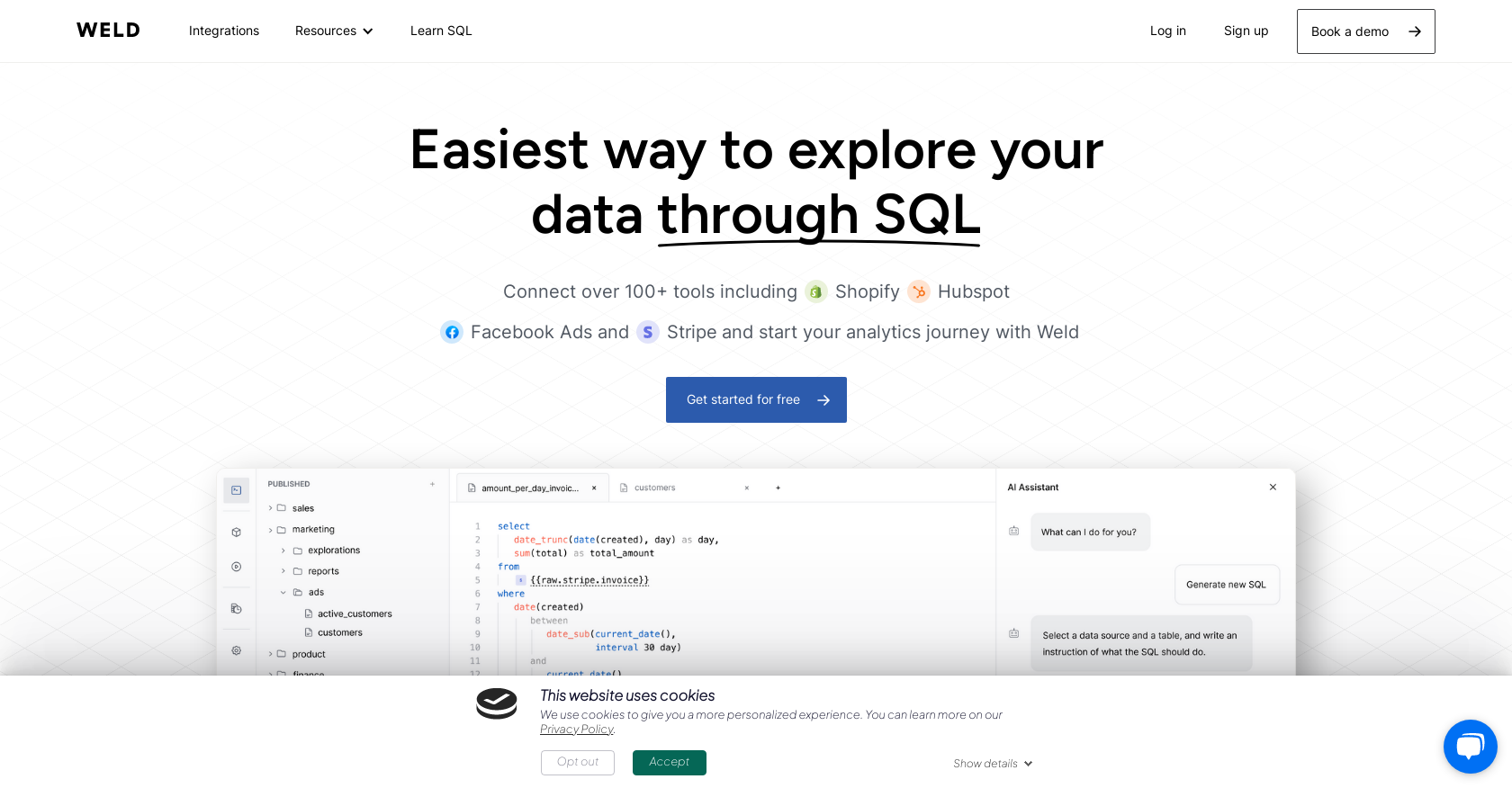
- Break down data silos across your entire tech stack by connecting to over 100 business tools including Shopify, HubSpot, and Stripe
- Transform raw data into strategic insights by detecting behavioral trends and benchmarking performance metrics across unified datasets
- Make data-driven decisions with comprehensive analytics that reveal patterns and comparative analysis between different data subsets
- Accelerate data modeling workflows using the SQL Editor with AI assistance that generates custom SQL code from simple prompts
- Sync customer data across all your tools in near-real-time with minute-by-minute updates through the Reverse-ETL feature
- Build and manage data models collaboratively with team-oriented SQL editing and data management capabilities
Pros & Cons
Pros
- Unifies data cross-platform
- Simplified data engineering
- Unique insights generation
- Boosts informed decision making
- Comprehensive cookies management
- Supports secure navigation
- Personalized experience assurance
- Enables valid website usage reporting
- Fast data integration
- Preference cookies for language
- Statistics collection for user analytics
- Effective personal marketing and ads
- Supports various business tools
- Beneficial for publishers and advertisers
- Appropriate for SQL queries
- Efficient data harness for businesses
- Handles disparate data sources
- Interactive dashboards for data visualization
- Text files processing for user's experience
- Multiple chart modes
- Sensitive data protection with 2FA
- Custom connector for data integrations
- Own data storage choice available
- Workflows orchestration for data sources
- Export data to apps and BI tools
- Provides SQL Editor
- Optimized user experience via load balancing
- Reliable metrics building with SQL
- Dependable user experience with 99.9% uptime
- Custom data activations to workplaces
- Easily understandable data models dependencies
- Scheduled data exports
- Compatibility with BigQuery and Snowflake
- Sync data in different frequencies
- User behavior tracking for enhancements
- Python and Javascript supported frameworks
- Integrated Hubspot campaigns with data
- Secure, reliable and scalable infrastructure
- Relevant advertisement delivery via Marketing cookies
- Offers resources like Blog and eBooks for knowledge enhancement
Cons
- No API mentioned
- No mobile version
- Doesn't support all databases
- No offline usage
- Limited data storage
- No customizable dashboards
- Missing third party integrations
- No real-time reports
- Limited export options
- No multiple users support
Reviews
Rate this tool
Loading reviews...
❓ Frequently Asked Questions
Weld is used for simplifying analytics and data engineering. Its main function is to unify data across various business tools, therefore giving users a comprehensive view of their business operations.
Weld can unify a variety of business data, including data from different tools, platforms, and infrastructures. This includes but is not limited to CRM data, financial data, social media data, customer interaction data, and sales data.
Weld simplifies analytics and data engineering by integrating different sources of business data into a unified format. It provides user-friendly interfaces and functionalities for data modeling and analysis, ranging from SQL editing to custom data exports, as well as visualization with interactive dashboards. All these facilitate seamless data management processes.
The speed at which Weld unifies data across various tools is dependent on the data's complexity and volume. However, Weld is designed to operate with high efficiency and it can sync data as frequently as every minute, ensuring rapid and near-real-time data integration.
Yes, Weld is a tool that relies heavily on SQL for data exploration. It offers an SQL Editor feature that enables you to create and manage your data models as a team. With its AI assistant, you can write a prompt and get tailor-made SQL code back. Weld also offers SQL tutorials for those who want to learn or improve their SQL knowledge.
The core features of Weld include an SQL Editor for data modeling, an Extract (ETL) feature to extract, load, and transform customer data to your data warehouse, and an Activate (Reverse-ETL) feature that synchronizes customer data to all your tools.
Using Weld, you can gain unique insights into your business operations. By unifying data from different sources, you can analyze behavioral trends, detect patterns, benchmark performance metrics, and make comparative analysis between different subsets of your data. This helps in strategic planning, decision making, and optimizing business processes.
Yes, Weld can integrate data from different sources. It can connect with over 100 tools ranging from CRM platforms to social media channels and financial systems, among others.
Weld uses multiple cookies for various purposes. Necessary cookies are used for functions like page navigation and access to secure areas of the website. Preference cookies remember user information such as their preferred language. Statistic cookies collect and report anonymous information about how visitors interact with the website. Marketing cookies track visitors across websites and display ads that are relevant and engaging for individual users.
The marketing cookies used by Weld are designed to track visitors across websites and display ads that are relevant and engaging for individual users. These cookies help in creating more value for publishers and advertisers by serving targeted ads, thereby improving the overall user experience and the effectiveness of ad campaigns. They are used by services like Google DoubleClick, Facebook, and third-party advertisers.
Weld uses your preferred language information to enhance your browsing experience. It uses preference cookies to remember this kind of information, enabling the website to behave or appear in a way that is consistent with your preferences.
Weld is compatible with over 100 business tools including Shopify, Hubspot, Facebook Ads, and Stripe. This means that it can unify data from all these different platforms, enabling users to conduct comprehensive data analytics.
By providing a unified view of data from various business tools, Weld enables users to make more informed business decisions. The insights obtained through its powerful analytics capabilities can inform strategies, optimize processes, and drive business growth.
Yes, Weld does track visitors on its website. It uses statistic cookies to collect and report anonymous information about how visitors interact with the website. This helps in understanding site usage, improving user experience, and optimizing the website.
Yes, you can opt out of data tracking on Weld. The platform offers varying levels of cookie acceptance to visitors, involving necessary, preference, statistic, and marketing cookies. You can select the types of cookies you want the website to use, thereby controlling the level of data tracking.
Yes, Weld offers personalized experiences by using preference cookies to remember information that changes the way the website behaves or looks, like your preferred language or the region that you are in.
Yes, Weld is GDPR-compliant. The use of the CONSENT cookie, for instance, is designed to detect if the visitor has accepted the marketing category in the cookie banner, which is necessary for Weld to comply with GDPR regulations.
Weld uses an Extract (ELT) feature which is designed to extract, load, and transform customer data to a certain data warehouse. This can be done as frequently as every minute. The data management is team-oriented, operated through an SQL Editor that facilitates the creation and management of data models.
Yes, Weld has an Activate (Reverse-ETL) feature that enables the synchronization of customer data across all your tools, and this can happen every minute.
You can join the Weld community by navigating to their website and clicking on the Community link. This will lead you to an invite page to a Slack channel - Weld's community platform - where you can join other data enthusiasts and the Weld team.
Pricing
Pricing model
Paid
Paid options from
$79/month
Billing frequency
Monthly