

Who Codes Best?
Overview
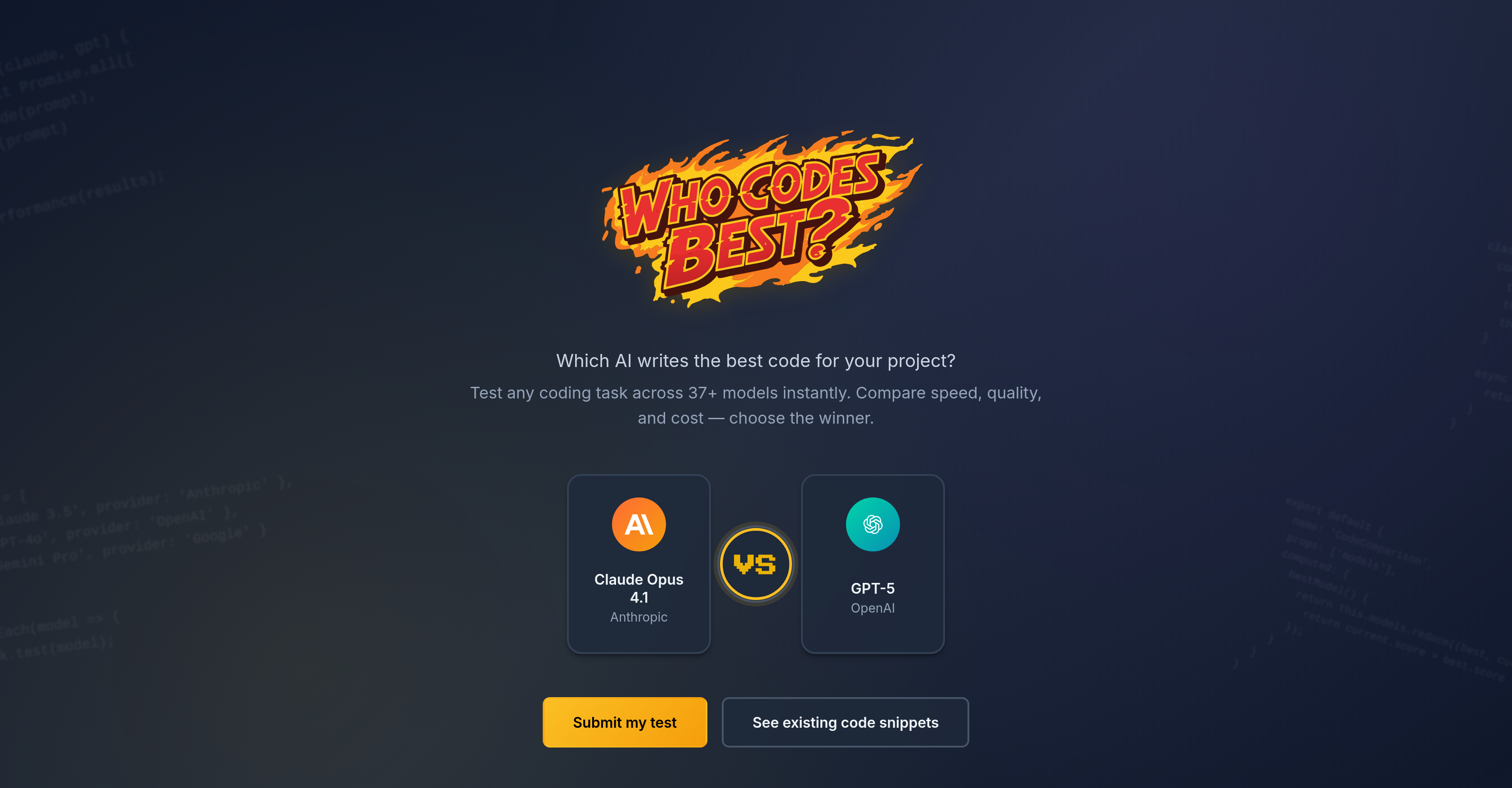
- Instantly identify the optimal AI coding assistant for any project using the CodeComparison function that ranks models by performance score
- Test your specific coding tasks across 37+ AI models simultaneously to compare real-world performance results
- Compare cost-effectiveness across major AI models to select the most economically viable option without sacrificing code quality
- Access ranked code samples from popular AI coding agents to evaluate output quality before committing to a model
- Stay current with AI coding developments through dedicated news and updates on latest model releases and benchmarks
- Make data-driven decisions using comprehensive benchmarking that tests coding capabilities across speed, quality and cost metrics
Pros & Cons
Pros
- Comprehensive analysis of models
- CodeComparison function
- Instantaneous coding task testing
- Speed, quality, and cost comparison
- Provides ranked code samples
- News and updates section
- Allows for informed choice
- Methodology transparency
- Facilitates decision making
- Regular updates on benchmarks
- Analyses code generation speed
- Analyses code generation quality
- Able to reduce models
- Returns top performing model
- Code generation samples
- Code Generation Agents
- Provides agent code snippets
- Benchmarks include variety of models
- Easy-to-navigate platform
- Constantly updated platform
- Daily comparison updates
Cons
- Unspecified comparison criteria
- No real-time comparison
- Possibly biased scoring
- Lacks comprehensive testing
- No user customization
- No interactive benchmarking
- Closed system
- Not open-source
- No API provided
Reviews
Rate this tool
Loading reviews...
❓ Frequently Asked Questions
Who Codes Best is a comprehensive platform offering analysis, comparison, and benchmarking of AI coding assistants. It tests the capabilities of major AI models to generate and review code, scoring them based on performance. It also offers a systematic method for comparison, the CodeComparison function, which assesses and returns the best performing model, enabling users to select their preferred AI based on speed, quality, and cost. It also features an overview of popular AI models and AI coding agents, ranked code samples generated, and a section for news and updates enhancing user awareness about latest AI coding model releases and benchmarks.
The CodeComparison function is a feature of Who Codes Best that allows for the comparison of AI models. This function uses the performance scores of models to assess their effectiveness. It reduces the list based on these scores and returns the model with the highest performance score. Essentially, it identifies the most optimal AI model in terms of its coding capabilities and performance.
Who Codes Best compares a wide range of AI models. Some specifically mentioned examples include 'Claude 3.5' from Anthropic, 'GPT-4o' from OpenAI, and 'Gemini Pro' from Google, among other AI models. There is also mention of running tests or tasks across 37+ models.
Core features of Who Codes Best include a method to compare, analyze, and score major AI models, AI benchmarking, providing code quality analysis along with speed and cost effectiveness analysis, providing ranked code samples generated by AI models and agents, collecting and presenting user comparison data, offering a section dedicated to AI news and updates, conducting coding task testing to evaluate AI model performance, and supporting user informed choice and AI-based decision making.
On Who Codes Best, users can test coding tasks across different AI models by providing specific coding tasks which will be processed by the different AI models on the platform. The platform then assesses the generated code in terms of speed, quality, and cost-effectiveness, allowing the user to compare and make an informed choice.
Yes, on Who Codes Best, you have the possibility to compare speed, quality, and cost of various AI models. The platform's comparison metrics enable users to make an informed choice regarding the best suited AI model for their requirements.
Who Codes Best evaluates AI models like 'Claude 3.5' from Anthropic, 'GPT-4o' from OpenAI, and 'Gemini Pro' from Google among others. It comprehensively tests the capabilities of these models to generate and review code. The models are benchmarked and scored using the platform's proprietary methodology to establish their performance levels.
AI Benchmarking on Who Codes Best serves a key function of evaluating the performance of various AI models. It tests the capabilities of these models by assigning them coding tasks and gauges their performance in terms of speed, quality, and cost-effectiveness. The results from these benchmarks are then used to rank and compare the models, helping users make informed decisions.
AI models are ranked on Who Codes Best based on their performance in generating and reviewing code. The platform uses a benchmarking method to test the capacities of the models, and scores them accordingly. These scores form the basis for ranking the models. The process involves comparison of speed, quality, and cost, among other factors.
Who Codes Best enables users to select the best performing model using its CodeComparison function. Once the models are evaluated based on their ability to generate and review code, the comparison function ranks them according to their score. The model with the highest score, indicating superior performance, is then identified as the best performing model.
Yes, Who Codes Best provides code samples generated by AI models. These are ranked code samples representing the capabilities of popular AI models and AI coding agents, allowing users to compare their effectiveness and quality.
News and updates about AI coding can be found within a dedicated section on Who Codes Best. This section provides users with the most up-to-date information regarding AI coding model releases, benchmarks, and other relevant news.
Who Codes Best is a reliable platform for AI comparison due to its comprehensive methodology which uses real-world testing data. It provides a transparent evaluation of major AI models, testing their capabilities to generate and review code. Moreover, the platform offers ranked code samples and upholds user informed choice by allowing for speed, quality, and cost comparison, thereby aiding in decision-making.
Speed analysis on Who Codes Best works by testing the time efficiency of different AI models during the code generation process. Models are given the same coding task and the speed at which they produce code is measured and compared, contributing to their overall performance score.
Yes, Who Codes Best offers a dedicated section for AI news and updates. The purpose of this section is to keep users informed about the latest releases and benchmarks in the AI coding model landscape.
Yes, Who Codes Best provides a cost-effectiveness analysis of AI models. This involves comparing the cost of using different AI models and relating that to the quality and speed of their performance, enabling users to choose the most economically viable option without compromising on the quality and speed of generated code.
Yes, Who Codes Best incorporates functionalities related to AI-based decision making, notably through its CodeComparison function. This performance assessment and comparison tool helps users to choose the most suitable AI model for their coding purposes.
Reviews for AI models on Who Codes Best can be found through the ranked code samples provided by the platform. These ranks, influenced by users' assessments as well as the platform's analysis results, serve as an effective review system for the different AI models.
Yes, Who Codes Best provides an overview of the AI coding market. By benchmarking, comparing and ranking a multitude of AI models and agents, users get a panoramic view of the options available, their capabilities, performance scores, and user reviews.
The purpose of the Coding Task Testing feature on Who Codes Best is to evaluate the performance of different AI models. It involves processing specific coding tasks through different AI models and assessing the resulting code. This feature allows users to test the capabilities of AI models and compare their speed, quality and cost-effectiveness.
Pricing
Pricing model
Freemium
Paid options from
$5/unit
Billing frequency
Pay-as-you-go