

Overview
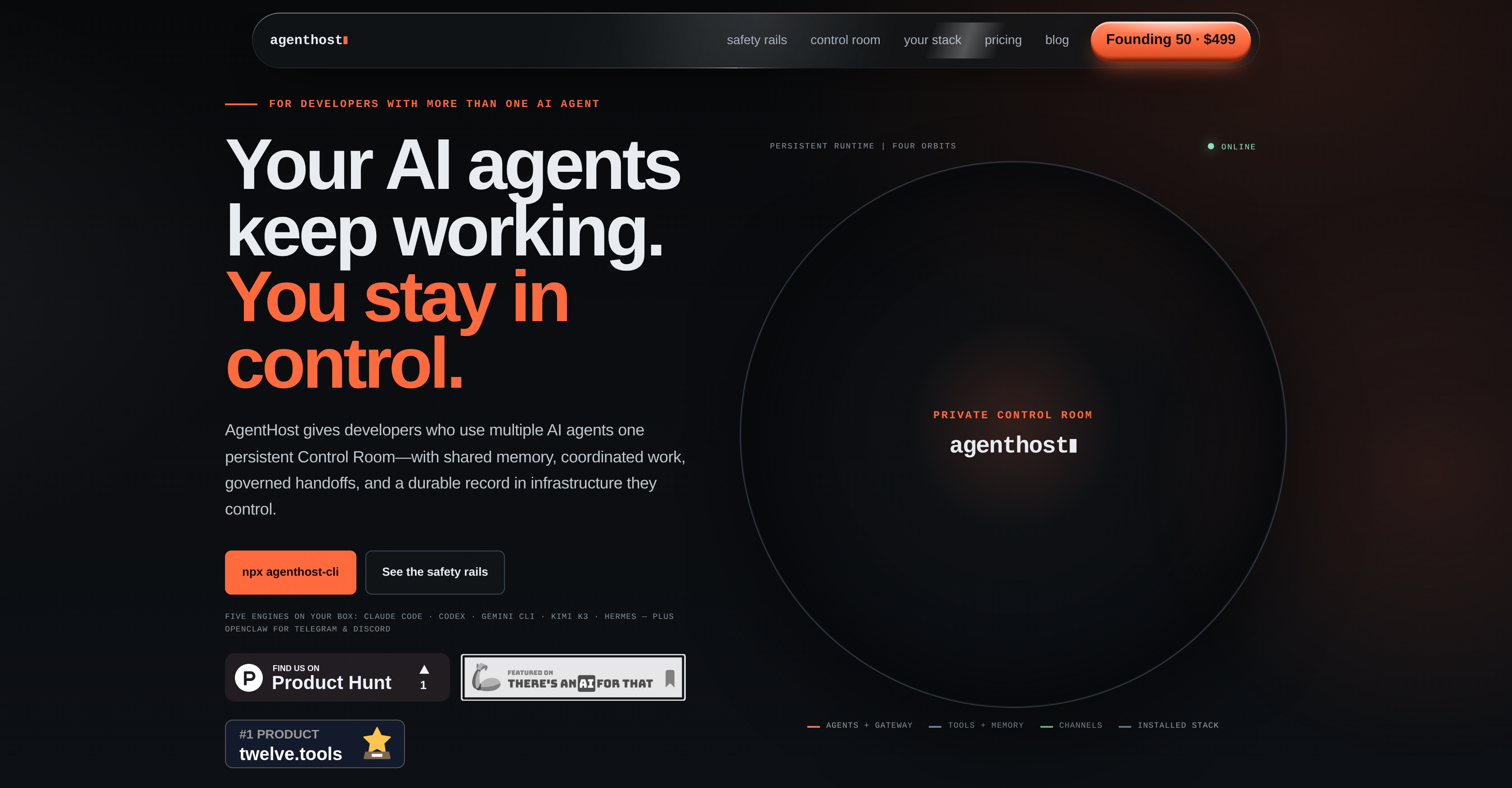
- Keep your AI agents running 24/7 without your laptop — deploy Claude Code, Codex, Gemini CLI, Hermes, or Ollama to an always-on box in your own cloud account with a single `npx agenthost-cli` command
- Monitor and steer every engine from your phone — access a control room with real-time status, a shared task board, and per-engine cost tracking without needing to be at your desk
- Prevent costly mistakes without reading code — use a governance gate that human-approves irreversible actions like deploys, spending, sends, and deletes before they execute
- Maintain full ownership of your data and agents — credentials stay encrypted in your cloud provider's store with no third-party backend, and `agenthost destroy` removes everything on demand
- Switch AI models without losing agent memory — memory, tools, and work state persist on infrastructure you own, so agents retain context across Claude Code, Codex, or Gemini CLI
- Ensure every action is traceable — detailed audit logs of all operations provide transparency and control over every AI decision and handoff
- Keep agents working while you're away — agents continue operating autonomously with shared memory and coordinated handoffs, retaining user control through approval gates and budget limits
Pros & Cons
Pros
- Persistent control room
- Shared memory feature
- Coordinated work facilitation
- Handoffs governance
- Durable recordkeeping
- Four agent interfaces
- Messaging gateway included
- Safety rails for security
- Work state persistence
- Gateway to tools access
- Memory channels availability
- Autonomous work system
- Chat workflows capability
- Messaging gateways integration
- Budget control access
- Approval and audit features
- Cross-engine review capability
- Human approval gates
- Detailed audit logs
- Operational transparency
- Persistent runtime
- Keep agent memory/tools/work-state
- Agents continue to work
- Claude Code and Codex integration
- Hermes Agent and Gemini CLI integration
- Telegram and Discord gateway: OpenClaw
- Delivers agent's identity intact
- Control Room allows workspace governance
- Spend caps per work chain
- Eligible work restrictions
- Scheduled agents feature
- 24/7 work without the need of monitoring
- Push notifications for work completion
- Governance by default, visibility of stop control
- Upload/download files to/from chat
- Supported tasks gain budgets, review, and durable record
- Files download feature
- Optional desktop bridge
- Migrates with existing skills, memory, MCP servers, plugins, and project state
- Caps per work chain
- All operations auditable
- Discrete access to each box secret
- Notification feature for 'Task Completion'
- Efficient work review system
- Production audit logs are public
- Governance system for code bugs
- All chat and loops are auditable
Cons
- Not beginner-friendly
- Limited agent interfaces
- Single messaging gateway
- Complex setup procedures
- Management overhead for users
- Only four agent interfaces
- Audit logs could overwhelm
- Complexity due to multiple features
- Potential security issues
- Persistent state could affect performance
Reviews
Rate this tool
Loading reviews...
❓ Frequently Asked Questions
AgentHost is a tool designed for developers managing multiple AI agents. It functions as a persistent control room where users can handle and manage all their agents. It offers shared memory, coordinated work, governed handoffs, and maintains a reliable and durable record in an infrastructure directly controlled by the developers.
AgentHost assists in managing multiple AI agents by providing a shared memory system and facilitating coordinated work across them. It governs handoffs between different agents while maintaining a durable and reliable record in an infrastructure that developers directly control. Its Control Room allows the persistence of the AI agents' memory, tools, and work state across sessions.
The four agent interfaces in AgentHost are Claude Code, Codex, Hermes Agent, and Gemini CLI.
OpenClaw, in AgentHost, functions as a messaging gateway. It supports chat workflows along with a robust agent-based system for autonomous work. It forms part of the robust command and control infrastructure for AI agents in AgentHost.
'Safety rails' in the context of AgentHost refers to security layers added to AI operations. They provide extra safety measures to prevent mishaps and ensure secure operations.
The Control Room in AgentHost maintains persistence across sessions by continually storing the AI agents' memory, tools, and work state. This consistent state allows the operations to last beyond short-term sessions and offers continuity for various functions over the long term.
AgentHost maintains detailed audit logs of all actions. These logs provide traceability for all operations, thereby ensuring transparency and control over AI operations.
Cross-engine review in AgentHost is a mechanism where major actions such as deploy, delete, send, and credentials are reviewed across different engines or systems. This capability is important for quality control and validation of major AI operations.
Yes, AgentHost accommodates human approval gates for actions like deploy or delete. This serves as an additional layer of control and security, ensuring that significant actions have human approval before proceeding.
AgentHost has security features like 'safety rails' that add security layers to your AI operations. It also maintains comprehensive audit logs of all actions, adding transparency and control over the operations.
AgentHost can help control budgets in AI operations by providing users with access to budgets that they can control. This means users can set and adjust the amount of resources allocated to their AI operations.
AgentHost facilitates shared memory and coordinated work by allowing multiple AI agents to tap into a common memory space and coordinate tasks efficiently. This mechanism ensures that AI performs tasks in a harmonious and systematized manner.
AgentHost handles autonomous work and chat workflows through its robust agent-based system. This system allows autonomous task completion and efficient communication via chat channels.
Yes, AgentHost can be integrated with tools such as Claude Code, Codex, Hermes Agent, and Gemini CLI. These tools form part of the agent interfaces provided by the platform.
The infrastructure controlled by developers in AgentHost comprises a shared memory system, coordination mechanisms for work and handoffs, and a system that maintains a durable, reliable record of all actions and decisions. It also includes various agent interfaces and a messaging gateway.
Yes, despite continuing operations even in the absence of the user, AgentHost still retains user control. It provides mechanisms for approvals, budget control, and audit trails that ensure the users remain in charge.
AgentHost assists in maintaining transparency over AI operations by keeping detailed audit logs of all actions taking place. This ensures that a clear record exists for review, enhancing transparency and operational understanding.
AgentHost supports handoffs and maintains a reliable record in infrastructure by providing coordinated work and governing handoffs among the AI agents. This ensures that tasks are properly transferred between agents, and every action and decision is accurately recorded and saved.
AgentHost ensures long-term durability in operations by maintaining a reliable record in the infrastructure controlled by the developers and providing shared memory and coordinated work. It operates persistently, such that interruptions in any given session do not halt or negatively impact overall operations.
AgentHost facilitates messaging gateway functions using its OpenClaw messaging gateway. This gateway is a part of a robust agent-based system that supports both autonomous work and chat workflows.
Pricing
Pricing model
Freemium
Paid options from
Free tier available
Billing frequency
Monthly
Refund policy
No Refunds