

AI Visibility Monitor by Work-Smart.ai
Overview
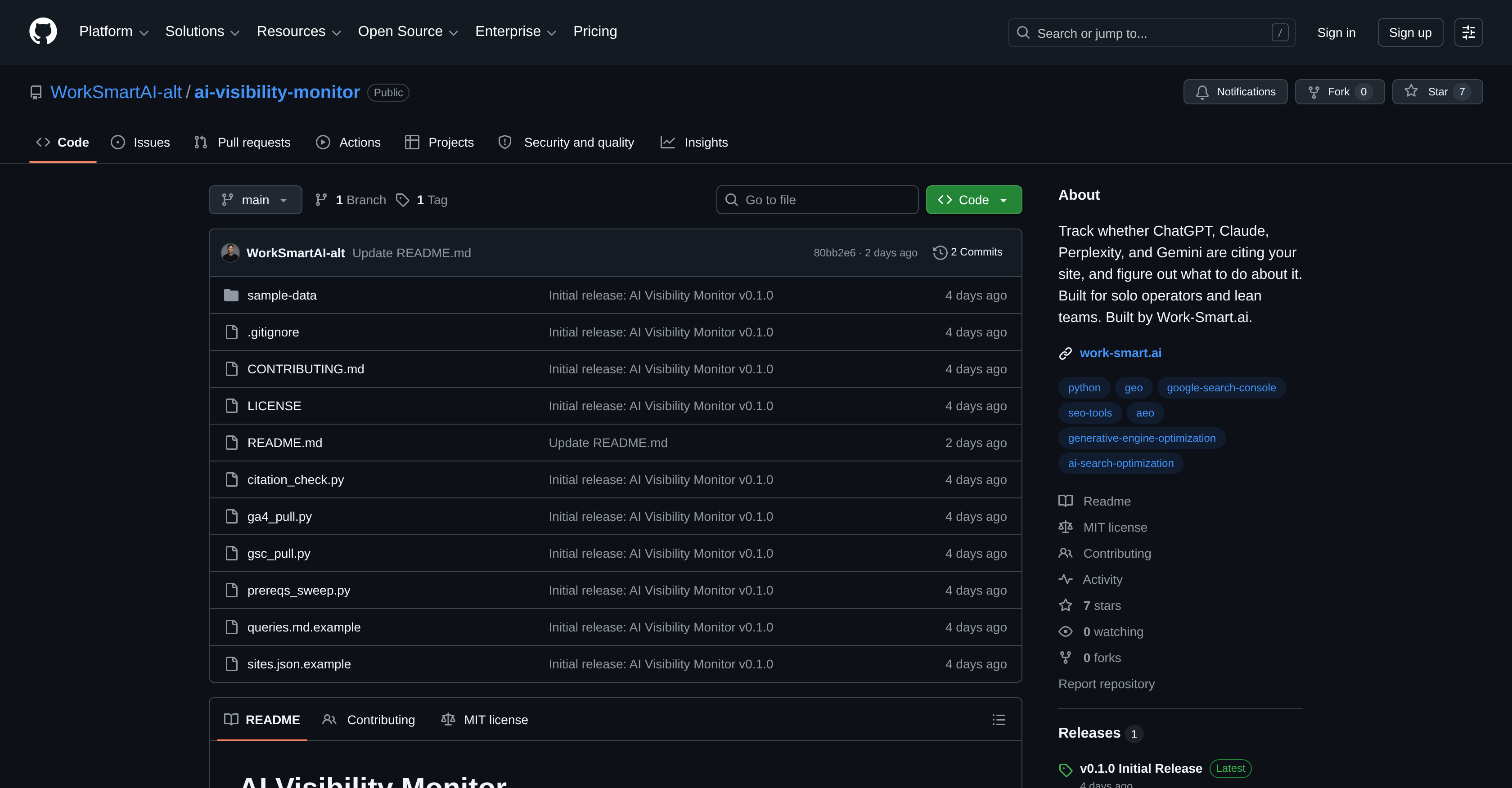
- Know exactly when ChatGPT, Claude, Perplexity, and Gemini cite your site at critical buyer decision moments — by running citation_check.py on your own credentials.
- Decide your next SEO move with weekly or monthly data on AI bot permissions, robots.txt, and llms.txt — extracted directly from your local Python scripts.
- Uncover hidden traffic opportunities by merging Google Search Console and Google Analytics 4 data into one JSON output — no dashboard subscriptions needed.
- Protect your site’s data privacy completely — all analysis runs on your local device, with no data shared to third-party servers.
- Scale your AI SEO efforts without enterprise contracts — configure domains and queries in a simple sites.json file, perfect for solo operators and lean teams.
- Integrate AI citation insights into your existing reports or dashboards instantly — the JSON output feeds directly into your current workflow.
Pros & Cons
Pros
- Open source tool
- Citation tracking
- Analysis of robot.txt
- Analyzes llms.txt
- Analyzes sitemap.xml
- Extract data from Google Search Console
- Pulls Google Analytics 4 data
- Local operation
- Supports decision-making
- Integration with dashboards via JSON
- Built for solo operators
- Supports lean consulting practices
- No enterprise contract requirement
- No SaaS requirement
- Python scripts for data generation
- Custom domain configuration
- Guidance for data interpretation
- Actionable insights
- Data privacy
- User-controlled operation frequency
- GitHub repository cloning
- Specific Python dependencies handling
Cons
- Requires Python script knowledge
- Needs manual installation and configuration
- Runs locally, no cloud support
- No built-in dashboards
- Requires user credentials for run
- JSON output only
- No support for service dashboard subscriptions
- Page performance check not included
- Limited data scope (primarily visibility)
Reviews
Rate this tool
Loading reviews...
❓ Frequently Asked Questions
AI Visibility Monitor is an open-source tool developed by Work-Smart.ai. It's designed to track and analyze AI search engine citations of a user's website, helping to understand their visibility on AI platforms and support decision-making processes for enhancing online presence.
AI Visibility Monitor works by running locally on the user's device and using Python scripts to generate data about website visibility and user engagement. It analyzes the website's robots.txt, llms.txt, sitemap.xml, and AI bot permissions, extracts data from Google Search Console and Google Analytics 4, evaluates whether specific domains are cited in AI-enabled web searches, and integrates the output data into existing dashboards or reports.
To set up AI Visibility Monitor, you start by cloning the repository from GitHub. Next, install specific Python dependencies related to the information needed and configure the tool for your domains and queries of interest. It's built for both solo operators and lean consulting practices.
No, the AI Visibility Monitor does not require a dashboard service subscription. It is designed to run on the user's local device.
The AI Visibility Monitor provides information on site crawlers and bot permissions, as well as data extracted from Google Search Console and Google Analytics 4. It specifically evaluates whether specific domains are cited in AI-enabled web searches, offering visibility data to users.
Data privacy with the AI Visibility Monitor is ensured by running the tool locally on the user's own device which avoids the sharing or transmission of data. It allows the user to maintain full control over the frequency of tool operations and the data generated.
The key features of the AI Visibility Monitor include analyzing robots.txt, llms.txt, sitemap.xml, and AI bot permissions, extracting data from Google Search Console and Google Analytics 4, evaluating domain citations in AI-enabled web searches, and outputting data in JSON format. It is designed to integrate with existing dashboards or reports.
Python is used in the AI Visibility Monitor as the programming language for scripts that run the tool's operations. These Python scripts are leveraged to generate visibility data and user engagement data.
Yes, the AI Visibility Monitor can be integrated into existing dashboards or reports. It offers output data in a JSON format, which can be easily used for creating or updating custom reports or dashboards.
The AI Visibility Monitor outputs data in a JSON format. This output includes information about website visibility, user engagement, crawler and bot permissions, and domain citations in AI-enabled web searches.
AI Visibility Monitor checks site visibility on AI platforms by leveraging Python scripts that analyze robots.txt, llms.txt, sitemap.xml, and AI bot permissions, extract data from Google Search Console and Google Analytics 4, and evaluate whether specific domains are being cited in AI web searches.
Yes, AI Visibility Monitor works with specific AI search engines like ChatGPT, Claude, Perplexity, and Gemini to track and analyze the citations of a user's website.
Yes, AI Visibility Monitor is built with considerations for solo operators and lean consulting practices. It is designed to be a tool that is affordable and provides what they need without requiring complex infrastructure or overhead.
Yes, initial setup of the AI Visibility Monitor requires installing specific Python dependencies that are relevant to the information needed for analysis in the tool.
You can configure AI Visibility Monitor for your domains during the initial setup process. After copying the example sites.json file to your own sites.json, you edit it to add your specific domains.
No, the AI Visibility Monitor does not need an enterprise contract. It's designed to offer visibility data to users without the need for a complex enterprise agreement.
AI Visibility Monitor helps in decision-making processes by tracking and analyzing the citations of a user's website by AI search engines. The insights gained from this data can be used to understand the website's visibility on AI platforms and develop strategies to enhance their online presence.
Yes, AI Visibility Monitor is capable of analyzing data from Google Analytics 4. It integrates this data into its analysis to provide deeper insights into website visibility and user engagement.
AI Visibility Monitor enhances your online presence by helping you understand your visibility on AI platforms. By tracking AI citations of your site and evaluating your visibility data, you can identify areas for improvement, make informed decisions, and implement strategies to improve your online presence.
AI Visibility Monitor helps with tracking AI citations of your site by using Python scripts that analyze data from various sources, including AI search engines such as ChatGPT, Claude, Perplexity, and Gemini. This data can be used to understand whether your site is being cited by these engines during AI-enabled web searches.
AI Visibility Monitor by Work-Smart.ai is an open-source tool created to specifically gauge and analyse the references made to a user's website by AI search engines such as ChatGPT, Claude, Perplexity, and Gemini. The underlying purpose is twofold - to log the mentions made by these AI engines of your website and to provide guidance on the interpretation of this data, thereby enabling robust action plans. It is designed to function locally on your device, leveraging Python scripts to generate data regarding site visibility and user engagement.
The AI Visibility Monitor tracks and analyzes citations from several major AI search engines, including ChatGPT, Claude, Perplexity, and Gemini.
Yes, the AI Visibility Monitor can analyse key website components such as robots.txt, llms.txt, sitemap.xml, and AI bot permissions for your site.
Yes, the AI Visibility Monitor can extract crucial data from Google Search Console and Google Analytics 4.
Yes, AI Visibility Monitor's output data is in the JSON format, thereby allowing seamless integration into your existing dashboards or reports.
The AI Visibility Monitor provides detailed visibility data in its output. This includes the analysis of your website's robots.txt, llms.txt, sitemap.xml, AI bot permissions, data from the Google Search Console and Google Analytics 4, and the assessment of whether specific domains are mentioned during AI-enabled web searches.
Initial setting up of the AI Visibility Monitor involves a three-step process. First, clone the repository from GitHub. Then, install the Python dependencies relative to your specific information requirements. Finally, configure the tool to match your domains, and the specific queries you want tracked.
No, AI Visibility Monitor does not necessitate a dashboard service subscription. The tool runs on your local device, allowing you full control over the data and the frequency of the operations.
The frequency of operating the AI Visibility Monitor depends on the specific Python scripts used. While some scripts are recommended to run on a monthly basis for meaningful citation comparisons, others are more effectively run on a weekly basis in response to the dynamic nature of search and traffic data.
Yes, the AI Visibility Monitor has the capability to evaluate if specific domains are mentioned during AI-enabled web searches.
Indeed, AI Visibility Monitor is constructed with a keen eye for solo operators and lean consulting practices. It is designed to provide essential visibility data without necessitating agreements on enterprise contracts.
Undoubtedly, the AI Visibility Monitor is designed to operate locally on your device. This ensures enhanced data privacy and allows you complete control over the operations' frequency.
Yes, through rigorous tracking and analysis of how your website is cited across AI platforms, the AI Visibility Monitor provides crucial guidance on how to respond to this data and bolster your online presence on these platforms.
The AI Visibility Monitor supports your decision-making processes by providing crucial visibility data and actionable insights. This allows you to comprehend your website's visibility on significant AI platforms and make informed judgments to improve it.
AI Visibility Monitor exploits Python scripts to process and generate crucial visibility data. The tool runs four separate scripts either on a weekly or monthly basis, each dealing with a distinctive aspect of your website's visibility and the references made to your site by AI search engines.
The AI Visibility Monitor requires specific Python dependencies to function. This constitutes python packages such as anthropic for the 'citation_check.py' script, and google-api-python-client and google-auth for 'gsc_pull.py' and google-analytics-data for 'ga4_pull.py'.
To configure the AI Visibility Monitor, one needs to provide information on their domains and specifically, the queries of interest that need to be tracked.
Yes, AI Visibility Monitor equips all users with crucial visibility data without the requirement of an enterprise contract.
AI Visibility Monitor efficiently tracks citations of a user's website by AI search engines through a robust Python script, citation_check.py, which regularly records and flags whether a user's domain appears during AI-enabled web searches.
Pricing
Pricing model
Free
Paid options from
Free