
Overview
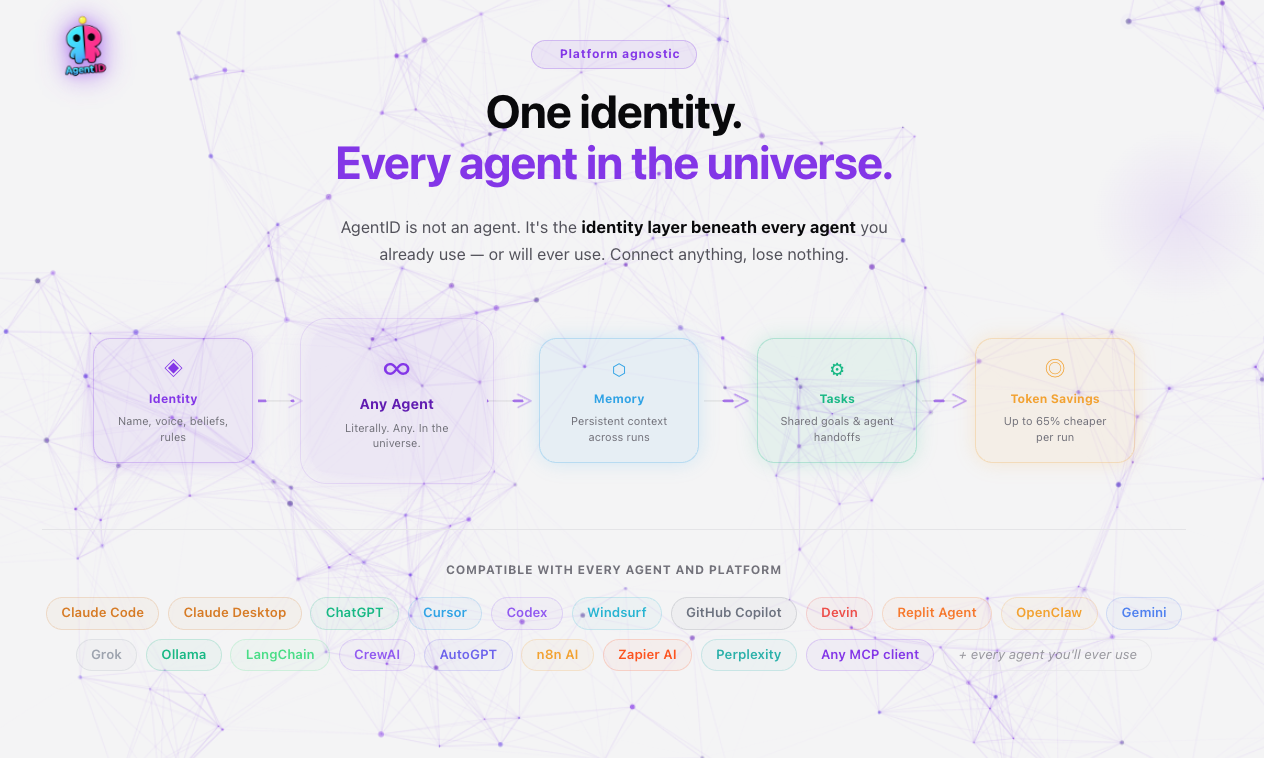
- Eliminate repetitive setup and ensure every AI agent speaks with the same voice and rules using a single, inherited identity file that prevents configuration drift.
- Slash token overhead by up to 65% with automated system prompt compression in Caveman Mode, requiring no manual prompt engineering.
- Turn isolated AI tools into a collaborative team where anything one agent learns is instantly available to all others through a persistent, shared memory pool.
- Monitor and orchestrate all connected agents in real-time from a unified command center, tracking changes, managing tasks, and auditing activity across every platform.
- Integrate seamlessly without rewriting your stack, connecting via MCP, SDK, or API to maintain your existing workflows across Claude, Cursor, Codex, and other agents.
Pros & Cons
Pros
- Cross-session memory persistence
- Single handle for various agents
- Shared memory for all agents
- Real-time dashboard
- Changes tracking
- Shared goals establishment
- Configuration drift prevention
- Multi-agent mission creation
- Task handoff support
- Multi-platform compatibility
- No need for lock-in
- No need for rewrites
- JavaScript/TypeScript SDK
- Free to start
- Real-time status updates
- Supports Claude, Cursor, Codex, OpenClaw
- Consistent agent attributes
- Efficient information duplication prevention
- Supports real-time memory updates
- Allows for agent monitoring
- Monitors agents' operations
- Automated system prompt compression
- Shared intelligence
- Caveman
- Live Memory Graph
- Visual 3D Identity Card
- Shared identity for builder SDK
- Real-time logging of events
- Single Command Center
- System prompt compression
- Multi-Agent Missions
- Live mission status updates
- Structured handoffs for tasks
- HTTP API for SDK agents
- Shared goal and context
Cons
- Token savings can make old workflows feel wasteful
- No support for non-JavaScript/TypeScript
- Managing one agent is hard to go back to after running a full team
- You may start treating agents like coworkers
- Friends may ask why your AI agents seem more organized than they are
Reviews
Rate this tool
Loading reviews...
❓ Frequently Asked Questions
AgentID is a tool that gives a persistent and portable identity to AI agents across various platforms. It enhances the coordination of these agents, allowing them to function more effectively as a team. Key features of AgentID include persistent personality and voice, enduring memory, a single @handle for connecting agents, shared memory, and support for individual and multi-agent users.
AgentID enhances teamwork among AI agents by offering a shared memory feature. This means that anything written by one agent can be read by all others, improving interoperability. It also allows for structured task handoffs between agents and supports real-time status updates keeping everyone informed. Moreover, multi-agent missions can be created in AgentID, enabling a shared context and goal amongst agents.
The purpose of the persistent personality feature in AgentID is to provide continuity in AI interaction irrespective of reboots or tool switches. AgentID maintains the same 'personality' and 'voice' for each AI agent across sessions, thereby producing a consistent user experience.
Yes, updates in AgentID memory are made in real-time. This feature allows users to monitor the agents' operations and update the memory instantaneously. It aids in efficient auditing and quick identification of changes.
The @handle in the AgentID tool serves as a unique identifier for AI agents, similar to a username or ID. It allows users to connect various agents under a single identifier, providing a consistent identity to the AI agents irrespective of the platforms they function on.
The shared memory feature of AgentID points to a global repository of data that all connected AI agents can access and contribute to. Write operations by one AI agent can be read by all others, fostering enhanced interoperability and shared wisdom across the AI team, helping to reduce information duplication and ensuring all agents work with up-to-date data.
Yes, AgentID integrations with other AI tools like Claude, Cursor, Codex, and OpenClaw among others are supported. This renders it particularly advantageous for individual AI users as they can use multiple tools while maintaining consistent AI functionality.
On AgentID's live dashboard, users can monitor agents' operations, manage memory updates in real-time, establish shared goals, and efficiently audit alterations. They can also track which AI agent made particular changes and if necessary, revert those changes.
AgentID's shared memory reserve prevents information duplication by offering a single memory space that all AI agents can read from and write to. This means if one agent learns something new and writes this information to the shared memory, other agents can access and learn the same without having to perform the same operations, thus eliminating duplication.
In AgentID, multi-agent missions refer to collective endeavors where agents share a common context and goal. Each multi-agent mission allows for structured task handoffs between agents and supports real-time status updates to keep everyone informed of the work progression.
AgentID does not require any rewrites or lock-ins. It respects existing AI stacks which means it doesn't require users to modify their present AI configurations or commit to a particular technology setup to incorporate AgentID functionality.
Yes, AgentID can effectively manage multiple AI agents. Every connected agent is assigned a unique @handle under which its operations can be tracked, and its memory persists. It can coordinate the working of these agents, allow them to share memory, and conduct multi-agent tasks, thereby enhancing efficiency and interoperability.
'AgentID respects existing AI stacks' means that integrating AgentID into a user's setup does not enforce any rewrites or modifications of their existing implementations. It can seamlessly interoperate in the current technological setup of the user, thus preserving their existing AI capabilities.
Users monitor agents' operations using AgentID via a live dashboard. This dashboard shows real-time status updates of each agent activity. It allows users to track which agent makes changes, revert the changes if necessary, and update memory instantaneously. It's a one-stop tool for overseeing the various operations of AI agents.
The task handoffs feature in AgentID implies the structured transfer of tasks between AI agents. This feature enables one agent to hand off tasks to another upon completion, ensuring seamless continuation of work. It's particularly useful for large operations that require multi-agent collaboration.
Yes, AgentID does provide real-time status updates of AI agents. This is a core feature of its offering, and it keeps all interested parties informed about the current operation status and developments in a timely manner.
The concept behind AgentID providing AI agents with a permanent identity revolves around achieving persistent and consistent performance of the AI. Regardless of the session, the platform, or the specific tool the agent is working on, the permanent identity ensures enduring memory, personality and voice, aiding in better integration and user experience.
Yes, AgentID can track which agent makes changes to the shared memory. This functionality is particularly valuable for auditing purposes and provides transparency about memory modifications to the operational team.
AgentID bolsters AI coordination and AI identity management by granting each AI agent a persistent identity across different platforms. This allows the AI agents to function as a unified team. The shared memory feature augments coordination by letting an agent's learning be accessible to all, and the individual @handle allows easy tracking and management of each agent's operations.
Yes, AgentID is compatible with different platforms. It serves as a portable identity layer for AI agents and can be used to monitor every agent across every platform from a single interface.
AgentID is a unique tool designed to assign a persistent, portable identity to AI agents across various platforms. It fundamentally enhances the coordination between AI agents, transforming them into a collaborative team rather than isolated entities. AgentID aims to ensure that these agents function more effectively by remembering past sessions, retaining their unique voice and personality, and maintaining a shared memory reserve.
AgentID presents multiple key features. It assigns each AI agent a persistent identity, including a consistent personality and voice that remains unchanged across sessions, even through reboots and tool switches. It has a single @handle to connect different agents and supports shared memory where one agent's knowledge can be accessed by all others. AgentID offers a real-time dashboard to monitor agent activities and manage shared goals seamlessly while also facilitating efficient auditing of changes made. It allows users to track which agent has made changes and revert if needed.
The persistent personality and voice feature of AgentID work through a single identity definition. The identity, including personality and voice, is defined once and is inherited by each connected agent. This keeps the agent's voice and personality consistent across sessions, tools, and platforms.
Yes, AgentID can work with the AI tools you are currently using. It is designed for compatibility with a broad range of AI tools and services - including Claude, Cursor, Codex, OpenClaw, and others, without requiring any lock-in or rewrites in your existing technology stack.
AgentID's live dashboard allows users to actively monitor and manage the operations of their AI agents. Users can see real-time updates of each agent's status and activity. The dashboard also enables live updates to shared memory, as well as efficient auditing of alterations made. It allows users to track changes made by different agents and revert them if necessary.
The single @handle in AgentID provides a pitstop for connection between different agents. It's a unique identifier, which aids in easy and quick identification of agents, enabling them to work effectively as a team by facilitating interaction and collaboration.
AgentID prevents information duplication through shared memory. When an agent learns something, it's written to the shared memory pool, which is accessible by all other connected agents. Hence, the information learned by one agent is shared among all, reducing repetitive learning and avoiding information duplication.
The shared memory reserve feature in AgentID is designed to facilitate collective learning and enhance agent interactivity. It functions as a store where an agent's acquired knowledge is deposited and shared - what one agent learns, all remember. It enables persistent context across tools, sessions, and time, significantly advancing the knowledge and capabilities of the AI agents.
Respecting existing AI stacks means AgentID doesn't interfere or require modifications with your pre-existing AI setup. It seamlessly integrates with the technology you are currently using, so there is no need for lock-in or rewrites.
Yes, AgentID can be integrated with any AI tool or platform. It has been designed for universal agent compatibility, implying it works with any agent you use, including but not limited to Claude, Cursor, Codex, OpenClaw, and Nanobot.
The multi-agent missions feature in AgentID allows agents sharing an identity to declare a shared goal, report their status, and pass tasks to each other in real-time across different tools and machines. It enables collective work on a task, facilitating shared context and goals among AI agents.
Real-time status updates in AgentID keep all interested parties informed about the operation of different AI agents. These updates cover tasks handed to agents, their progress, tasks completed, and tasks handed off to other agents, ensuring everyone involved has up-to-the-minute status information.
AgentID simplifies AI configuration by defining your identity once and letting any number of agents connect to it. It means each agent inherits the same voice, the same memory, and the same handle, straight from your identity file. This results in zero configuration drift.
The SDK for building agents with AgentID supports TypeScript and JavaScript languages. Developers can build their own agents using these languages.
Caveman Mode in AgentID is a feature designed to cut token costs up to 65%. Once enabled, AgentID automatically compresses your system prompt without requiring prompt engineering, effectively reducing the token cost.
Configuration Drift Prevention in AgentID means preventing deviations from established or planned configurations. By inheriting a defined identity, each connected agent has consistent characteristics, effectively preventing configuration drift.
AgentID provides a unified AI identity by having a single identity file. This identity file is automatically inherited by every agent that connects to it. As a result, all the connected agents share the same name, voice, beliefs, and rules which make up their shared identity.
Single command center in AgentID offers a unified platform for users to monitor and manage the activities of their AI agents. By centralizing control in a single-place, it allows users to efficiently track, audit, and update the operations of different agents simultaneously.
Persistent AI identity in AgentID implies that the AI agents maintain consistent features across different platforms and sessions. The identity, including name, tone, rules, and shared memory do not change with tool switches or reboots, hence, ensuring a uniform experience.
Yes, you can start using AgentID for free. It offers a free-to-start plan which gives you basic functionalities and allows you start setting up identities for your AI agents without any financial commitment. You can later upgrade to a paid plan for additional features.
Pricing
Pricing model
Freemium
Paid options from
$7.99/month
Billing frequency
Monthly