
Overview
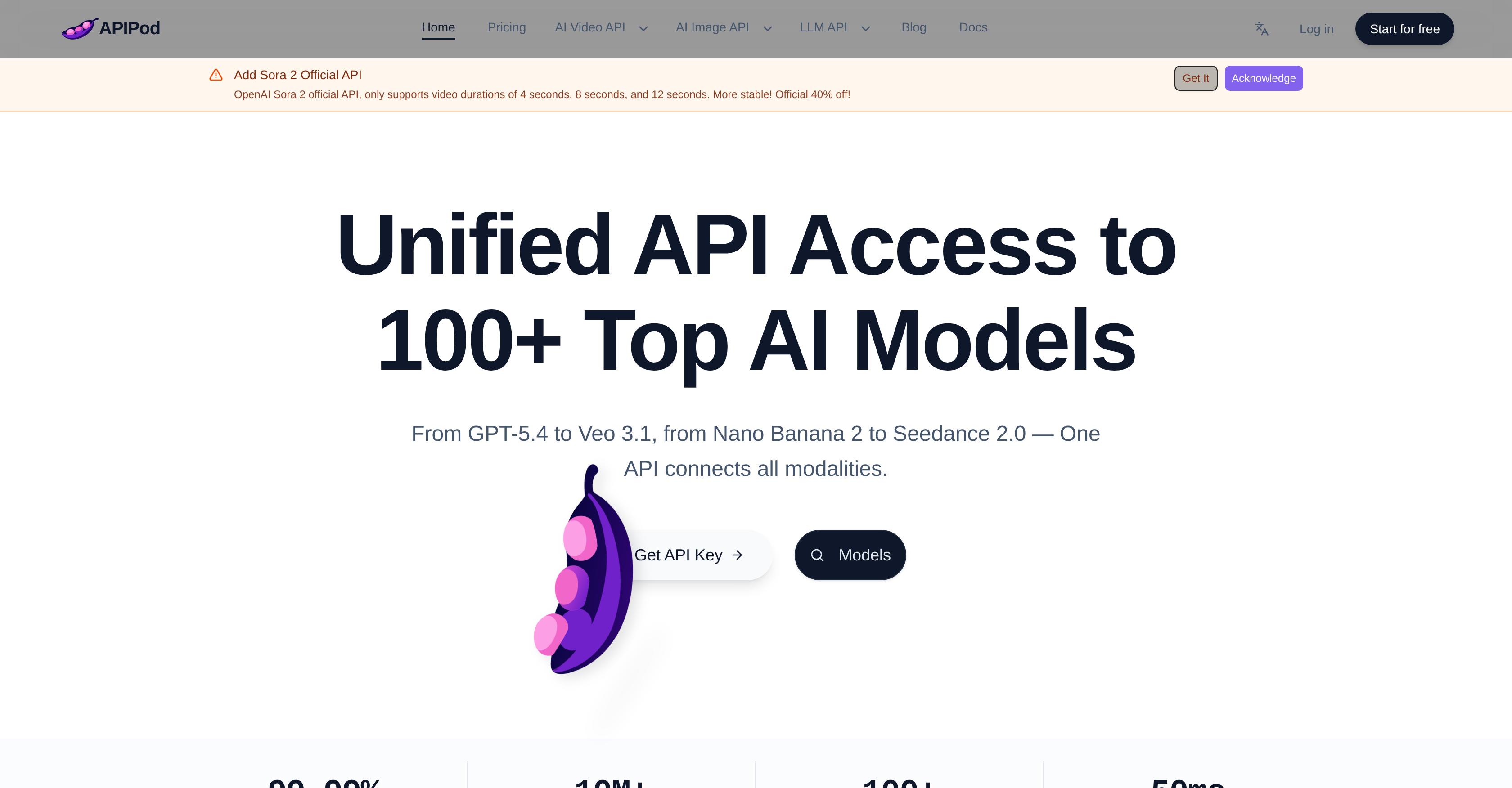
- Build complex multi-modal workflows from chatbots to video apps with unified API access to over 100 top AI models like GPT-5.4, Claude Opus, and Sora 2.
- Scale to handle over 10 million daily requests with enterprise-grade reliability from a 99.99% uptime guarantee and 50ms global latency.
- Integrate in minutes without rewriting code using full OpenAI SDK compatibility, unified error handling, and rich debugging information.
- Prevent cascading failures and ensure business continuity with automatic Circuit Breaker Protection that isolates faults after three consecutive errors.
- Optimize costs and improve stability for each model using intelligent multi-channel routing that automatically selects the best-performing backend.
- Gain full visibility into performance and spending with real-time request logs, token usage stats, and cost analysis dashboards.
- Automate bulk content production for blogs, marketing, and social media by chaining multiple models in a single API call pipeline.
- Create autonomous AI agents that reason and execute tasks by seamlessly connecting different models like GPT-4 and Claude 3.
Pros & Cons
Pros
- Unified API for modalities
- 99.99% Uptime Guarantee
- 10M+ Daily Requests
- 50ms Global Latency
- Ease of multi-channel routing
- Automatic fault tolerance
- Real-Time Request Logs
- Cost Analysis Dashboards
- Intelligent Multi-Channel Routing
- Circuit Breaker Protection
- Observability Platform
- Bulk User Compatibility
- Automated content production
- Unified error handling
- Rich debugging information
- Comprehensive Monitoring Metrics
- Large Scale Use
- Image And Video Generation
- Support for chat, video, image, and music generation
- Handles complex professional tasks
- Real-time health monitoring
- Automatic fault isolation
- Code compatibility
- Multi-modal workflows
- Low global latency
- Automatic channel selection for cost reduction
- Developer-first approach
- Protected circuit breaker
- Image to video capability
- Text to video capability
- Video creation engine
- Multi-modal video model
- Online retrieval function for image generation
- Accurate parsing of complex instructions
- Visual content enhancements
- Real-time network information integration
- Multi-backend channels configuration
- Auto circuit-break after 3 consecutive failures
- Flexible billing
- Supports Free API Key
- Cheaper than Replicate and Fal.ai
Cons
- Complex multi-model workflows
- No available models in categories
- Possibility of cascading failures
- Thirty seconds of downtime
- No given model specifics
- Unclear cost structure
- No support mentioned
- Fault tolerance may fail
Reviews
Rate this tool
Loading reviews...
❓ Frequently Asked Questions
APIPod is an AI-based aggregation platform providing a unified API to access a variety of leading AI models. It supports various tasks including chat, video, image, and music generation activities. APIPod serves as an interface to popular AI models like GPT-5.4, Veo 3.1, Nano Banana 2, Seedance 2.0, Claude Opus 4.6, and more. High flexibility, fault tolerance, and multi-channel intelligent routing abilities make it an ideal platform for building various AI applications including autonomous agents and automated content production tools. It also provides real-time health monitoring, request log analysis, token usage stats, cost analysis dashboard, and various other features for performance and cost optimization.
APIPod provides access to a range of top AI models including, but not limited to, Claude Opus 4.6, GPT-5.4, Grok Imagine, Kling Motion Control, Seedream 5.0 Lite, and Sora 2.
APIPod's Circuit Breaker Protection feature is designed to prevent cascading failures and ensure business continuity. After three consecutive failures, this feature automatically breaks the circuit for 30 seconds.
APIPod supports the development of complex multi-modal workflows. Whether an AI application involves chatbots, creative tools, audio/video apps, or multimedia platforms, APIPod streamlines the process by offering a unified API access to a range of AI models.
The average global latency of APIPod is 50 milliseconds. This low latency ensures rapid response times for queries, enhancing user experience.
The intelligent multi-channel routing feature in APIPod allows for one model to be configured with multiple backend channels. It automatically selects the optimal channel, which can help reduce costs and improve the stability of an AI application.
Yes, APIPod can be seamlessly integrated with OpenAI SDK. There is assurance of code compatibility with OpenAI SDK and there's no need for code changes during the integration process.
APIPod enables automated content production by allowing bulk generation of various content forms such as text, images, and videos using a single API call pipeline. User can use it to generate blog posts, marketing copies, and social media images.
APIPod has the capacity to handle over 10 million daily requests. This high request handling capacity ensures smooth operations even at high loads.
APIPod's observability platform provides real-time request logs, token usage stats, and cost analysis dashboards. These features aid in tracking application usage, identifying optimization opportunities, and managing the costs of AI app deployment.
In APIPod, there is complete assurance of code compatibility, which means users can integrate it with existing codebases without needing to change their code foundations.
In APIPod, cascading failures are prevented through its Circuit Breaker Protection feature. After three consecutive failures, this feature automatically breaks the circuit for 30 seconds hence preventing further failure propagation.
APIPod emphasizes developer excellence by providing a platform fully compatible with OpenAI SDK requiring no code changes for integration. There's unified error handling, rich debugging info, and comprehensive monitoring metrics that help developers to focus more on building products rather than integrating APIs.
APIPod ensures business continuity through its Circuit Breaker Protection feature. After three consecutive failures, this mechanism automatically pauses operations for 30 seconds, preventing cascading failures.
Yes, APIPod supports real-time health monitoring. This functionality is incorporated into its Circuit Breaker Protection feature and it includes automatic fault isolation.
APIPod handles error management and debugging by offering features like unified error handling and rich debugging information. It provides comprehensive monitoring metrics that aid developers in identifying and troubleshooting errors effectively.
APIPod assists AI application development by serving as a unified access point to various AI models. It enables the building of anything from simple chatbots to complex multi-modal workflows. This makes it a suitable foundation for next-generation AI applications.
APIPod can be used for creating autonomous AI agents. Users can chain multiple models to build agents that can reason, code, and execute tasks autonomously.
APIPod can be used to build chatbots of varying complexity. By connecting with top AI models through a unified API, APIPod provides the foundational capabilities needed to design, build and deploy chatbots.
APIPod's latency platform aids in ensuring low latency while handling requests. It helps maintain quick response times, enhancing the overall user experience in real-time AI applications.
APIPod's multi-channel intelligent routing offers a mode where a single model is configured with multiple backend channels. It automatically selects the optimal channel to reduce costs and improve stability. The automatic fault tolerance feature works hand in hand with this, ensuring that the platform keeps functioning correctly even if individual components fail. This combination of features enables APIPod to provide a steady, reliable AI development environment.
APIPod grants unified access to over 100 top AI models, capturing a diverse range of AI functionalities.
APIPod's compatibility with OpenAI SDK is ensured by making it fully compatible with no code changes required. It provides unified error handling and comprehensive monitoring metrics which allow developers to focus more on building products rather than integrating APIs.
APIPod comes with a real-time health monitoring feature that offers automatic fault isolation. It also includes an observability platform that provides real-time request logs, token usage statistics, and cost analysis dashboards. Together, these features support proactive troubleshooting, monitoring of AI model usage, and optimization of application performance and costs.
APIPod's featured AI models include Anthropics Claude Opus 4.6, Open AI's GPT-5.4, xAI's Grok Imagine, ByteDance's Seedream 5.0 Lite, and OpenAIs Sora 2. These models are capable of handling a diverse range of tasks, including text to video, image to video, and language model text functionalities.
APIPod's Circuit Breaker Protection is a safeguard feature that auto-initiates a circuit break for 30 seconds after three consecutive failures. This proactive step serves to prevent cascading failures, ensuring business continuity.
Yes, APIPod is designed to cater to large-scale usage. It can handle capacity for millions of daily requests and offers a 99.99% uptime guarantee, coupled with low global latency.
APIPod offers a 99.99% uptime guarantee. This high level of service availability helps ensure continuous, uninterrupted access to the various AI models, supporting large scale application requirements.
APIPod's observability platform presents real-time request logs, token usage statistics, and cost analysis dashboards. This complete suite of monitoring metrics aids AI application optimization by providing insights into performance and costs. Developers can pinpoint inefficient operations, track token usage, and analyze costs, therefore making more informed decisions and adjustments.
APIPod provides several robust features that offer benefits to developers. It ensures compatibility with OpenAI SDK without requiring any code changes. The unified API access, real-time health monitoring with automatic fault isolation, real-time request logs, and comprehensive monitoring metrics, give developers the evidence-based insights they need. On top of this, APIPod avoids unnecessary complexities, thus allowing developers to concentrate more on product development.
APIPod ensures business continuity in case of cascading failures through its Circuit Breaker Protection feature. The system automatically breaks the circuit for 30 seconds after three consecutive failures, thereby preventing cascading failures from taking down the entire service.
Yes, a broad array of AI applications can be developed using the APIPod platform. These can range from simplistic chatbots to complex multi-modal workflows. You can also leverage the platform to build autonomous AI agents and automated content production tools.
APIPod distinguishes itself from other AI models aggregation platforms by providing more than just an API proxy. It offers a unified API access to over 100 top AI models, incorporates a circuit breaker protection mechanism, provides real-time health monitoring with automatic fault isolation, and features an intelligent multi-channel routing system. It promises high uptime, handles large scale usage, and supports deep observability, all while remaining fully compatible with OpenAI SDK without any need for code adjustments.
APIPod offers a low global latency of 50ms, allowing for fast, responsive access to its broad AI model portfolio, regardless of user location.
APIPod can be used for automated content production in various ways. By chaining multiple models together, such as GPT-4 and Claude 3, it can generate blog posts, marketing copies, and social media images in bulk using a single API call pipeline.
APIPod allows for integration without changing the code foundations by maintaining full compatibility with the OpenAI SDK. It offers unified error handling and rich debugging information, streamlining the integration process and allowing developers to focus on building products rather than managing integration complexities.
The real-time request logs feature in APIPod helps developers by providing immediate insights into API requests. This assists not only in troubleshooting but also in monitoring usage patterns, optimizing performance, and controlling costs.
APIPod ensures easy integration with the OpenAI SDK by providing full compatibility without the requirement of any code changes. This means developers using the OpenAI SDK can leverage APIPod's offerings directly, without having to adjust their existing codebases.
Top AI models according to APIPod include GPT-5.4, Veo 3.1, Nano Banana 2, Seedance 2.0, Claude Opus 4.6, and more. Users of APIPod can access these models smoothly through the platform's single, unified API.
Pricing
Pricing model
Free Trial
Paid options from
Free Trial
Billing frequency
Pay-as-you-go