

Overview
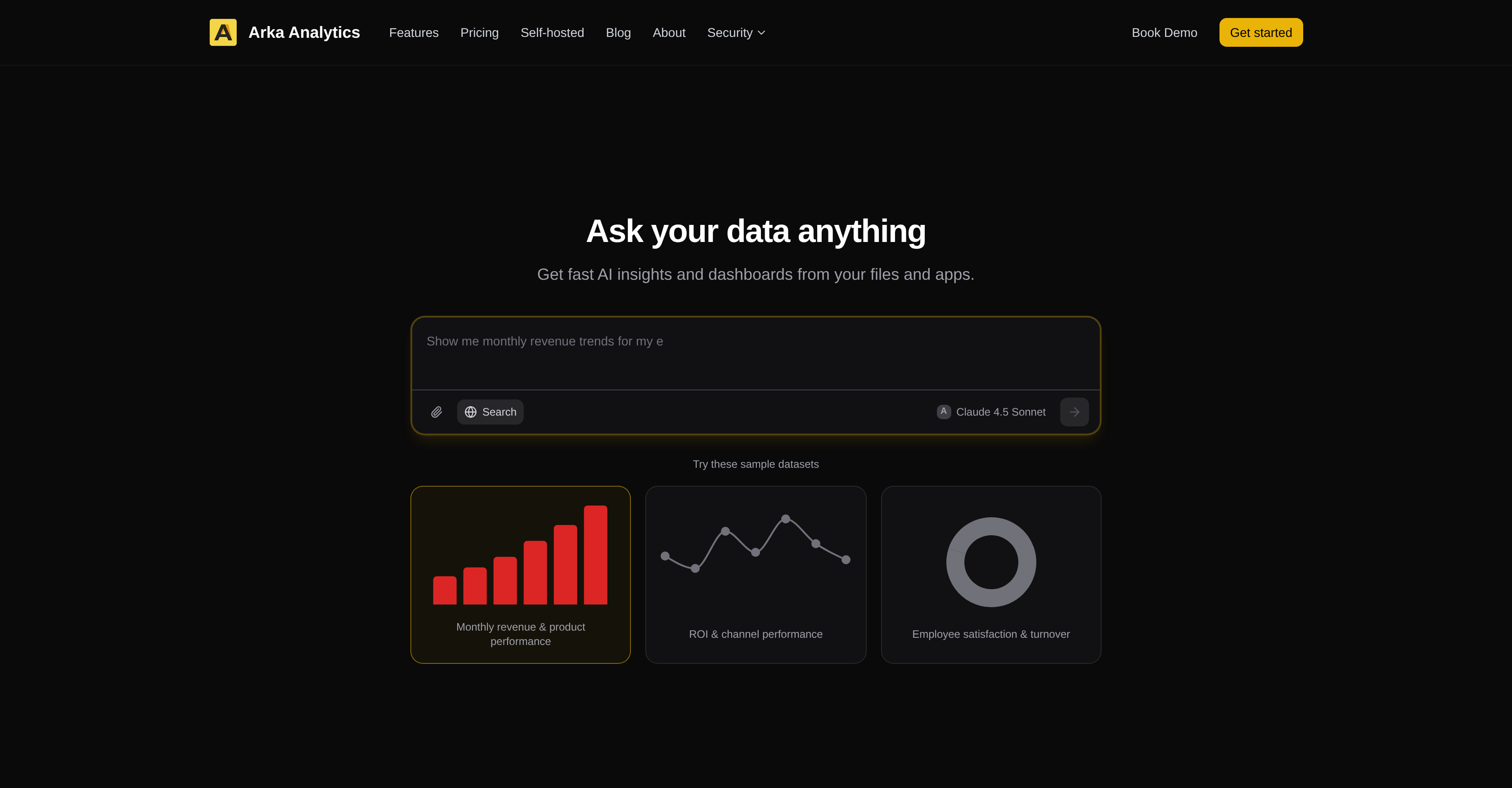
- Get instant, accurate answers from your data without writing SQL or building models by asking questions in natural language.
- Unify product, sales, and customer support data into a single view to break down silos and gain complete business visibility.
- Perform ad-hoc analysis and receive just-in-time insights for sales, customer success, and product teams to make faster decisions.
- Deploy within your own infrastructure with the self-hosted option to meet strict enterprise security and data control requirements.
- Connect seamlessly to your existing stack, including Databricks, Snowflake, Salesforce, and Mixpanel, without disrupting workflows.
Pros & Cons
Pros
- Non-technical friendly
- Natural language processing
- Flexible data agents
- Data unification ability
- Breaks data silos
- Enterprise security options
- Eliminates need for sliders, filters
- Supports multiple integration platforms
- Automatic workflows
- Organisation memory features
- Ad-hoc analysis capability
- Sales analytics
- Customer success insights
- Engineering leadership analytics
- Data leadership analytics
- Self-hosted option
- Business User-Friendly Interface
- CRM Integration
- Support Tools integration
- Product Engineering Analytics
- Data Warehousing support
- BigQuery Integration
- Snowflake Integration
- Databricks Integration
- Redshift Integration
- Mixpanel Integration
- Salesforce Integration
- Zendesk Integration
- MongoDB Integration
- Structured and unstructured data handling
- Elimination of semantic layer
- Natural language answers
- Security Control with Self-Hosted Option
- Instant insights for ad-hoc analysis
- Just-in-time insight delivery
- Unify various sets of data
- Complete data visibility
- Business analytics automation
- Real-time customer health scores
- Feature adoption, user cohorts analysis
- Data from multiple sources unification
- Offers a fundamentally different approach to dashboards
- Business user-friendly interface
- High accuracy of insights
- Complete control with self-hosted option
- 10x lower cost with automatic model selection
- 75% faster insights
- Multiple tools integration for complete insight
Cons
- No filters/dropdowns available
- No sliders available
- NLP may misunderstand queries
- Dependent on integrations
- Requires self-hosting for security
- Non-standard dashboard interface
- Potential lack of detailed insights
- Interface may overwhelm non-technical users
- Only insights, no full predictions
Reviews
Rate this tool
Loading reviews...
❓ Frequently Asked Questions
Arka is an AI-driven analytics tool that is aimed at supporting business teams in their scale-up efforts by offering in-depth insights from a wide range of data sets.
Arka's key features include AI insights, integrated dashboards, flexible data agents and workflows, natural language data queries, business intelligence, cross-functional data unification, data visualization, workflow automation, decision support and more. There's also a self-hosting option for enhanced enterprise security.
Yes, Arka is designed to be used without any need of SQL knowledge or data modeling expertise.
Arka's natural language querying allows users to interact with their data by asking questions in a natural, conversational manner. This intuitive feature simplifies the data analysis process, making it accessible even to non-technical users.
Arka integrates with a multitude of platforms including but not limited to Databricks, Snowflake, BigQuery, Redshift, Mixpanel, PostHog, Amplitude, FullStory, Salesforce, Zendesk, HubSpot, Google, Asana, Jira, Linear, PostgreSQL, MySQL, MongoDB, and DynamoDB.
Yes, Arka offers the option for self-hosting, providing an added layer of security for enterprises.
Arka is capable of unifying a wide variety of data, including data from product, sales, and customer support functions into a comprehensive, singular view.
Arka's AI-native dashboard offers a novel user interface that negates the need for traditional elements like sliders, filters, or dropdowns. It allows users to ask questions of their data in natural language for enhanced user-friendliness.
Indeed, Arka features automated workflows which contribute towards making the process of data analysis much simpler.
Organization memory is a feature in Arka that effectively retains knowledge of past data interactions, paving the way for ongoing learning and improved future interactions.
Arka's unique approach to dashboards is rooted in its AI-native design. Unlike traditional dashboards that rely on sliders, filters, or dropdowns, Arka's dashboard allows users to query their data in natural language format.
Absolutely, Arka is built to suit the needs of different teams within an organization, including sales, customer success, product, and engineering teams.
In Arka, data agents are flexible features that facilitate the selection and categorization of data for analysis.
Arka contributes to an organization's decision-making efficiency by breaking down data silos and unifying multiple data sets to provide a comprehensive view. This aids in drawing precise insights and making informed, accurate decisions quicker.
Business analytics automation in Arka involves the use of AI to automatically generate insights from various data sets, thereby significantly reducing the time and effort required for data analysis.
'Seamlessly' in context means that Arka can be integrated with various platforms such as Databricks, Snowflake, BigQuery, and more in a smooth, effortless manner, without causing disruptions to existing workflows.
Yes, Arka does offer insights on sales, product, and customer support data. It unifies these diverse data sets into one unified view, providing complete visibility and aiding in efficient decision-making.
Yes, one of the salient features of Arka is its ability to enable users to query their data in natural language. This simplifies data interaction and analysis, making it accessible to non-technical users.
Yes, Arka offers a fundamentally different user interface for its dashboard. It is AI-native and eliminates the need for traditional elements such as sliders, filters, and dropdowns, making data exploration much simpler.
Arka breaks down data silos by unifying different types of data, such as product, sales, and customer support data, into a single, comprehensive view. This allows for complete visibility and facilitates smoother data analysis and decision-making processes.
Arka exhibits several key features like AI insights, dashboards, and flexible data agents and workflows. It has a unique interaction interface with the ability for users to ask questions of their data in natural language. Arka supports data unification which brings data from different aspects of business like product, sales, or customer support into a comprehensive single view. Additionally, there's an option for self-hosting for enterprise security needs.
Arka is beneficial for scaling businesses as it integrates and unifies data from various company functions such as product, sales, and customer support. This provides a complete visibility of critical data, which helps in breaking down data silos and speeds up decision-making, allowing businesses to adapt quickly and grow effectively.
Arka's analytics function through the use of AI models. When a user presents a query, Arka autonomously selects the most appropriate AI model based on the complexity of the question. This ensures not only an accurate response but also reduces the workload on your team, allowing you to focus more on strategic decision-making instead of data analysis.
Yes, Arka is designed to be user-friendly even for those without advanced knowledge of SQL or data modeling. Its natural language processing allows users to ask questions in simple, natural language, and it provides analytical insights without the need for SQL queries or data modeling.
Arka provides AI-native dashboards. These dashboards differ from traditional ones by allowing users to interact with them through natural language inquiries, eliminating the need for data handlers to manually manipulate sliders, filters, or dropdowns.
Arka's approach to dashboards is fundamentally different because it eliminates the need for manual adjustments. Users can ask questions directly using natural language and receive insights without the need to adjust sliders, filters, or drop-down menus. This leads to a more intuitive and streamlined user experience.
Yes, Arka offers seamless integration with multiple platforms including Databricks, Salesforce, BigQuery, and many others. This feature ensures that Arka can easily fit into and extend your existing software ecosystem, enhancing your analytical capabilities without disrupting current operations.
Arka's data unification feature amalgamates data from different business functions into a single view. This is advantageous as it offers complete visibility, eliminates data silos, and delivers a comprehensive perspective on company operations and performance, thereby facilitating timely and informed decision-making.
Arka facilitates decision-making efficiency by providing fast AI insights from your data and offering a unified view of data from different areas of your business such as product, sales, and customer support. This unified view provides a comprehensive understanding of the business which aids quicker and more informed decision-making.
One of the security features that Arka offers is a self-hosting option. Enterprises wanting a deeper control over their data environment can self-host Arka, which ensures that the data never leaves their environment, thereby significantly enhancing data security.
Yes, Arka is equally useful for both sales and customer success teams. It provides real-time answers to crucial queries, aids in identifying growth opportunities, tracking customer health scores, and spotting at-risk accounts before they leave, thus making the decision-making process efficient and effective.
Arka's AI-native dashboard enhances the user experience by eliminating sliders, filters, or drop-downs. Users can ask questions in natural language, and Arka, with its AI capability, interprets the questions and provides accurate insights, making the process of exploration and data analytics more intuitive and straightforward.
Yes, Arka is designed to select the most fitting AI model for your queries automatically. This is dependent on the complexity of the questions, and Arka does this to ensure the accuracy of its responses, ultimately leading to an optimized user experience.
Yes, Arka does offer ad-hoc analysis options. Users can perform on-the-fly analysis and gather insights as and when required, which makes Arka effective for dynamic, real-time business analytics.
Arka helps break down data silos in organizations by unifying structured and unstructured data from different sources such as data warehouses, CRMs, support tools, and analytics software into one consistent view. This integrated and holistic view of data facilitates cross-functional alignment and informed decision-making.
Arka's AI insights can provide valuable analytics for sales such as identifying expansion opportunities, tracking customer health scores, and providing real-time updates instantaneously. These insights help the sales team to make informed decisions quickly, thereby enhancing their operational efficiency.
Yes, Arka offers the provisioning for self-hosting. Businesses with specific security needs can deploy Arka in their own infrastructure, which not only augments data security but also allows enterprises entire control over their data environment.
Arka simplifies data analysis by providing AI-powered insights, automatically selecting AI models based on query complexity, and offering a unified view of data from different business aspects. It also eliminates the need for SQL, data modeling, or extra engineering expertise, making it a user-friendly tool that simplifies the oft-complicated process of data analytics.
Arka is considered business-user friendly for several reasons. Firstly because it doesn't require users to have knowledge of SQL or data modeling. Secondly, its AI-native dashboard allows users to ask questions in natural language rather than coded queries. Arka also integrates with popular platforms and provides a unified view of cross-functional data, all while selecting the best AI model automatically depending on the complexity of the queries, thereby making it an accessible tool for non-technically oriented business users.
Pricing
Pricing model
Free Trial
Paid options from
$20/month
Billing frequency
Monthly