
Overview
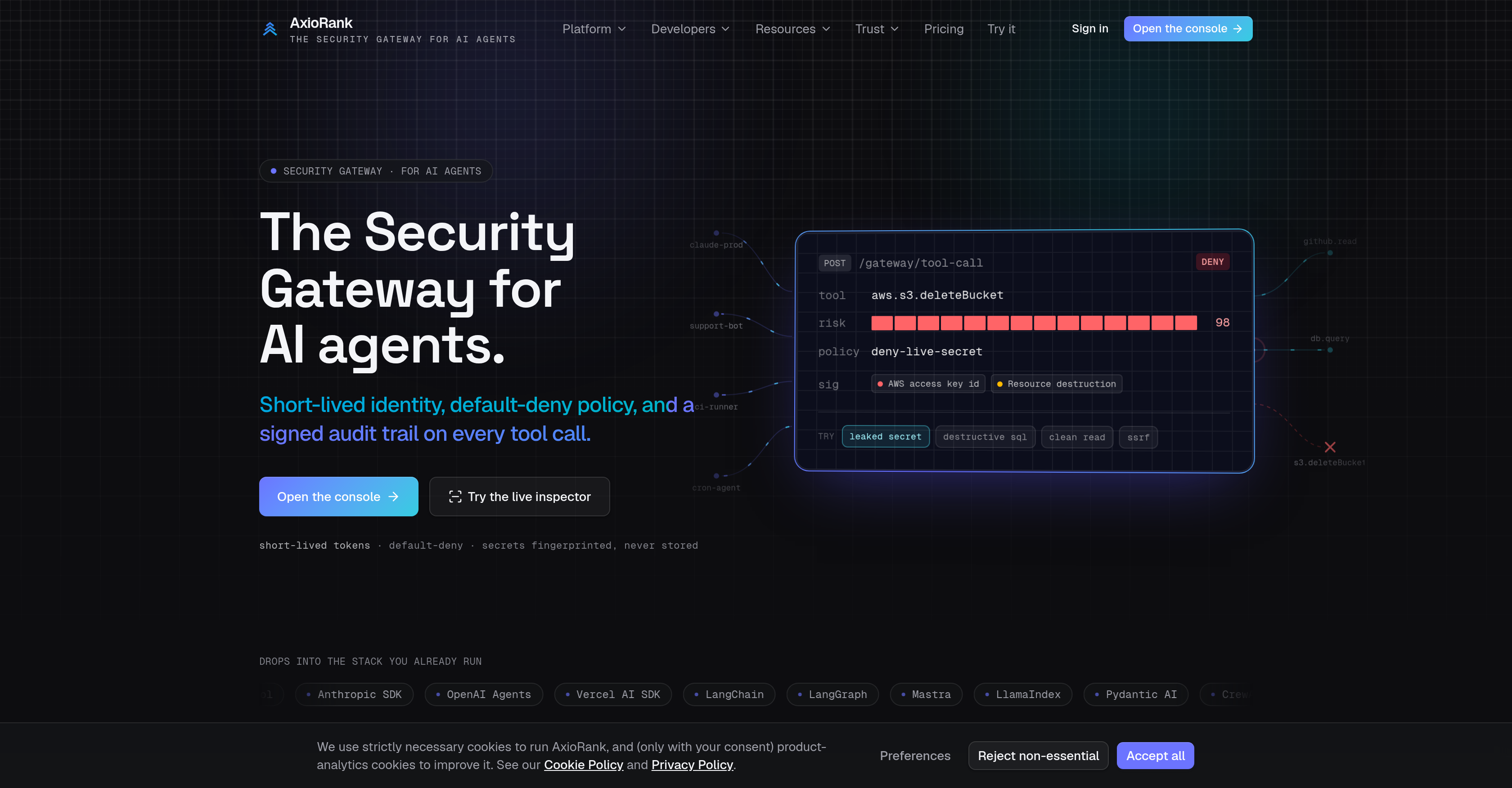
- Prevent unauthorized access to databases and code repositories by giving each agent a short-lived, non-replayable identity that expires automatically
- Stop credential leaks and destructive commands before they execute, using payload detectors that mask and log threats in a redacted audit trail
- Meet compliance requirements with a real-time, redacted audit trail that records every agent interaction without exposing sensitive data
- Enforce zero-trust policies instantly with local identity verification and risk scoring that delivers allow, deny, or hold verdicts in a single hop
- Eliminate database round-trips for identity checks using locally verifiable tokens that cannot be replayed, reducing latency and attack surface
- Scale autonomous AI operations safely by applying deny-overrides policy logic that blocks any action flagged as a security threat
Pros & Cons
Pros
- Real-time audit trail
- Temporary identity issuing
- Risk scoring feature
- Real-time redacted audit recording
- Identity verification
- Multiple security checks
- Rapid operation verdicts
- Deny-overrides policy design
- Payload scanning
- Mask and log issues
- Short-lived identity provision
- Controls agent misuses
- Infrastructure interaction checkpoint
- Temporary identities limit misuse
- Managed access to clouds, databases, and repositories
- Machine credential provision
- Content detectors
- Agent integrity monitoring
- Zero-trust security for agent actions
Cons
- Uses 'Deny overrides' design
- Short-lived identities limit
- Only writes redacted records
- Potential latency from multiple checks
- Limited detectors range
- Conduction of security checks in one hop
- Lack advanced Content inspection
- No obvious scalability options
- Agent rewrite not supported
- No dynamic identities support
Reviews
Rate this tool
Loading reviews...
❓ Frequently Asked Questions
AxioRank serves as a security gateway for AI agents. Its main purpose is to strengthen the security of AI agents as they interact with MCP servers, APIs, and databases. AxioRank provides a checkpoint for every interaction an AI agent makes with the infrastructure. It also generates an audit trail of these interactions. By giving AI agents temporary identities and evaluating your policies, AxioRank plays a key role in risk mitigation and access management.
AxioRank secures AI agents through multiple security checks. First, by providing agents a temporary, short-lived identity, it limits the duration of validity of these identities, making it less vulnerable to misuse. Every tool call directed at AxioRank's gateway triggers multiple security operations in one action: local identity verification, risk scoring, policy evaluation, checking the allow-list, and writing a redacted record. The system scans payloads for potential threats such as embedded live credentials or destructive commands and logs issues within a redacted audit record.
AxioRank manages access for autonomous AI applications by providing a 'short-lived' identity for the agents. This limited validity of these identities helps mitigate risks associated with autonomous interactions. Focusing on regulated interactions, AxioRank evaluates the policies, scores the associated risk, and writes a real-time, redacted audit trail. Every call directed at the gateway triggers several security checks, ensuring secure access to resources for autonomous AI applications.
AxioRank provides a 'short-lived' identity to AI agents as part of its security protocol. This temporary identity is given to the AI agents every time they interact with the user's infrastructure. The duration of validity of these identities is limited, which lowers the potential for misuse. This means that even if the identity credentials were to be acquired maliciously, they would only be valid for a limited time and thus, prevent long-term unauthorized access.
AxioRank performs thorough security checks in one swift operation. Whenever a tool call is directed towards the AxioRank's gateway, the system triggers local identity verification, risk scoring, policy evaluation, checking the allow-list, and the creation of a redacted audit trail. It actively looks for potential threats such as embedded live credentials or destructive commands within payloads and remedies such issues proactively.
The term 'deny-overrides' in AxioRank policy engine refers to its underlying security principle where, if an action is deemed a security threat, it is immediately overridden with a 'deny' action. This essentially means that the policy engine prioritizes secure, regulated interactions by ensuring that any potential risk is instantly blocked or denied, overriding any other operations.
AxioRank scans payloads by employing a range of detectors that identify any potential issues. It scrutinizes the payloads for any traces of embedded live credentials or commands that might lead to destructive action. The payloads are scanned for potential issues such as embedding live credentials or performing destructive commands.
When AxioRank encounters issues in the payloads, it masks and logs these within a redacted audit record. Essentially, any detected irregularities are distorted or obfuscated, and then registered into an audit trail. This method contributes to the safeguarding of sensitive data while maintaining a record of possible security threats and attempted breaches.
'Agent integrity monitoring' in the context of AxioRank refers to their continuous scrutiny of AI agent actions to ensure maximum security. AxioRank uses the principle of zero-trust security for every operation connected to the AI agent, leaving no room for unauthorized or risky actions. The software meticulously oversees the activities of AI agents, keeping a tight check on the legitimacy and integrity of their actions.
AxioRank manages access to cloud environments by implementing a temporary identity verification system for each AI agent. All agent-related interactions with cloud environments are routed through AxioRank's gateway which involves extensive security procedures like risk scoring, policy evaluation and more. The gateway then delivers swift decisions - whether to allow, deny, or hold on the operation.
Yes, AxioRank can interact with code repositories as a part of managing access for autonomous AI applications. AI agents under AxioRank's security framework can hold credentials to interact with varied resources including databases, cloud environments, and code repositories. The interactions directed at these entities trigger AxioRank's multiple security checks ensuring secure and regulated exchanges.
AxioRank provides a comprehensive audit trail for all actions taken by AI agents. This audit trail contains every interaction an agent has with the user's infrastructure. The audit trail is redacted in real time, masking and logging potential issues within a secure audit record. This allows you to trace back any action for auditing purposes and facilitates accountability and control over AI agents' operations.
Zero-trust security in the context of AxioRank essentially means that no AI agent action is trusted by default. Each agent has to trade a static key or a federated identity for a short-lived signed token that verifies locally with no database round-trip and cannot be replayed. This approach ensures that every action or request is verified before being approved, making it credible and efficient in maintaining high-level security standards.
AxioRank verifies the identity of AI agents through a local verification system. Each agent is assigned a temporary identity or 'short-lived' token. These tokens can be locally verified without any database round-trip and cannot be replayed, making them highly secure. The tokens also have a short lifespan, which further limits their possible misuse.
Risk assessment plays a vital role in AxioRank's processes since it helps determine the level of threat associated with each interaction made by the AI agent with the infrastructure. Every interaction is evaluated for its risk level. The identified risk score is used to decide an appropriate course of action - whether to allow, deny, or hold the operation.
'Redacted record' refers to an edited log or record whereby sensitive information has been removed or obscured. AxioRank maintains a redacted record of all AI agent actions as part of its audit trail. When an issue is detected in payloads during interaction, the problem is masked or made neutral and logged within this redacted audit trail, preserving security while keeping a track of potential threats.
Yes, AxioRank is highly compatible with MCP servers. It is expressly designed to improve the security of AI agents interacting with MCP servers. AxioRank functions by providing a checkpoint for every interaction an AI agent makes with such infrastructure while also creating a comprehensive redacted audit trail for those actions.
'Regulated interactions' refer to safe, governed exchanges between AI agents and user infrastructure. AxioRank aims to manage such regulated interactions, where each interaction is meticulously checked, evaluated based on provided policies, risk-scored, and then either approved or denied. This method ensures that only safe and approved exchanges take place between the AI agents and your infrastructure.
AxioRank secures database interactions by providing temporary and secure identity to AI agents. As part of its real-time and systematic security checks, AxioRank verifies local identity, evaluates risk, checks policy, consults the allow-list, and writes a redacted audit trail for each action directed towards the databases. This ensures that all database interactions made by the agents are under stringent review and control.
AxioRank is highly flexible when it comes to managing AI agent interactions. With its comprehensive security checks that include local identity verification, risk scoring, policy evaluation, and an allow-list as assurance, AxioRank can adapt to various requirements and specifications. Its protocol supports a plethora of agent protocols and is also designed to function both within and outside the user's standard stack, proving AxioRank's flexibility and efficiency.
Pricing
Pricing model
Freemium
Paid options from
$49/month
Billing frequency
Monthly
Related Videos
Product Hunt Launch
AxioRank•18 views•Jun 28, 2026