
Overview
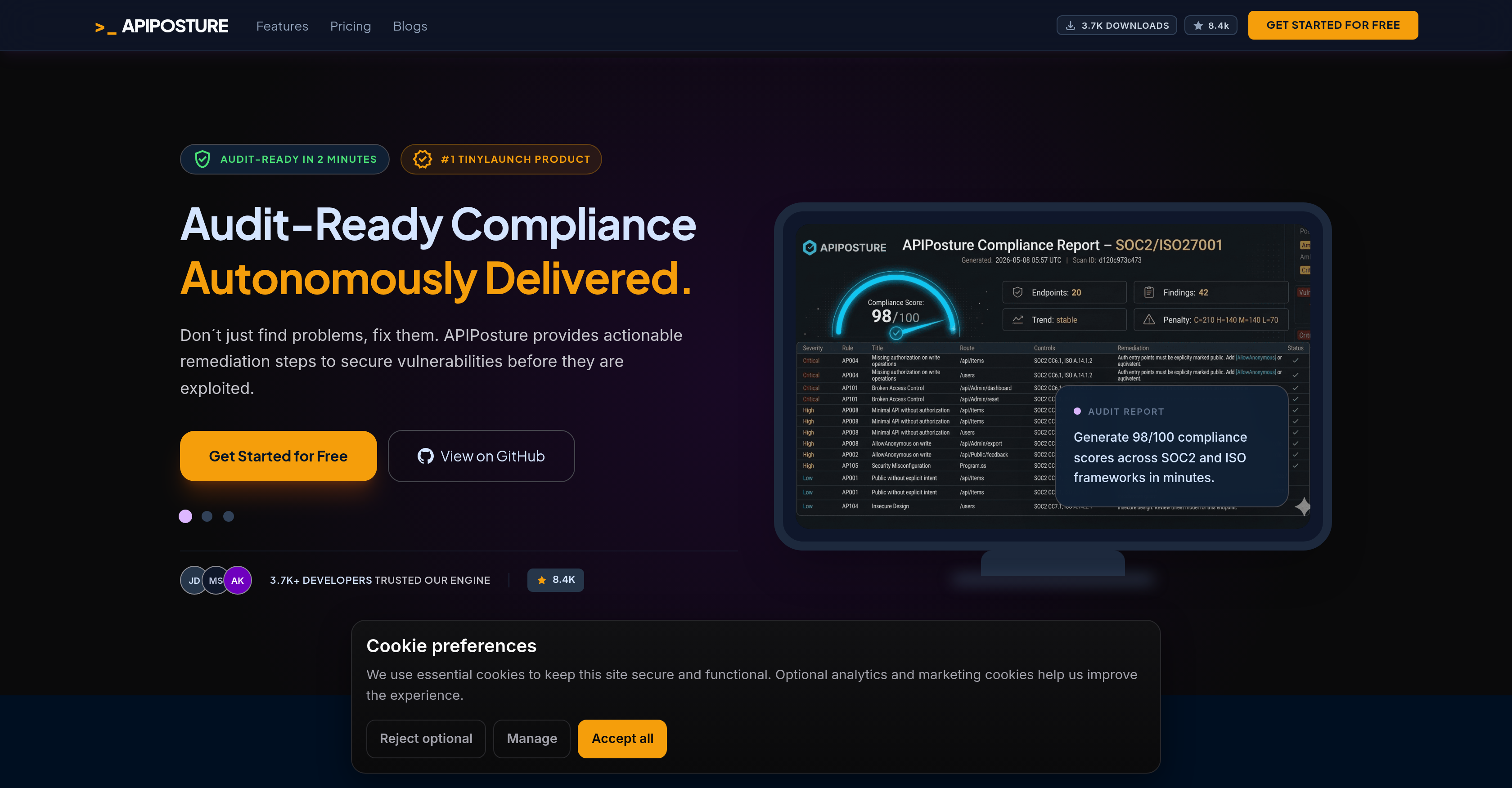
- Achieve audit-ready SOC2 and ISO compliance scores in minutes with automated scanning that generates exhaustive reports and continuous logs for governance, risk, and compliance.
- Eliminate authorization flaws and OWASP API risks across .NET, Python, Node, Go, Java, and PHP APIs through deep scans that pinpoint misconfigurations instantly.
- Secure AI-generated shadow APIs overlooked by standard GRC reviews using autonomous monitoring that maps and checks all endpoints continuously.
- Close security gaps before exploitation with adaptive-remediation steps and automatic virtual patching that provide machine-readable fixes on the spot.
- Maintain complete data privacy during scanning with a local-first zero-trust architecture that ensures sensitive information never leaves your machine.
- Meet SOC2 and ISO 27001 audit requirements effortlessly through continuous logs and automated exports that deliver real-time evidence for compliance frameworks.
Pros & Cons
Pros
- Supports multiple languages
- Autonomous vulnerability remediation
- Compliance for SOC2, ISO
- Continuous autonomous monitoring
- Automatic virtual patching
- Privacy-centric local scanning
- Real-time GRC evidence
- Shadow API detection
- Adaptive remediation features
- Automated export for SOC2/ISO
- Rapid API scanning
- Scans for OWASP risks
- Locates API misconfigurations
- Compliance tracking dashboard
- Real-time evidence collection
- Machine-readable fixes
- High compliance score generation
- Instant compliance audit
- Always-on compliance
- Automatic discovery of endpoints
- Instructions for vulnerability fixes
- Local-first security stance
- CLI functionality
- Local, deep visibility scanning
Cons
- Limited compliance frameworks
- No GDPR support
- No HIPAA compliance
- Shadow APIs detection uncertain
- Limited programming languages
- No mobile platform support
- Local-first scanning restrictive
- Lack of detailed documentation
- No light version
- Limited community support
Reviews
Rate this tool
Loading reviews...
❓ Frequently Asked Questions
ApiPosture supports numerous programming languages such as .NET, Python, Node.js, Go, Java, and PHP.
ApiPosture detects API vulnerabilities like authorization flaws and other risks stipulated in OWASP API.
ApiPosture provides actionable remediation steps along with automatic virtual patching to remediate identified vulnerabilities in a system.
Yes, ApiPosture has the ability to generate high compliance scores across SOC2 and ISO frameworks.
Yes, ApiPosture can scan AI-generated APIs effectively, as they might often slip through typical GRC reviews.
ApiPosture provides actionable remediation steps that can secure vulnerabilities before they are exploited.
ApiPosture's automatic virtual patching works by instantaneously addressing potentially exploitable weaknesses in a system, thereby reducing the exploitation risk.
Local-first, zero-trust architecture in ApiPosture confirms that the data scanned remains on the local machine, ensuring privacy and security, giving it an elevated assurance level.
ApiPosture performs real-time monitoring through continuous autonomous monitoring, thus providing real-time evidence for governance, risk, and compliance (GRC).
ApiPosture can scan APIs developed in a wide range of programming languages like .NET, Python, Node.js, Go, Java, and PHP; it also includes AI-generated APIs.
Yes, ApiPosture can swiftly find misconfigurations in APIs and offers solutions for them.
ApiPosture is designed to scan APIs in seconds, discovering any misconfigurations almost instantly.
ApiPosture generates an exhaustive audit report after scanning APIs, which includes compliance scores for SOC2 and ISO frameworks.
ApiPosture handles API security for Python by scanning for vulnerabilities, identifying authorization flaws, and providing remediation steps.
Yes, ApiPosture is suitable for compliance auditing, as it emphasizes audit-ready compliance, delivering high compliance scores across SOC2 and ISO frameworks.
ApiPosture improves risk mitigation in API development through its continuous monitoring, capable of detecting vulnerabilities and providing instant remediation steps including virtual patching.
The significance of autonomous monitoring in ApiPosture lies in its ability to continuously observe, discover, and remediate API vulnerabilities, thereby keeping a system audit-ready.
Yes, ApiPosture helps in locating authorization flaws in APIs, it has specific functionality dedicated to the identification of such issues.
ApiPosture maps API endpoints through its continuous autonomous monitoring, which can locate all endpoints, including those created by AI that might evade typical GRC reviews.
Yes, ApiPosture works with locally stored data. Its local-first, zero-trust architecture ensures that data scanned remains on the local machine, ensuring maximum security and privacy.
ApiPosture is an API security scanner that supports a range of programming languages. It focuses heavily on audit-ready compliance, providing an autonomous solution to locate and fix API vulnerabilities. It stands out for its local-first, zero-trust architecture scanning, ensuring high privacy and security by keeping all scanned data on the local machine. The tool also constantly monitors the APIs to provide real-time evidence for governance, risk, and compliance. ApiPosture also automatically maps and checks all endpoints, including those created by AI tools.
The primary function of ApiPosture is to identify and remediate API vulnerabilities. It does this in seconds, supporting numerous programming languages and consistently monitoring endpoints to detect authorization flaws and risks associated with the OWASP API.
ApiPosture helps with API security through multiple functions. It identifies authorization flaws, misconfigurations, and other risks related to the OWASP API through deep scans. It also provides ‘adaptive-remediation’ services, offering instructions for fixing vulnerabilities that have been identified. Moreover, it scans the system to find 'shadow APIs,' which are APIs created by AI that might have slipped under the radar and could heighten the system’s vulnerability.
ApiPosture offers unique features like local-first, zero-trust architecture scanning, shadow APIs detection, adaptive remediation, and continuous autonomous monitoring. The local-first scanning enhances security by ensuring that the data scanned remains on the local machine. Shadow APIs detection helps identify APIs created by AI tools that can increase system vulnerability. Adaptive remediation provides corrective measures to address any vulnerabilities discovered. Continuous autonomous monitoring offers continuous logs for compliance.
ApiPosture locates API vulnerabilities by scanning APIs for authorization flaws and risks associated with the OWASP API. Through continuous autonomous monitoring of endpoints, including those artificially generated by AI tools, ApiPosture can identify vulnerabilities that may have been missed in standard GRC reviews. Once vulnerabilities are located, the software provides actionable remediation steps along with automatic virtual patching.
ApiPosture places significant emphasis on audit-ready compliance. It provides actionable remediation steps or automatic virtual patching to secure vulnerabilities before they are exploited, and maintains continuous logs for SOC2/ISO 27001 automated exports. This means that ApiPosture can help businesses stay compliant with these frameworks and avoid inadvertent API-related risks.
ApiPosture generates compliance scores by identifying and remediating issues that could potentially compromise compliance with SOC2 and ISO frameworks. Audit-ready in mere minutes, ApiPosture provides an in-depth scanning of API's, then leverages the results of these audits to generate high compliance scores, which effectively reflect the level of compliance with these frameworks.
Yes, ApiPosture has the capability to detect OWASP API risks. It's designed to scan APIs for authorization flaws and risks associated with the OWASP API, identifying potential issues and providing measures to secure any exposed vulnerabilities.
The autonomous monitoring feature of ApiPosture sets it apart as it can substantially cover AI-generated endpoints which usually go unnoticed in standard GRC reviews. It carries out incessant monitoring of all APIs to provide real-time, tangible evidence that can be used for governance, risk, and compliance-related purposes. This always-on monitoring gives it an edge in tracking potential vulnerabilities in the system.
Yes, ApiPosture does provide remediation steps for located vulnerabilities. Not only does it identify potential security issues, but it offers actionable remediation steps to secure vulnerabilities and ensure the system is secure. Additionally, ApiPosture's autonomous remediation feature provides machine-readable fixes to close security gaps instantly.
ApiPosture's automatic virtual patching function works together with remediation steps as part of its security strategy. When potential vulnerabilities are identified, the virtual patching function can be used to 'patch' these weaknesses, providing an additional layer of security and ensuring that vulnerabilities are addressed promptly and effectively until a more permanent fix can be applied.
The purpose of local-first zero-trust architecture scanning in ApiPosture is to maximize data security and privacy. By scanning locally, data does not need to be sent or stored elsewhere. This means a higher level of data protection and a greater assurance of privacy, as sensitive data remains on the user's machine.
Yes, ApiPosture does offer a continuous monitoring feature. This feature helps in providing real-time evidence for governance, risk, and compliance. It scans the APIs continually, tracks any vulnerabilities, and maintains comprehensive logs for SOC2/ISO 27001 automated exports.
The purpose of the shadow APIs detection feature in ApiPosture is to identify APIs created by AI tools. These 'shadow APIs' are often overlooked in standard GRC reviews and can increase the vulnerability of the system. By detecting these APIs, ApiPosture can identify and address the associated risks more effectively.
Yes, ApiPosture does provide assistance with automated exports in compliance with SOC2 and ISO27001. It maintains continuous logs for automated exports for these frameworks. With automation, compliance is streamlined and more dependable with the software ensuring that all requirements are faithfully met.
Yes, ApiPosture can detect API misconfigurations. As a part of its primary functions, it conducts security scans to quickly locate any API misconfigurations that may expose the system to potential exploits or vulnerabilities.
ApiPosture's adaptive-remediation' feature involves providing instructions on how to apply fixes for any located vulnerabilities. Upon identifying potential security risks, ApiPosture informs the user about necessary fixes and provides guidance on how to implement these measures to close any identified security gaps. These corrective measures can be applied manually by the user, or by an AI, increasing the system's resistance against possible attacks.
Yes, ApiPosture is capable of scanning AI-generated endpoints. Its monitoring capabilities extend to AI-generated APIs that might typically escape standard GRC reviews. ApiPosture effectively maps and checks all endpoints, identifying vulnerabilities that might not be otherwise detected.
The advantage of using ApiPosture for API security scanning is its comprehensive approach to securing APIs. It aims at discovering API flaws swiftly, supports various programming languages, and offers features like local-first scanning and adaptive remediation. Its automatic virtual patching and autonomous monitoring provide continuous API security. Moreover, its focus on audit-ready compliance means it not only identifies problems but also assists in fixing them while maintaining logs for SOC2/ISO 27001 audits. Built with a zero-trust architecture, it ensures that scanned data remains on your machine, promoting data security and privacy.
Pricing
Pricing model
Freemium
Paid options from
$9/month
Billing frequency
Monthly
Related Videos
ApiPosture in 60 seconds
APIPosture•6 views•Apr 29, 2026