

Overview
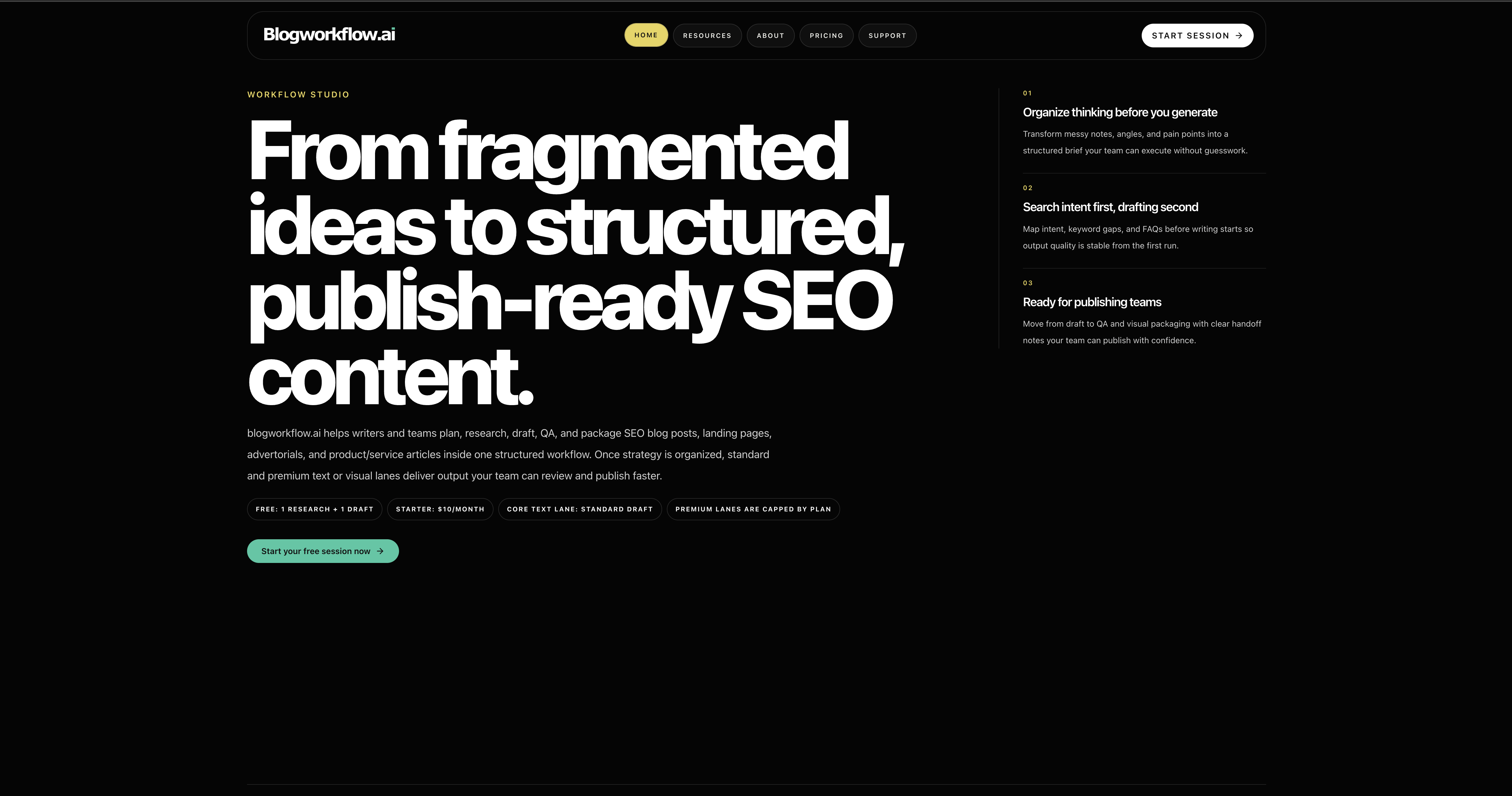
- Turn fragmented ideas into publish-ready SEO blog posts and landing pages by following an 8-step workflow that enforces search intent mapping, SERP gap assessment, and keyword clustering before drafting begins.
- Maintain commercial direction from topic selection to final draft with a reasoning model that frames business outcomes, audience pain points, and article promise—keeping every output conversion-focused.
- Eliminate revision cycles with built-in quality assurance checks at each stage, from outline logic to visual packaging, ensuring error-free, coherent content on the first run.
- Produce SEO-optimized advertorials and product-led articles that fill content gaps, using structured input that aligns brand voice, evidence, and outline logic before text generation.
- Reuse SEO packs containing intent mapping, SERP gap notes, FAQ opportunities, schema hints, and link direction notes across multiple projects to scale content production without losing quality.
- Deliver publish-ready output packs with visual guidance, structured drafts, and SEO directions—handing publishing teams everything they need to go live without additional editing.
Pros & Cons
Pros
- Structured content creation
- Publish-ready output
- SEO-direction included
- Visual guidance provided
- 8-step workflow system
- Handles initial planning to packaging
- Transforms rough drafts into content
- Search intent consideration
- Keyword and SERP gap analysis
- Topic and revenue angle definition
- Helpful for SEO and content agencies
- Useful for in-house marketing teams
- Creates SEO-compliant blogs
- Creates advertorials and product/service articles
- Quality assurance
- Scalable payment options
- Turns fragmented ideas into structured content
- Defines topic and revenue angle
- Identifies SERP gaps
- Compiles evidence and builds outline
- Incorporates quality check
- Provides visual package
- Professional blog production
- Advertorial content creation
- Product-led SEO content creation
- Offers range of payment options
- Brand setup assistance
- FAQ opportunities utilization
- Link-direction guidance
- Automation of workflow steps
- Output consistency
- Reduces rewrite cycles
- Multiple output packs
- SERP gap notes creation
- Keyword clusters generation
- Visual lanes for graphics
- Flagship text and image models
- Premium lanes for stronger reasoning
- Reasoning model for cohesive content
- Repeatable workflow
- Transforms messy notes into clear brief
- Handoff clarity
- Workflows through specific content operation model
- Enhances clearer handoff
- Increases visible value
- Stronger path from brief to publishing
- Customizable according to user type
- SEO pack output
- QA and publish pack creation
Cons
- No collaborative features
- No mention of data security
- Limited to SEO related content
- No multi-language support
- Pricing unclear for premium offerings
- Quality assurance process unspecified
- No integrated publishing channels
- No mobile app accessibility
- No information on tool's training data
Reviews
Rate this tool
Loading reviews...
❓ Frequently Asked Questions
BlogWorkflow.ai is an AI-powered content workflow software designed to facilitate the creation of SEO-compliant blogs, landing pages, product/service articles, and advertorials. It guides the user through initial planning and research to drafting, quality assurance, and final packaging of the content.
BlogWorkflow.ai uses a systematized content-input framework that organizes raw data into well-structured briefings. It applies this framework to transform disparate ideas and concepts into structured and coherent content. This is achieved through its 8-step system which provides clarity in the entire process of drafting and creation of content.
BlogWorkflow.ai provides a publish-ready output pack that encompasses drafts, visual guidance and, SEO directions. The output quality is consistently maintained at every stage, starting with the input briefing. It also offers a structured content-input framework that can be reused in multiple content projects.
BlogWorkflow.ai addresses search intent and keyword gaps by enforcing them in its early planning and research phase. It ensures the content developed is in line with the target user's search intent and helps identify any keyword gaps that could potentially decrease the content's visibility or relevance in search engine results.
BlogWorkflow.ai operates on an 8-step system. The individual steps cover topic and revenue angle definition, SERP gap assessment, initial planning, outlining the draft build, to quality assurance, and visual packaging. Each stage has a distinctive goal, an AI role, and an expected handoff, making unstructured drafts coherent and providing teams clarity in the entire process.
Yes, BlogWorkflow.ai can be utilized for creating a wide range of content including both blog posts and landing pages. Its advanced features allow it to handle the unique requirements of both types of content effectively.
BlogWorkflow.ai helps in content creation by providing clarity right from the planning stage to the final output. For SEO optimization, it considers search intent, keyword gaps, and FAQs to stabilize output quality. It helps in defining the topic and revenue angle, performs SERP gap assessment, and maintains the commercial direction throughout the cycle. In addition, it also provides SEO guidance in the form of an output-pack.
Quality assurance within BlogWorkflow.ai is handled within the 8-step system. Thorough scrutiny at each step - from initial planning to visual packaging - results in high quality, error-free content. Each phase of this process is meticulously built to check for maximum content accurateness and coherency.
AI in BlogWorkflow.ai plays a significant role in polishing raw information into coherent content. It guides keyword research, optimizes content for search intent, helps to define revenue angles and topics, identifies SERP gaps, and ensures the commercial direction of the content. Furthermore, it forms a part of the reasoning model which transforms the brief into a stable working objective.
BlogWorkflow.ai addresses frequently asked questions in its content by incorporating them during the optimization process. It ensures that the FAQs are included in the content in a way that it meets the requirements of the end-user while also maintaining the SEO-compliance of the final output.
BlogWorkflow.ai's content-input framework takes into account strategies, ideas and insights, and systematizes them into a standardized format which can be executed seamlessly. This includes aligning intent, evidence, outline logic, and brand voice before the text generation process thus setting the foundation for the creation of consistent and high-quality content.
BlogWorkflow.ai helps with topic and revenue angle definition within its 8-step cycle. It frames a business outcome, audience pain, and article promise before the writing begins. A reasoning model then compresses this brief into a stable objective from which the workflow proceeds.
BlogWorkflow.ai works on its strategic SERP gap assessment in its initial planning phase. The aim here is to identify any potential gaps in the existing content that could affect its visibility on the Search Engine Results Pages.
BlogWorkflow.ai is best suited for both SEO and content agencies as well as internal growth and content teams within companies. It is beneficial for anyone who aims to maintain a structured workflow while creating high-quality, SEO-optimized, and commercially sound content.
BlogWorkflow.ai uses its systematized 8-step workflow and structured content-input framework to convert messy notes into publish-ready content. By organizing the user's fragmented ideas and concepts, it aids in the creation of logically structured and coherent content.
The BlogWorkflow.ai's SEO pack output includes intent mapping, SERP gap notes, FAQ opportunities, keyword clusters, schema hints, and link direction notes, all of which can be reused by the content publishing team.
Yes, BlogWorkflow.ai assists in the production of advertorials and product/service articles. With its AI-driven workflow, it can be used to create a wide range of SEO-optimized content - from blog posts and landing pages to advertorials and detailed product/service articles.
BlogWorkflow.ai incorporates visual guidance within its content production process. It not only helps in vague drafting but also provides visual direction that aligns with the overall objective of the content. This includes an output pack with visual guidance included within its scope.
BlogWorkflow.ai ensures the maintenance of commercial direction throughout the content creation process by preserving the initial commercial intent, primary topic selection, and conversion relevance at every stage. The AI model employed by BlogWorkflow.ai works on translating the initial brief into a steady commercial directive for the rest of the workflow stages.
Yes, BlogWorkflow.ai can assist in the optimization of product pages and landing pages. It embarks on keyword direction, search intent, content gaps, page structure early in its process, thus forming SEO-optimized content which increases the quality of these pages so they perform better in the search engine results.
Some of the key features of BlogWorkflow.ai include a structured content-input framework, an 8-step system for content creation, AI-driven commercial direction maintenance, a Search Engine Results Pages (SERP) gap assessment, topic and revenue angle definition, a publish-ready output pack, and the creation of SEO directions and visual guidance.
BlogWorkflow.ai employs an 8-step system to streamline content creation. It starts with defining the topic and revenue angle, setting up the brand, identifying gaps in search engine results pages. This is followed by compiling evidence, building an outline, drafting, conducting a quality assurance check, and creating a visual package. This system turns fragmented thoughts into a structured and publish-ready content, providing clarity throughout the process.
For SEO compliance, BlogWorkflow.ai takes into account factors like search intent, keyword gaps, and frequently asked questions (FAQs). It provides SEO direction as part of its output pack. The tool maps intent, identifies SERP gaps, highlights keyword clusters, and pinpoints FAQ opportunities, offering in-depth SEO impact.
The 8-step content creation system of BlogWorkflow.ai involves defining the topic and revenue angle, setting up the brand, identifying gaps in SERP, compiling evidence, building an outline, drafting, conducting a quality assurance check, and creating a visual package.
The primary audience for BlogWorkflow.ai includes SEO agencies, content agencies, in-house marketing teams, internal growth teams, and content units in companies.
Yes, BlogWorkflow.ai can be effectively utilized for different types of content including the creation of blogs, landing pages, advertorials, and product-led articles.
Yes, BlogWorkflow.ai incorporates quality assurance checks in its 8-step system. From the drafting stage, it moves to QA and finally, visual packaging. This ensures each created document is up to a high standard before it is ready for publishing.
In BlogWorkflow.ai's content creation process, search intent is considered right at the initial stage. Users can map search intent, keyword gaps, and FAQs before writing to ensure output quality is steady from the first run.
The publish-ready output pack provided by BlogWorkflow.ai includes well-structured drafts, SEO directions, SERP gap notes, keyword clusters, FAQ opportunities, schema hints, link-direction notes, and visual guidance.
BlogWorkflow.ai uses a reasoning model to define and maintain the commercial direction of the content from the very beginning. During the first step of its 8-step system, it defines the business outcome, audience pain point, and article promise, and this commercial intent is maintained through every subsequent step.
Yes, BlogWorkflow.ai can be favorably employed by internal growth and content teams within companies. It offers a consistent and repeatable workflow for the creation of blogs, landing pages, advertorials, and product education.
Yes, BlogWorkflow.ai offers scalable payment options, with provisions suiting different needs and budget ranges. It provides several pricing plans, including Free, Starter, Pro, and Growth.
BlogWorkflow.ai takes into consideration various components of SEO such as search intent, keyword gaps, SERP gap assessment, FAQ opportunities, schema hints, and link-direction attributes. It also provides SEO directions as part of its output pack.
BlogWorkflow.ai uses its systematized content-input framework and a specific 8-step workflow process to help convert messy notes and raw concepts into well-structured, organized content.
In BlogWorkflow.ai, the SERP gap assessment feature is executed during one of the steps in its 8-step content creation workflow. It identifies gaps in the SERPs as part of its structured SEO content workflow, which later helps in drafting content that fills these gaps.
Through its structured-content input framework and the subsequent workflow stages, BlogWorkflow.ai aids in crafting professional blogs. By defining the topic and revenue angle, identifying SERP gaps, compiling evidence, creating an outline, drafting, conducting a QA check, and developing a visual package, it ensures the creation of coherent, professional-quality blog content.
For advertorial content creation, BlogWorkflow.ai provides structured workflow stages that facilitate the efficient creation process. The tool handles processes right from initial planning and research down to drafting, quality assurance, and packaging.
BlogWorkflow.ai facilitates the development of SEO blog posts by structuring unorganized thoughts into a well-defined content input through its 8-step workflow. It maps search intent, identifies keyword gaps, provides SEO direction in the output pack, and finally drafts an SEO-compliant blog post.
BlogWorkflow.ai offers specific features to support in-house marketing teams. It provides features like a repeatable workflow for blogs, landing pages, and advertorials, clear handoff notes for publishing teams, and scalable payment options corresponding to varying team sizes and budgets.
Pricing
Pricing model
Free Trial
Paid options from
$10/month
Billing frequency
Monthly