
C1 Artifacts API - Thesys
Overview
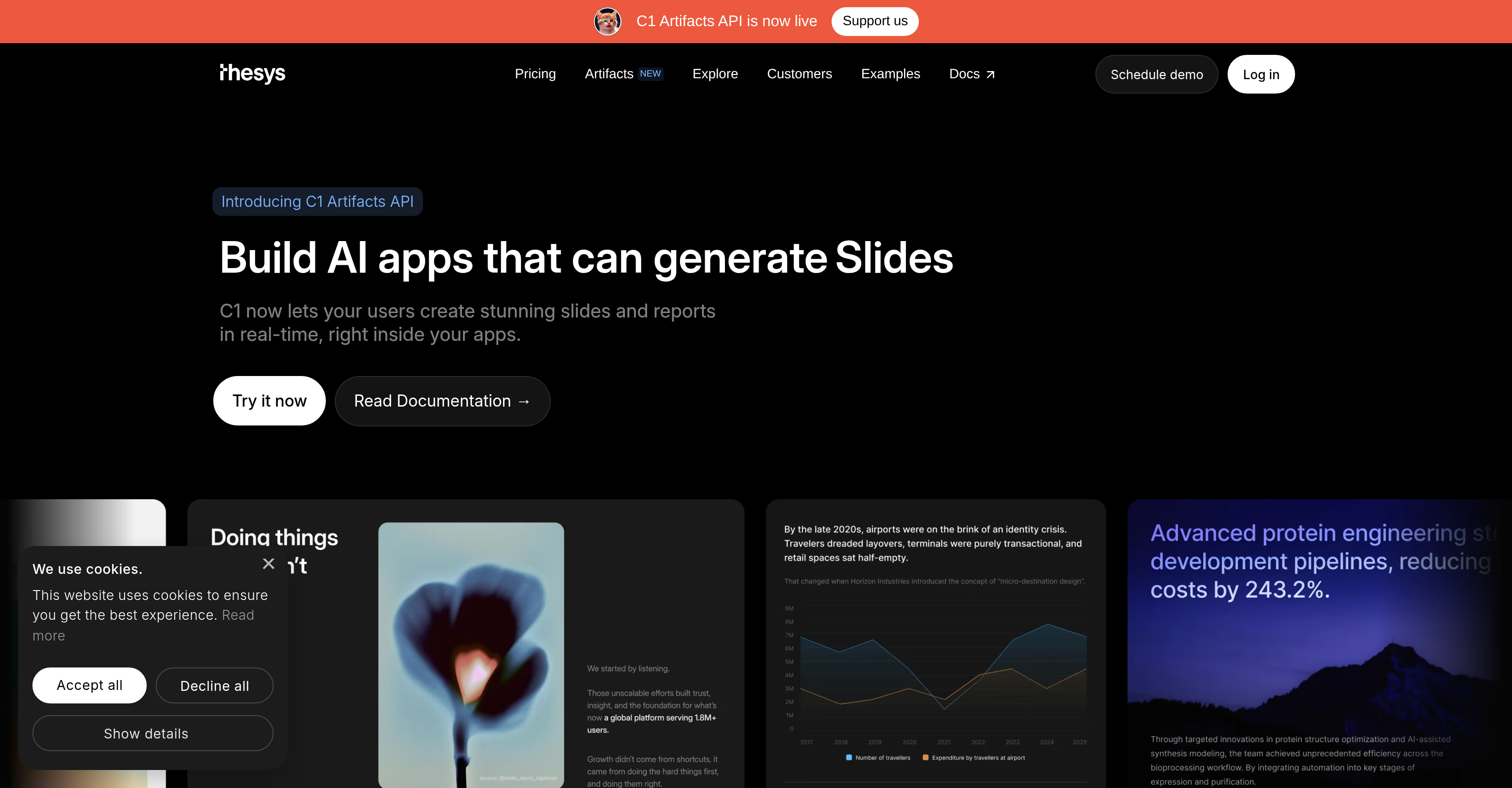
- Transform AI applications into interactive tools that generate slides and reports instantly with real-time generative UI
- Eliminate manual report creation by automatically producing high-quality presentations directly within your application
- Add sophisticated UI capabilities without complex coding through straightforward three-step API integration
- Scale from startup prototypes to enterprise systems with a cloud-based platform designed for any project size
- Create customized interface components that adapt to user inputs dynamically using generative UI technology
Pros & Cons
Pros
- Produces high-quality slides
- Generates reports within applications
- Interactive app response
- Provides immediate response
- Generative UI capabilities
- Easy integration process
- Usable as MCP
- Easy to use
- Requires less technical understanding
- Bespoke UI generation
- Cloud-based
- Documentation support
- Customization
- Scalability
- Real-time reports
- Demo scheduling
- Startups and enterprise support
- Adaptable interface
- Developers-friendly
- Generates real-time slides
- Seamless system integration
- Supports various use-cases
- Managed Cloud Platform
- User Interface Design
- Application Development
- Enterprise-Level Support
- Startups Support
Cons
- Only integrates in-app
- Limited standalone functionality
- Generative UI specificity
- Limited to UI generation
- Constrained real-time responsiveness
- No mentioned multi-platform compatibility
- Not for non-developer users
- Requires MCP for alternative use
- Lacks sufficient customization details
Reviews
Rate this tool
Loading reviews...
❓ Frequently Asked Questions
The C1 Artifacts API by Thesys is a tool that allows users to generate high-quality slides and reports directly within their applications. It integrates generative UI capabilities into AI-powered apps, enabling them to interactively respond in real time.
C1 Artifacts API improves user experience by providing immediate, interactive response within the app itself. This ability to generate slides and reports in real time considerably enhances the app's efficiency and usability.
Key features of the C1 Artifacts API include real-time, interactive UI, App Integration, MCP (Message Command Pattern) use within AI applications, slide production, and report generation. It also bears the hallmark of ease of use, even with its advanced capabilities.
C1 Artifacts API integrates with AI-powered apps by bringing generative User Interface (UI) capabilities into them. This allows the app to respond interactively in real time, offering a more engaging user experience.
Yes, C1 Artifacts API can indeed be used as an MCP (Message Command Pattern) within AI applications, providing another layer of functionality and versatility to the tool.
Yes, ease of use for developers is a key feature of the C1 Artifacts API. Even though it has advanced capabilities, it is designed so developers can add it to their apps quickly without requiring significant effort or highly specialized technical understanding.
With the C1 Artifacts API, users can produce high-quality slides and reports directly within their applications. It allows AI-powered apps to present information interactively and instantaneously, enhancing user experience and efficiency.
Users can produce slides and reports within their apps using C1 Artifacts API by leveraging its generative UI capabilities. These enable real-time interactive responses within the app, permitting users to generate and render reports and presentations swiftly and efficiently.
C1 Artifacts API plays a central role in real-time response by integrating generative UI capabilities into AI-powered apps. This enhances the app's ability to respond interactively in real time, resulting in a more engaging user experience.
The on their website does not provide specifics on the steps to integrate C1 Artifacts API with an application. However, it mentions that the integration process is straightforward, implying that it does not require complex procedures.
The primary offering of C1 Artifacts API is its ability to integrate generative UI capabilities into AI-powered apps. This means it can make any AI application more interactive and responsive by creating real-time user interfaces.
Generative UI is a design methodology that uses AI and algorithms to automatically create user interfaces. The C1 Artifacts API utilises generative UI by integrating these capabilities into AI-powered apps, thereby enabling real-time, interactive response.
C1 Artifacts API is efficient because it allows AI-powered apps to respond and present data interactively and instantaneously. It thus significantly reduces the time taken to generate slides and reports, enhancing overall user experience.
C1 Artifacts API can enhance the capabilities of your AI application by integrating generative UI into it. This transforms your app into a powerful, interactive tool that can respond in real-time to create high-quality slides and reports.
C1 Artifacts API is a product of Thesys, a company that specializes in creating tools and services that enable AI-powered application interactions.
C1 Artifacts API aids in the generation of interactive UI that can respond in real-time. The exact types of UI it can generate are not specified on their website.
In the context of C1 Artifacts API, real-time interactive UI means that the UI of an AI-powered app can respond immediately to user actions. This enables the instantaneous generation of high-quality slides and reports based on user input.
Despite its advanced capabilities, C1 Artifacts API is designed with ease of use in mind. This implies that it does not require a high level of technical understanding to implement. Developers can quickly add it to their apps without significant effort.
The 'Message Command Pattern' (MCP) feature of the C1 Artifacts API is a means by which the API can be integrated within other AI applications. It however doesn't detail on their website what specific role or function it serves.
Your AI app can benefit significantly from real-time UI response with C1 Artifacts API. It will enable your app to instantly present information via generated slides or reports, thereby enhancing user experience and boosting user engagement.
The C1 Artifacts API by Thesys enables AI apps to interactively respond in real-time. It can produce real-time slides and reports allowing users to have an interactive and efficient user interface immediately within the app. Furthermore, the tool features UI code generation, meaning it can create necessary user interface elements for application interactions.
To integrate the C1 Artifacts API into your application, you need to complete three steps, the specifics of which are outlined in Thesys's extensive documentation. Alternatively, you can use it as a Managed Cloud Platform (MCP) within your preferred AI applications.
The MCP refers to a Managed Cloud Platform. In the context of the C1 Artifacts API, it serves as an environment in which the API can be deployed, using the tool within your preferred AI application via cloud-based technology.
The design philosophy of the C1 Artifacts API emphasizes simplicity and ease of use. For developers, the tool can be integrated into their AI apps without significant effort or the need for high-level technical understanding. The integration can be achieved in just a few straightforward steps, and extensive documentation and support are available to assist during the process.
'Generative UI' refers to the tool's ability to automatically generate user interface components for AI applications. This means that the C1 Artifacts API can create customized user interface elements or components that are suited to your specific applications.
The C1 Artifacts API enables real-time interaction in AI apps through its generative UI capabilities. AI apps integrated with the tool can provide instantaneous response and interaction via the UI, enhancing user experience and efficiency.
Thesys provides extensive support for the C1 Artifacts API, ranging from detailed documentation to guide integration and usage, a community for developers, and enterprise-grade support. The company also gives users a platform to schedule demos to better understand and explore the tool's capabilities.
Yes, the C1 Artifacts API is cloud-based. It can be deployed on a Managed Cloud Platform (MCP) within users' favourite AI applications.
In the context of the C1 Artifacts API, real-time slides and reports refer to the immediate generation of user interface elements such as slides and reports during the application’s run time. These elements are generated dynamically based on the user interactions and real-time data.
The UI code generator of the C1 Artifacts API uses the principles of generative UI to create customizable user interface components interactively in real time, improving the interactivity of AI apps.
Yes, the C1 Artifacts API is a powerful tool for application development, enabling the creation of highly interactive AI-app UIs and integrating a wide range of functionality like real-time report and slide generation.
Yes, the C1 Artifacts API is designed to cater to both startups and enterprise-level customers. The tool ensures scalability according to different project requirements and can flexibly serve both small-scale and larger, enterprise-level applications.
Indeed, with the C1 Artifacts API, you can customize the interaction with your AI app. The tool’s generative UI capabilities allow developers to create customized UI components for real-time interaction within their applications.
Yes, the C1 Artifacts API can adapt to real-time changes. Its generative UI technology allows for the dynamic creation of UI elements, which can adjust and modify based on real-time inputs and user interactions.
Yes, Thesys provides a platform for customers to schedule demos to understand and explore the C1 Artifacts API capabilities better.
Yes, C1 Artifacts API has scalability as one of its strong suits. It can be dynamically adjusted to suit the needs of diverse projects, from small-scale to enterprise-level, based on requirements.
The specifics of the three steps to integrate the C1 Artifacts API into your application are outlined in the extensive documentation provided by Thesys.
Thesys provides detailed documentation as support for the C1 Artifacts API. This includes a complete guide on variety of topics like integration of the API, its usage, capabilities, and more.
Yes, the user interface design made by the C1 Artifacts API is adaptable. The API’s generative UI capabilities allow it to create customized UI components that can adjust and modify according to real-time user interactions.
Pricing
Pricing model
Freemium
Paid options from
$49/month
Billing frequency
Monthly
Refund policy
No Refunds
Related Videos
Thesys C1: First-Ever Generative UI API - Build Interactive AI Apps & Agent!
WorldofAI•13.2K views•Oct 25, 2025