

Overview
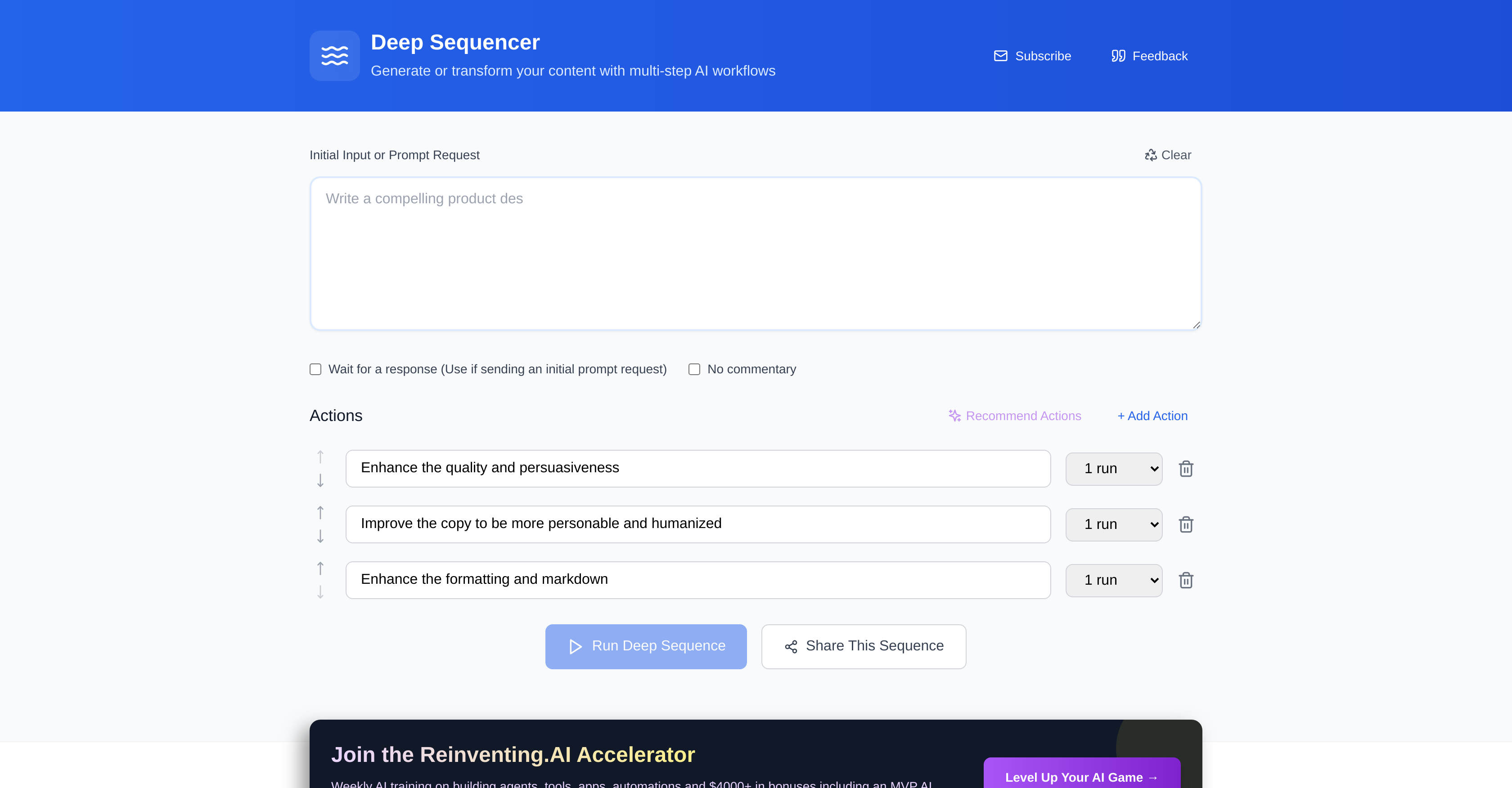
- Achieve more accurate weather forecasts by analyzing meteorological data sequences with machine learning
- Predict user behavior patterns in digital marketing by learning from sequential customer actions
- Accelerate genomics and proteomics research through biological sequence analysis and pattern recognition
- Improve prediction reliability over time as the AI continuously learns from your data inputs
- Adapt to complex sequences across different fields with agile functionality that handles diverse data types
- Generate actionable research insights by evaluating sequences of events to forecast future occurrences
Pros & Cons
Pros
- Adaptable functionality
- Agile design
- Constant updates and improvements
- Effective for complex sequences
- Ideal for various fields
- Enhances prediction accuracy
- Learning and improving capability
- Reliable predictions
- User behavior prediction
- Useful in genomics, proteomics
- Helpful in Earth sciences
- Applicable to digital marketing
- Trains on user inputs
- Can predict future events
- Understands and evaluates sequences
- Offers insightful predictions
- Biological sciences application
Cons
- Specificity to sequence data
- Requires continuous data input
- Potential overfitting risk
- Limited to predictive analysis
- Potentially high complexity
- Relies on developer updates
- Limited interdisciplinary application
- Needs extensive data for accuracy
- Lacks adaptability outside sequences
- Might require advanced user knowledge
Reviews
Rate this tool
Loading reviews...
❓ Frequently Asked Questions
Deep Sequencer utilizes machine learning to analyze sequences by training on inputted series of events or data points. This allows it to understand patterns, generate insightful predictions about future events, and continuously improve its predictive power.
Deep Sequencer can be beneficial across a multitude of fields including genomics and proteomics in biological sciences, weather forecasting in Earth sciences, digital marketing by predicting user behavior, and other areas requiring sequence and predictive analysis.
Users input a series of events or data points into Deep Sequencer for analysis. However, the exact process of inputting data would depend on the specific interface of Deep Sequencer.
Deep Sequencer improves its predictive power over time through its AI-driven learning capability. With each new set of data inputs or series of events, it refines its understanding and prediction of patterns, thereby enhancing its predictive abilities.
Yes, Deep Sequencer is extensively suited for researchers, scientists, or analysts. Its precise and effective predictive capabilities on complex sequences make it a robust tool for any data-driven discipline.
Deep Sequencer improves prediction accuracy by learning and adapting from each inputted sequence of data. This constant learning and adaptation process, driven by AI, allows it to fine-tune its predictions and boost accuracy over time.
While the exact frequency of updates isn't listed on their website, it is noted that Deep Sequencer is continually updated and improved by its developers, reflecting a strong commitment towards maintaining its effectiveness and relevancy in the field of AI-driven predictive analysis.
In the fields of genomics and proteomics, Deep Sequencer could address challenges related to sequence analysis and prediction. By processing biological sequence data, it can predict and understand patterns contributing towards research insights in these fields.
In weather forecasting within Earth sciences, Deep Sequencer could analyze sequences of meteorological data to understand and predict weather patterns, helping in creating more accurate forecasts.
Yes, Deep Sequencer has the capability to predict user behavior in digital marketing. It can learn from a sequence of user actions or behaviors to predict future behavior patterns, supporting more effective marketing strategies.
Yes, Deep Sequencer can indeed be utilized in the field of Biological Sciences. Its proficiency in sequence analysis and prediction can be leveraged in areas like genomics and proteomics.
Deep Sequencer adapts its functionality to different sequences by learning from a diversity of inputted events or data. This allows it to be effective in dealing with complex sequences across diverse fields.
Deep Sequencer is mentioned to have an agile design. While specific design elements are not detailed, the inherent agility refers to the AI's ability to effectively manage and adapt to different data sequencing tasks.
Yes, one of the main functions of Deep Sequencer is to evaluate sequences of data. It assesses inputted event or data sequences to derive new insights and formulate predictions about future occurrences.
The predictions made by Deep Sequencer are stated to be reliable and effective. Its constant learning and improvement from data inputs, coupled with ongoing development and enhancements, contribute to the robustness of its predictions.
Deep Sequencer is considered an advanced AI tool due to its sophisticated capabilities in sequence analysis and prediction. Its continuous learning from data inputs, adaptability, and ongoing development all contribute to its advanced status in the field of AI.
Yes, Deep Sequencer has a learning capability that allows it to adapt and improve from data inputs, enhancing its ability to predict and understand sequences over time.
The primary function of Deep Sequencer is to predict, understand, and evaluate sequences of data. It uses machine learning to enhance these capabilities and provide insightful predictions about the likelihood of future events.
Deep Sequencer can be instrumental in Earth Sciences in forecasting weather as it can analyze and predict patterns within large volumes of meteorological data. This can lead to more accurate weather forecasts, aiding Earth Sciences related analysis efforts.
The phrase 'sequence your ideas into creative waves' isn't defined on their website, but in context, it could suggest the innovative use of Deep Sequencer to analyze and predict patterns from complex data sets, converting data into actionable insights and driving novel research ideas.
Pricing
Pricing model
No Pricing