

Epochal - AI Video Generator
Overview
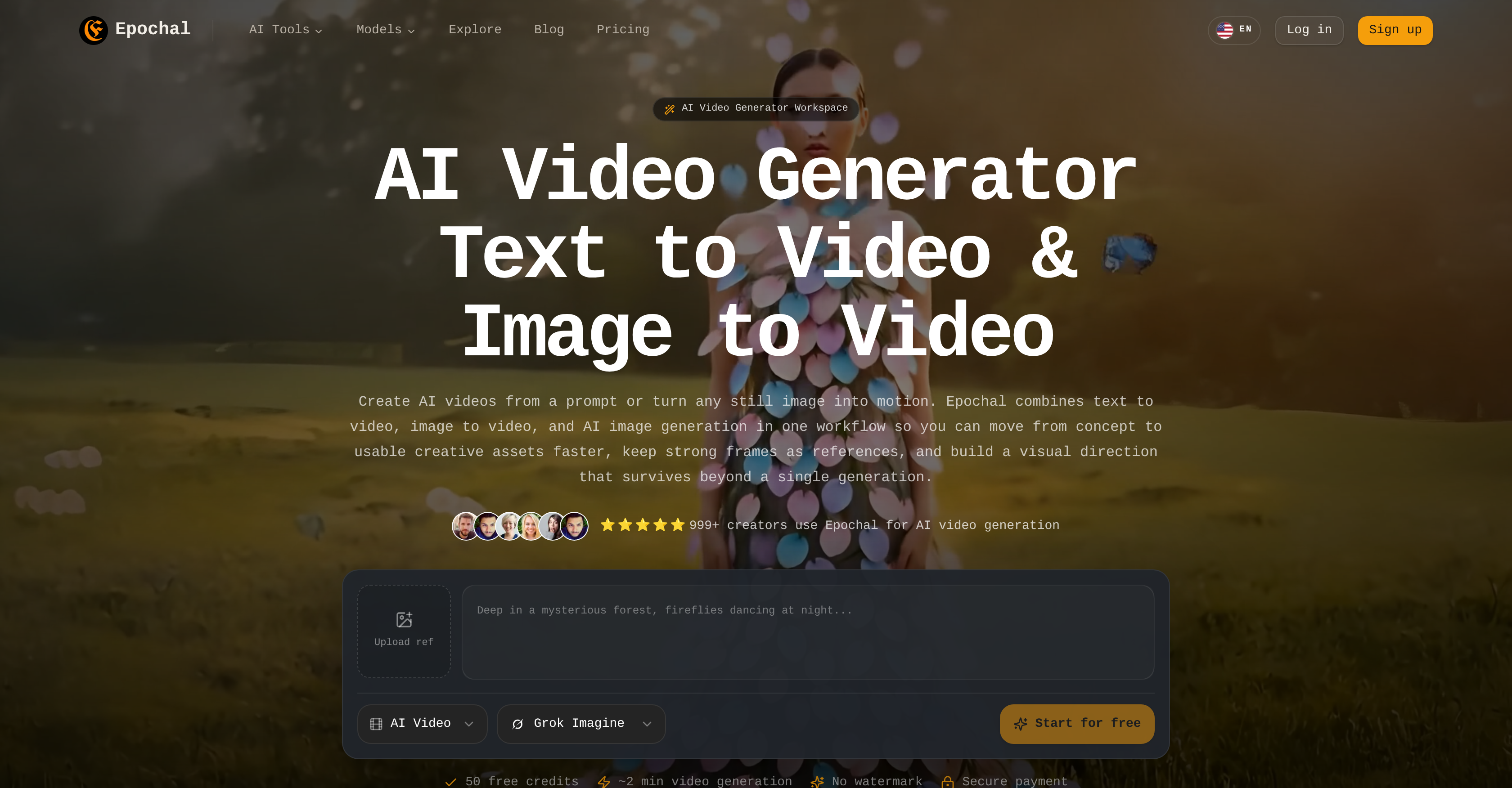
- Transform text prompts directly into cinematic videos with realistic motion and native audio using integrated models like Veo for high-fidelity generation.
- Animate static images into dynamic video sequences while maintaining visual consistency and strong reference frames for coherent results.
- Select the optimal AI model for each project's needs, from economical long-form videos (Wan) to multi-scene storytelling (Kling) and professional workflows (Runway).
- Accelerate ideation to final asset with a unified workflow that combines AI image generation, text-to-video, and image-to-video in one seamless process.
- Maintain continuous context and creative intent throughout iterations, ensuring visual results stay true to your original concept without rebuilding context.
- Control cinematic details like camera moves, lighting, and style directly from your prompt for custom, production-ready visuals and product scenes.
Pros & Cons
Pros
- Text-to-video transformation
- Image-to-video animation
- Allows for custom lighting
- Enables custom style
- Offers model comparison
- Facilitates project management
- Accelerates creative process
- Caters to diverse user needs
- Multiple starting points for projects
- Maintains continuous context
- Supports high-fidelity video generation
- Useful for multisensory storytelling
- Economic high-resolution video creation
- Handles complex motion
- Enables believable character creation
- Promotes multi-scene sequencing
- Facilitates asset creation
- Caters to different execution styles
- Unified workspace provided
- Aid for creative ideation
- Campaign development support
- Creates short videos
- Generates cinematics scene
- Produces product visuals
- Allows for scene description
- Supports multi-shot storytelling
- Aids long-form video creation
- Cost efficiency features
- Camera motion control
- Native audio support
- Promotes visual consistency
- Inbuilt creative delivery system
- Smooth transition from concept to assets
- Handles professional production workflows
- Robust design
- High versatility
- No switching between products
- Iterative workflow improvement
- Designed for repeatable workflow
- Designed for production volume
- Supports multiple project types
- Reduces friction between ideation and execution
- Saves best frames and variations
- Strong model for ongoing production
- Strong support for product marketing
- Suited for creative team needs
- Ad creatives and social clips production
- Suited for short-form video ideation
- Operational in many professional scenarios
Cons
- Limited model options
- Requires technical expertise
- Limited style customization
- Difficult result comparison
- No native audio support
- Requires prompt or image
- Potential visual inconsistencies
- Limited multi-shot storytelling
- No lightweight option
- Not fully production-oriented
Reviews
Rate this tool
Loading reviews...
❓ Frequently Asked Questions
Epochal enables video creation from text prompts through its integrated AI technology. Users provide the text motive and Epochal's system then processes this, transforming the input into a consumable video asset. This is delivered via AI models such as 'Veo' for realistic movement, 'Kling' for storytelling, and 'Seedance' for text or image-led video generation.
Image-to-video technology in Epochal works by converting static images into dynamic video sequences. This allows the user to enrich their content, bringing still photos to life in an engaging, visual format. Furthermore, the user can maintain strong frames as references providing consistent results throughout this transformation process.
Absolutely. Epochal provides the functionality to animate a static image into a moving sequence. This is accomplished by leveraging its AI algorithms to interpret the static image in conjunction with the user's input, generating a unique motion sequence as output.
'Continuous context' in Epochal refers to the ability of the software to maintain a consistent reference or chain of iterations throughout the video creation process. This means that the system retains the original conceptual framing or guideline, ensuring the visual results remain true to the initial creative intent.
AI image generation in Epochal works as the first step in video creation process. Based on a user's prompt or description, a key frame is generated using AI. This can act as a static image that can be further animated or incorporated into further generation steps, laying the groundwork for video production based on text input or other directives.
Different AI models in Epochal cater to the varied needs of video generation by focusing on different aspects. For example, 'Veo' is used for real motion and high-fidelity video generation, 'Kling' helps with multisensory input storytelling, and 'Wan' is utilized for cost-effective high-resolution videos. Each model adds unique value, helping users to achieve their specific video production goals.
Typical users of Epochal include a diverse group of creators like filmmakers, graphic designers, content creators, marketers, and artists. Epochal caters to anyone looking to quickly and efficiently generate videos using AI, without compromising on visual consistency.
Epochal uses AI technologies to maintain visual consistency in video generation by referencing original concepts and the previous strong frames. The software retains the original conceptual framing throughout the video creation process, ensuring consistent visual results in line with the initial creative intent.
Epochal caters to a variety of project requirements and execution styles through its collection of AI models that focus on various aspects of video generation. From high-fidelity video generation to professional production workflows, Epochal's features make it adaptable to many creative needs, making it a robust tool for diverse project requirements.
The 'Economic High-Resolution Video' feature of the Wan AI Model in Epochal refers to the ability to produce high-quality videos at a lower computational cost. This model is equipped to generate 1080P multi-shot videos, offering a cost-effective solution for producing high-quality content without straining resources.
The multi-scene sequencing feature of the Sora 2 Pro AI Model in Epochal facilitates better sequencing and continuity in video generation tasks. This model is advantageous when a project requires complex storyboard and multi-scene scripting, ensuring more control and a stable overall output.
The Runway AI Model supports professional production workflows in Epochal by being versatile across text generation, scene editing, and image-to-video tasks. Its workflow is designed to accommodate the demands of professional production, making it a necessary tool for team use and professional content creation.
'Rapid video generation' in the context of Epochal denotes the quick transformation of a concept into a usable creative asset. Owing to the integrated workflow that combines text-to-video, image-to-video, and AI image generation technologies, users can swiftly carry out the video production process.
Yes, it is possible to generate high-fidelity videos with the Veo AI Model in Epochal. The model is designed for higher-fidelity video generation, offering more realistic motion and a sharper output quality. It also supports native audio and multi-image reference control for comprehensive video creation.
The key difference between the Grok Imagine AI Model and other models in Epochal lies in their application. The Grok model is particularly useful for lightweight creative video expression, capable of transforming text or images into short videos with fluid motion and synced audio. Other models have different specializations, such as Veo for realistic motion or Kling for multisensory storytelling.
Epochal uses AI animation in the process of video creation from a text prompt or a static image. By leveraging AI models and algorithms, Epochal can generate video content with complex animations and realistic character movements, increasing the overall visual impact of the video.
Creators can utilize Epochal for content creation by using its integrated AI technologies. Whether the video is generated from a text prompt or a still image, Epochal's features enable creators to generate content in a quick, efficient and visually consistent manner, allowing for seamless transition from initial concept to consumable assets.
Epochal's features such as text-to-video, image-to-video, AI image generation and support for a range of high-performing AI video models make it a versatile tool in AI video creation and animation. It also offers a certain degree of customizability, with different AI models catering to unique project requirements, from high-fidelity video generation to complex animations and professional workflows.
Epochal supports multisensory input storytelling with the Kling AI model. The model is designed to interpret and implement a variety of input modes in its video storytelling process, such as text, image, video, and audio references, thereby producing cohesive and immersive narrative videos based on a rich set of user-provided information.
Yes, the native audio in Veo 3.1 model significantly escalates the strength and continuity of video motion in Epochal. This is significant for generating videos with more realistic motion, multi-image reference control, and sharper output quality, leading to a more immersive video content.
Epochal is an AI-driven software that specializes in video generation. It combines three technologies: text-to-video, image-to-video, and AI image generation to create a unified workflow. This AI video generator enables users to produce a variety of video content, from cinematic scenes and product visuals to short videos. Whether working with text prompts, still images, or AI-generated key frames, Epochal supports the creation of a cohesive, visual narrative to bring concepts to life. It also includes a diverse selection of leading AI video models to cater to different project demands and focuses.
Epochal generates videos from text prompts through an AI-driven process. It takes textual input and uses machine learning algorithms to interpret the content and context of the text. Based on these interpretations, the AI constructs a video that reflects the descriptions, emotions, or actions outlined in the prompt. This allows for quick creation and efficient transition from initial concept to finished video.
Yes, Epochal can animate static images. The AI software takes a still image as an input and uses AI image-to-video technology to apply motion to the image sequence, thus transforming it into a moving scene or sequence.
Epochal's key features include AI video generation from text or image prompts, selection of leading AI video models, creation of cinematic scenes and product visuals, and application of custom lighting and style. It also allows multi-shot storytelling, facilitates project management, Xupports undertaking creative ideation, campaign development, production asset creation, and animation. As a unified workspace, it provides a comparison between different AI video models and introduces efficiency in cost and creative process acceleration.
Epochal is typically used by a diverse group of creators. These could be individuals, creative teams, or even businesses looking to leverage AI for video generation. From ideating cinematic scenes and short videos to creating product visuals, users can experiment and conceptualize a variety of video content with ease.
Yes, Epochal can be used for different types of video projects. Whether a project benefits from a text-prompt, a still image, or an AI-generated key frame as a starting point, Epochal provides the tools necessary. It offers a variety of AI video models with specific functionalities, catering to different project demands and execution styles. This means you can choose whether you need high-fidelity video generation, realistic motion, multisensory input storytelling, image-led video generation, economical high-resolution videos, complex motion, or believable characters, or a combination of these. This makes it a versatile tool for video generation tasks.
The Epochal workflow process starts with either text prompts, a still image, or AI-generated key frames for video creation. The user then selects the most appropriate AI video model to work with, for example 'Veo' for high-fidelity video generation and realistic motion, or 'Seedance' for text or image-led video generation. Once the model is selected, Epochal generates the video while maintaining the context and continuity of the concept. It's a streamlined process that moves efficiently from concept to deliverable assets.
Epochal supports a selection of leading AI video models. These include 'Veo' for high-fidelity video generation and realistic motion; 'Kling' for multisensory input storytelling; 'Seedance' for text or image-led video generation; 'Wan' for economical high-resolution videos; 'Hailuo' for complex motion and believable characters; 'Sora 2 Pro' for better multi-scene sequencing; 'Grok Imagine' for creative content; and 'Runway' for professional production workflows.
The 'Veo' model in Epochal is distinguished by its capacity for high-fidelity video generation with more realistic motion and sharper output quality. It also provides multi-image reference control and native audio, making it suitable for projects that require high-quality motion and rich audio.
The 'Seedance' model in Epochal is advantageous for its ability to support text, image, video, and audio references. This makes it useful for creating cinematic clips with smoother transitions and more coherent multi-shot narratives.
The 'Kling' model in Epochal offers robust features suitable for both prompt-based and image-led generation. It allows better multi-shot storytelling, camera motion control, and native-audio short video output, offering a multifaceted approach to video generation.
The 'Wan' model in Epochal is economical due to its ability to generate cost-efficient 1080P video with longer-form support. This model is practical for creating multi-shot videos while maintaining stable character consistency, stronger motion logic, and native audio-video sync.
The 'Sora 2 Pro', model in Epochal enhances multi-scene sequencing through its capabilities for better multi-scene ordering and visual consistency. This model is useful for video generation tasks that require stronger continuity and more stable overall control.
The 'Hailuo' model contributes to Epochal's believable character generation with its focus on high-fidelity motion, expressive characters, and more cinematic visuals. This is especially useful for scenes involving intricate actions or lighting changes.
The 'Grok Imagine' model in Epochal can generate creatively expressive content. It has the ability to transform text or images into short videos with fluid motion and synced audio, which makes it an ideal choice for creating dynamic, artistic content.
The 'Runway' model in Epochal is highly beneficial for professional production workflows. Its functional across text generation, scene editing, and image-to-video tasks. It offers a workflow that is more tailored to professional production and team usage, making it advantageous for large-scale, professional projects.
Epochal uses the 'Wan' model for cost-efficient long-form video creation. This model offers a practical solution for generating 1080P multi-shot videos that maintain stable character consistency, stronger motion logic, and native audio-video sync. The efficiency of this model allows for longer videos to be produced at a more reasonable cost.
The custom lighting and style feature in Epochal refers to the ability for users to describe and specify lighting and style elements when providing inputs for video generation. This level of customizability gives users more control over the look and aesthetic of their generated videos.
Epochal accelerates the creative process by leveraging AI technologies that streamline workflows. His integrated approach unifies separate steps, such as text or image conversion to video and AI image generation, into one fluid process. This effectively reduces the time spent rebuilding context and allows for faster transition from ideas to usable creative assets.
In Epochal, animation and scene description are managed using AI technologies. Users can animate still images to create dynamic scenes, and also have control over describing the scene parameters like camera movement, subject matter, lighting, and style. This facilitates greater expressive control over the generated output during the creation process.
Pricing
Pricing model
Free Trial
Paid options from
$8.33
Billing frequency
One-time