

Overview
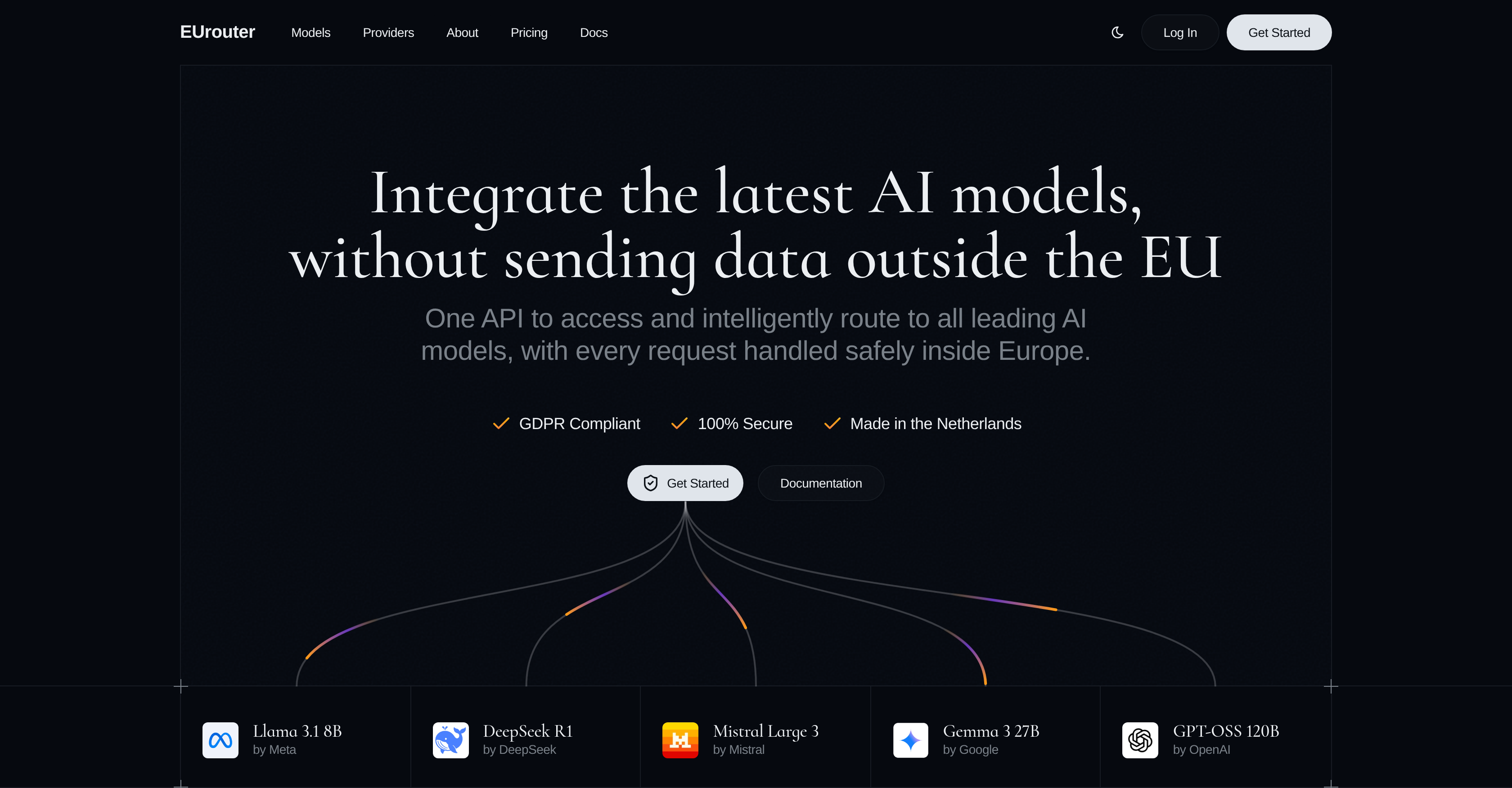
- Eliminate GDPR compliance risks by ensuring all AI model traffic and data handling remain exclusively within the European Union through EU-only routing and zero data retention.
- Access and switch between 100+ leading AI models from providers like OpenAI, Meta, DeepSeek, and Mistral through a single, unified API without managing multiple integrations.
- Automatically optimize for the best price-performance ratio on each request using an intelligent routing system that selects models based on cost, quality, and latency.
- Integrate in minutes with your existing codebase using an API that is a drop-in replacement for the OpenAI API schema, requiring minimal development effort.
- Monitor and control all API usage, costs, and performance metrics like total requests and average latency through a centralized, dedicated dashboard.
- Scale reliably with built-in failover and handle up to 1 million requests monthly on a Pro plan, ensuring service continuity for business-critical applications.
Pros & Cons
Pros
- Ensure GDPR compliance
- All traffic within EU
- Advanced API integration
- Intelligent routing system
- Zero data retention
- Secure data handling
- Beneficial cost-performance ratio
- Quick integration capabilities
- Allows user model integration
- Prevent data breaches concerns
- Ensure privacy violations protection
- Promise full GDPR compliance
- Built-in failover
- Real-time observability
- Per-key limits, spend caps
- Simple integration with codebase
- Real time usage monitoring
- Adjustable performance metrics
- Optimal routing for cost, speed
- Reliable access to popular models
- Secure and compliant solution
- EU data residency enforcement
- Affords model variety access
- Reduces vendor lock-in risk
- Real-time logs and metrics
- Versatile pricing plans
- Organization controls availability
- Controlled API token usage
- Routing for superior uptimes
- Specific model picking option
- Automatic best model selection
- Offers insights into usage
- Streaming support available
- Function calling in JSON mode
- Provides balancing of cost, latency, uptime
- Created in the Netherlands
- Integration documentation provided
Cons
- Geographically limited
- Possible higher latency
- Limited to certain models
- Reliant on multiple providers
- GDPR limits may apply
- Nedd to switch APIs
- May lack enterprise features
- Handling compliancy complexity
- Potential performance inconsistency
- Doesn't offer SLAs
Reviews
Rate this tool
Loading reviews...
❓ Frequently Asked Questions
EUrouter is an artificial intelligence tool that offers a unified API for accessing and intelligently routing to various leading AI models. EUrouter is designed to handle data within the Europe region in order to comply with GDPR requirements. The tool is developed in the Netherlands and offers features such as zero data retention and EU-only routing for all AI traffic, ensuring data privacy and protection. Besides, EUrouter integrates with popular AI models from providers like Meta, DeepSeek, Mistral, and OpenAI, among others.
EUrouter ensures GDPR compliance by making sure that all data is handled within the Europe region. It offers features like EU-only routing for AI traffic and zero data retention. Every request made via EUrouter is handled safely within Europe, ensuring compliance with GDPR. Additionally, EUrouter’s compliance extends to its API keys and maintaining API usage within prescribed limits to prevent any data misuse.
EUrouter can integrate with popular AI models from various providers, including Meta, DeepSeek, Mistral, OpenAI, and many others. According to their webpage, EUrouter can access 100+ AI models, making it a comprehensive tool for businesses needing diverse AI functionalities.
No, EUrouter does not retain any user's data. One of the key features of EUrouter is zero data retention, which aligns with its strong emphasis on data privacy and GDPR compliance.
EU-only routing in the context of EUrouter means that all AI traffic is handled within the boundaries of the Europe region. This ensures GDPR compliance by avoiding the sharing of sensitive data across non-compliant regions or platforms. This feature eliminates concerns about data breaches and privacy violations.
Yes, EUrouter can integrate AI models from popular providers such as Meta and OpenAI, alongside others. The purpose is to allow businesses to use leading AI models while ensuring data security and privacy.
EUrouter's smart routing API is designed to optimize cost, performance, and reliability. It intelligently picks the best model considering factors such as price, quality, or latency, ensuring users get the best price-performance ratio.
The process of integrating EUrouter with existing AI models is made simple and quick. Users sign up for an account and get an API key to have access to the best AI models. The API schema of EUrouter is a drop-in replacement for the OpenAI API schema, which facilitates straightforward integration into an existing codebase.
The smart routing API of EUrouter serves a dual purpose. Firstly, it intelligently routes users to the most optimal AI model, factoring in aspects like cost, quality, and latency. Secondly, it ensures all AI requests are handled safely within Europe, adhering to EU data handling and GDPR compliance requirements.
EUrouter is designed for simplicity and quick integration. With an OpenAI-compatible API schema, EUrouter can be easily brought into an existing codebase. The focus is to make the transition effortless for developers while maintaining stringent data security and GDPR compliance standards.
EUrouter provides a host of benefits for businesses focused in Europe. It ensures all AI traffic remains inside the EU, eliminating data privacy concerns. By offering access to multiple AI models in one place, it eliminates the need for separate integrations. Moreover, it guarantees GDPR compliance, reducing legal and compliance risks. Lastly, with features like smart routing, EUrouter can optimize on cost, performance, and reliability.
Yes, EUrouter provides encryption for data security. The exact details of the data encryption process are not specified on their website, however, given the tool's emphasis on data security and privacy, secure encrypted AI traffic can be strongly inferred.
EUrouter stands out from other AI tools in the Netherlands due to its focus on data privacy, GDPR compliance, and feature-rich unified API. It allows access to multiple popular AI models, intelligent routing systems for optimized performance, and it ensures all traffic remains within the EU region, thereby eliminating concerns over data breaches and privacy violations.
EUrouter's unified API provides a single access point to various leading AI models. Users can sign up for an account, get an API key, and start routing requests to these models. The API is designed to be compatible with existing codebases, making the integration process smooth. It also manages all the underlying complexities, ensuring performance, reliability, and data residency within Europe.
EUrouter emphasizes on data privacy and protection because it operates in the European domain where GDPR rules apply. By ensuring EU-only routing and zero data retention, EUrouter helps businesses access diverse AI models without compromising on data security, thus avoiding potential legal liabilities related to GDPR non-compliance.
The maximum request limit on EUrouter's free plan is 400 requests per month, with a rate limit of 20 requests per minute and a daily limit of 50 requests.
The EUrouter's Pro pricing plan offers a monthly limit of 1,000,000 requests with a rate limit of 150 Requests Per Minute. The Pro plan costs €99 per month and features a cost markup of just 3%.
Although their website does not detail specific custom features in their Enterprise plan, they do mention the availability of more usage or custom features for enterprise customers, indicating a flexibility and scalability in their offering.
EUrouter is designed with an emphasis on compliance, convenience, and customization to meet the unique needs of businesses. On the compliance front, EUrouter adheres to GDPR rules by offering features like EU data handling and zero data retention. For convenience, EUrouter provides a unified API that integrates quickly and easily with existing codebases, and allows access to various leading AI models from one place. As for customization, the smart routing system enables users to optimize according to their particular balance of cost, quality, and latency.
Zero data retention is a significant feature of EUrouter, denoting that the tool does not store any user data. This is crucial for maintaining data privacy and adhering to GDPR requirements, as it alleviates any concerns related to data security, potential breaches, or misuse.
EUrouter provides a unified API that allows access to various leading AI models. Its smart routing system intelligently routes to deliver optimum cost, performance, and reliability. It operates under GDPR requirements, ensuring all data handling remains within Europe.
EUrouter provides access to AI models from a wide variety of providers, including Meta, DeepSeek, Mistral, and OpenAI, among others.
EU-only routing in EUrouter relates to ensuring that all AI traffic is routed only within the European Union, maintaining compliance with GDPR requirements by eliminating any risk of data transfers outside EU borders.
EUrouter's smart routing API operates by delivering the most beneficial route in terms of cost, performance, and reliability. The specific workings of this feature have not been explicitly outlined on their website.
In the context of EUrouter, zero data retention means that EUrouter does not retain any user data, thereby enhancing data privacy and security.
Yes, integrating EUrouter with existing AI models is quick and easy. The platform's API is similar to OpenAI's, facilitating hassle-free integration with existing codebases.
Yes, EUrouter provides an API which is similar to OpenAI's, making it highly compatible and easy to integrate into existing AI systems.
Yes, you can monitor and control your usage of EUrouter through a dedicated dashboard which provides details about their usage.
To get started with EUrouter, users need to sign up an account and obtain an API key. The API key grants them access to various AI models. Detailed integration documentation is provided for the seamless integration of models with existing systems.
EUrouter offers access to AI models from global providers like Meta, DeepSeek, Mistral, and OpenAI, allowing users to access a wide spectrum of the latest AI models.
Yes, EUrouter prides on being easily integratable. It's designed to be a drop-in replacement for the OpenAI API schema, making it simple to integrate with existing codebases.
Yes, EUrouter guarantees that all your data handling stays within Europe. This is a fundamental part of its commitment to GDPR compliance and data privacy.
EUrouter's intelligent routing system is designed to optimize the price-performance ratio. While not detailed explicitly, it likely functions based on user input or preset parameters, choosing the most cost-effective and efficient route according to the situation.
Yes, EUrouter is a one-stop-shop solution to access and utilize a plethora of AI models while also ensuring that all data remains within the European Union for GDPR compliance.
EUrouter being developed in the Netherlands resonates with its commitment to EU-centric operation and compliance with European laws and regulations, like GDPR.
The data security in EUrouter is robust. It operates with zero data retention and all data handling is done within the European Union, eliminating concerns about non-compliant data transfers or storage.
While EUrouter mentions built-in failover and reliability amongst its features, the exact measures for these are not outlined specifically on their website.
EUrouter provides access to the Llama 3.1 8B AI model by Meta, as per the information available on their website.
EUrouter provides a dedicated dashboard enabling users to monitor and control their usage, including details about the total requests, average latency, and other usage metrics.
Pricing
Pricing model
Freemium
Paid options from
$39/month
Billing frequency
Monthly
Refund policy
No Refunds