

HeyBrain
Give every employee and AI agent the same verified answers: a shared AI brain consolidates documents, conversations, and tools into one enterprise knowledge base that serves as your single source of truth.
Listing not yet reviewed by our editors · How we check
Overview
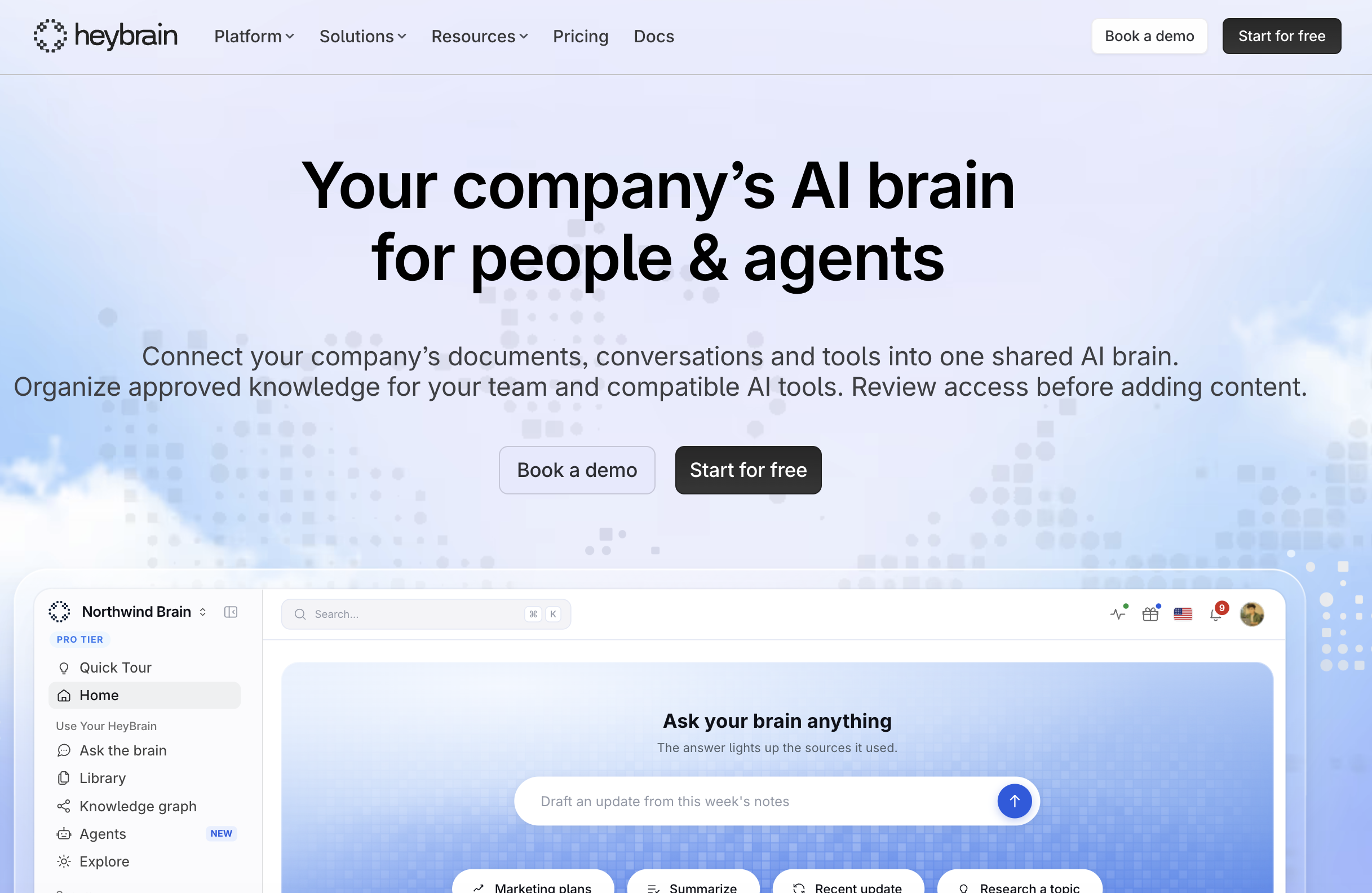
- Give every employee and AI agent the same verified answers: a shared AI brain consolidates documents, conversations, and tools into one enterprise knowledge base that serves as your single source of truth.
- Keep confidential information confidential while still answering questions fast: every AI answer respects your existing data permissions, so people and agents only see what they're authorized to access.
- Pass audits and assign accountability without manual tracking: every access request is logged and tied to a named individual or named agent, giving you a complete audit trail for data governance and verification.
- Find and fix over-shared files before they become a security incident: exposure sweeps scan the knowledge base for sensitive content and flag information shared too broadly.
- Hand off repetitive work and routine decisions: deploy AI agents that automate tasks and act on governed company knowledge within the rules your organization sets.
- Keep using the AI tools your teams already rely on: API key access securely connects external tools and workflows to the central knowledge base, with no need to migrate to a new stack.
- Stop searching through stale documentation: the knowledge base updates continuously from new documents, conversations, and tools, keeping enterprise search results current and instantly searchable.
Pros & Cons
From the listing; not yet checked by our editors.
Pros
- Centralizes documents, conversations, tools
- Emphasis on governance
- Records every access
- Offers automation capabilities
- Deployment of work automation agents
- Sensitive content monitoring, 'exposure sweeps'
- Clear record of every access
- Named individual or agent accountable
- API key facilities for connections
- Single-source-of-truth functionality
- Continuous knowledge base update
- Document centralization
- Enterprise collaboration
- Data permission management
- Data automation
- Security monitoring
- Data verification
- Accessible, optimized knowledge base
- Knowledge management, data governance
- Workspace settings feature
- Agent API key
- Identity, scope, audit records
- Permissions come from the source
- Agent has own identity
- Keeps access, not content records
- Connects spread knowledge
- Reusable skills for team, agents
- Live activity follow-up
- Inherited permissions from source
- Reduced unnecessary token usage
- Find across connected knowledge
- Answer sources for referencing
Cons
- Comprehensive governance may complicate usage
- Requires considerable initial setup
- Highly dependent on existing permissions
- Lacks real-time editing capabilities
- Heavy documentation centralization
- Overall complex tool
- Possible over emphasis on security
- Lack of direct content manipulation
Alternatives to HeyBrain
Tools that share the most tags with HeyBrain.
- Sensay
Retain critical institutional knowledge when employees leave through AI-led interviews that capture their unique expertise and problem-solving approaches
Free trial · from $500/year
$500/year
Not yet checked
- HelpCrunch
Resolve 80% of common customer questions without agent intervention by embedding a smart widget that lets customers search articles before contacting support
Free trial · from $15/month
$15/month
Not yet checked
- SurfSense
Find any piece of information across all company documents in seconds with AI-powered hybrid search that surfaces cited answers from your centralized knowledge base.
Not listed
Not listed
Not yet checked
- Linkly AI
Keep all your documents private and secure with local-only processing that never uploads files to the cloud, ensuring complete data sovereignty.
Free
Not listed
Not yet checked
- Docsie
Publish professional internal and external knowledge bases instantly with markdown and WYSIWYG editing, eliminating complex setup for technical writers and product managers
Freemium · from $89/month
$89/month
Not yet checked
- MemoryBase
Never repeat information to any AI assistant again by storing and retrieving past conversations automatically across ChatGPT, Claude, and Gemini.
Free trial · from $9/month
$9/month
Not yet checked
Reviews
Rate this tool
Loading reviews...
Frequently asked questions
What is Brain and how does it work?
Brain is a governed AI knowledge platform intended for enterprise use. It serves as a centralized hub for a company's knowledge, drawing from documents, conversations, and various tools, and offers a 'shared AI brain'. This shared AI brain allows for staff and AI agents within an organization to access and utilize this knowledge whenever necessary. Moreover, it prioritizes governance by tracking every access and ensuring the AI's responses respect the existing permissions.
How does Brain centralize documents?
Brain centralizes documents by functioning as a unified knowledge platform. The gathered documents are integrated into the 'shared AI brain', forming a consolidated database that can be accessed by staff and AI agents within an organization. This enables quick and efficient information retrieval, reducing redundancy and improving productivity.
How does Brain ensure data governance?
Brain ensures data governance by meticulously recording every interaction with the platform. Every access request is linked to a named individual or a named agent, assigning responsibility for all actions performed on the platform. Moreover, Brain ensures that each answer provided by the AI respects the permissions existing in the system.
What is the 'shared AI brain'?
The 'shared AI brain' is a centralized knowledge base within the Brain platform that consolidifies all of a company's information, including documents, conversations, and tools. This data amalgamation enables staff members and AI agents within the organization to reap insights from the pooled knowledge whenever they require it, enhancing operational efficiency.
Which AI agents can use Brain?
The specifics of which AI agents can use Brain is contingent upon the integrations enabled on the platform. Any AI that an organization uses which is compatible can tap into the knowledge base. Furthermore, Brain does provide automation capabilities enabling deployment of agents to automate tasks.
What automation capabilities does Brain offer?
Brain provides automation capabilities through the deployment of agents. These agents can be programmed to execute various tasks, making informed decisions based on the vast knowledge base at their disposal. The specifics of the tasks they can automate will depend on how they are programmed and the rules set in place by the organization.
How are 'exposure sweeps' managed in Brain?
'Exposure sweeps' in Brain allow users to monitor sensitive content. This feature audits the shared knowledge base, checking for content that may have been over-shared or that might hold sensitive information. This is part of the security and governance measures in place to protect against unauthorized access or improper disclosure.
Can Brain integrate with other AI tools?
Yes, Brain allows integration with other AI tools that a company might already be using. The exact integration capability may vary depending on the specific AI tool. It uses API key facilities for such connections to external implementations.