

Overview
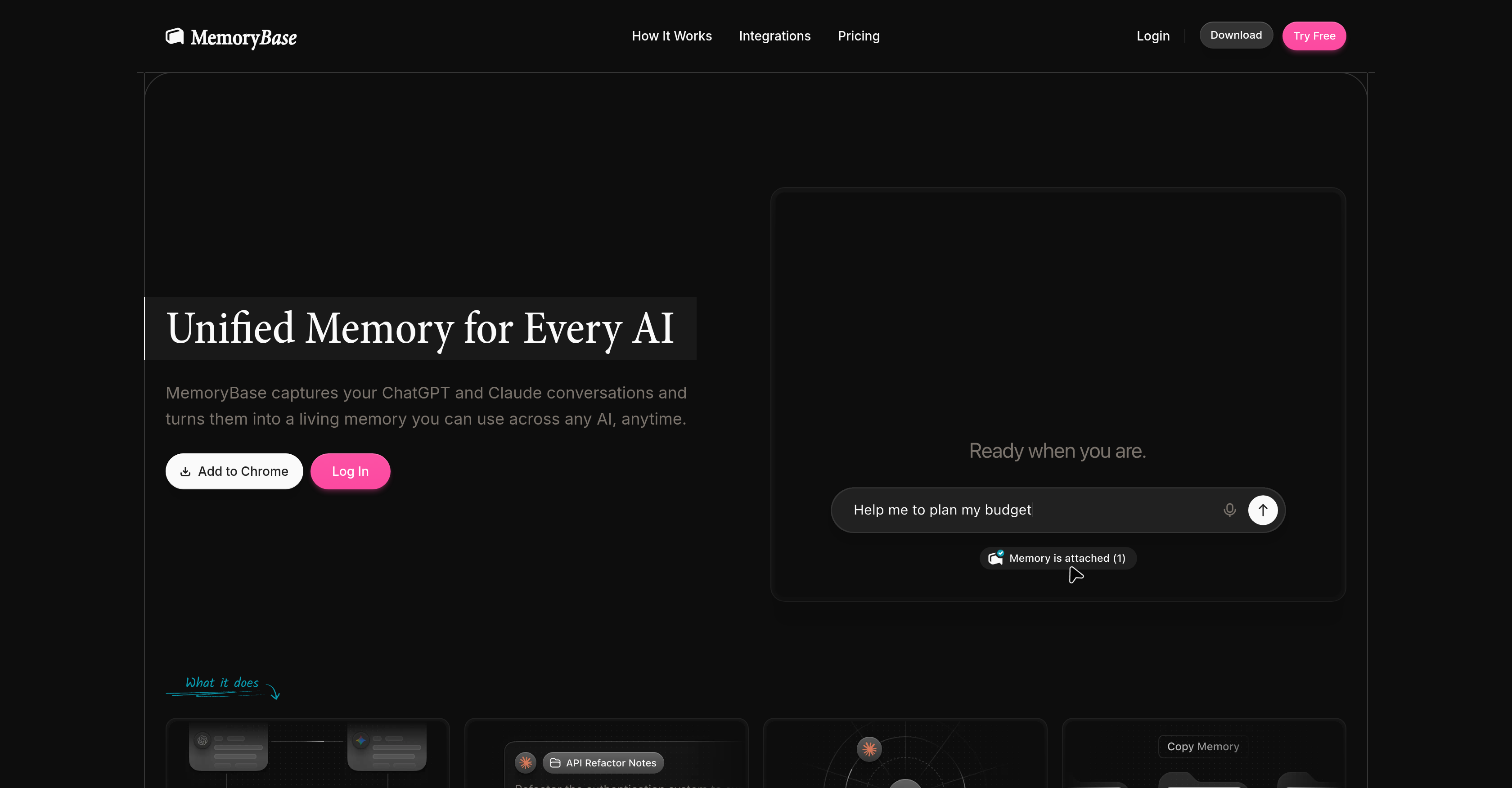
- Never repeat information to any AI assistant again by storing and retrieving past conversations automatically across ChatGPT, Claude, and Gemini.
- Move a conversation thread from one AI tool to another without losing a single detail, using cross-model context transfer that preserves your full history.
- Get personalized responses from every AI tool based on your stored preferences and interaction patterns, without manually re-entering context each time.
- Push any AI conversation directly into your IDE to maintain a continuous thread of discussions while coding, eliminating context-switching.
- Browse your entire conversation history organized by date or project automatically, so you can instantly find past insights without manual filing.
- Control exactly what each AI assistant knows about you by pruning, exporting, or limiting access to specific memories from your unified repository.
- Keep sensitive information private with end-to-end encryption and local data stripping before syncing, ensuring only you decide what leaves your device.
Pros & Cons
Pros
- Unified memory capture
- Cross-model memory functionality
- Seamless context transfer
- User history management
- IDE integration benefit
- Automatic conversation organizing
- User-friendly memory browsing
- Complete data control
- End-to-end data encryption
- Sensitive information kept local
- Project memory access
- Chronological memory browsing
- Project-level memory browsing
- User-defined context packs
- Enhances personalized communication
- Expandable integration capabilities
- Priority support for Pro
- Conversation labelling and organization
- Unlimited chat history (Pro)
- Unlimited context packs (Pro)
- Data pruning availability
- Data export option
- Automated background updates
- Move chats instantly
- Individual agent context adapting
- ChatGPT compatible
- Claude compatible
- Gemini compatible
- Security focused design
- Privacy prioritizing
- User-ran context building
- Context aware agents
- Easy memory export
- Data deletion option
- Free version available
- Pro version for advanced users
- Memory recall for each tool
- One-click full data export
- No lock-in policy
Cons
- Focused on Text-Only Conversations
- Limited integration capabilities
- Data pruning could lead to data loss
- Might be difficult to navigate large volumes of data
- Security concerns with sensitive information
- End-to-end encryption may slow performance
- Limited browsing options of memory
- Potential privacy breaches
Reviews
Rate this tool
Loading reviews...
❓ Frequently Asked Questions
MemoryBase captures dialogue from AI tools ChatGPT and Claude by monitoring and recording the interactions made between users and these AI tools. This process involves the analysis and storage of the various forms of dialogue data these tools generate during conversations.
'Living memory', when referred to MemoryBase, means that the tool does not just store the information from the interactions, but it keeps the data active, accessible, and utilizable in real-time or in future interactions across different AI applications. These stored dialogues can evolve over time, providing a dynamic, up-to-date record of user-AI conversations.
Yes, MemoryBase can be accessed and used at any time and place. It's designed to be available across any AI tool, at any time, providing a consistent record of past interactions even if the location or circumstances change.
MemoryBase helps in reducing repetition of information to AI by storing previous interactions with AI tools. It can then retrieve and utilize this stored information when required, negating the need to repeatedly provide the same information in future engagements with the AI.
The advanced retrieval system of MemoryBase works by efficiently and accurately sourcing data from the stored dialogues during future conversations. It is designed to pinpoint and fetch specific interaction details from a repository of past dialogues, based on the context and requirements of the current interaction.
For users who engage with multiple AI tools concurrently, MemoryBase can prove highly useful as it provides a unified storage space for all their interactive dialogues. This eliminates the need to manage different memory repositories for different AI tools, and also facilitates a more fluid and connected use of various AI tools.
'Tool-agnostic' in the context of MemoryBase means that it is designed to function with any AI tool, irrespective of the tool's specific design or usage parameters. It is not restricted to a specific AI tool or type and can uniformly work with a wide array of AI applications.
MemoryBase improves the quality of interaction with AI tools by eliminating the necessity to repeatedly provide the same information. It stores previous interactions and fetches the relevant data when needed, leading to smoother, more efficient, and contextually aware conversations.
MemoryBase enhances the understanding of user's preferences and context over time by progressively processing and storing the patterns, choices and context-specific details of user interactions. Over time, this stored data creates a reliable record of user preferences that can be utilized to customize future interactions.
Yes, MemoryBase can enable a more personalized interaction experience with AI. By capturing the context and preferences of users over time, MemoryBase can facilitate AI tools to deliver personalized responses, thereby delivering a more user-centric interaction.
MemoryBase enhances efficiency in communication with AI by eliminated the need to repeat information each time. By storing and retrieving past interactions, it allows AI tools to operate within the knowledge of prior dialogues, leading to more time-effective and consistent operations.
Yes, MemoryBase can be used across different AI applications. As a tool-agnostic platform, it is designed for cross-application usage, allowing dialogues to be utilized in any AI tool, which provides a consistent user experience across different applications.
The AI Memory Management feature of MemoryBase works by systematically storing, categorizing and retrieving AI dialogues. It efficiently manages the memory of interactions, making the information easily retrievable when needed for future interactions with any AI tool.
Dialogue Capture in MemoryBase is the functionality that records the interactions between users and AI tools. It captures the input and output of conversations, transforming them into living memory that can be used for future reference during AI engagement.
MemoryBase aids in AI Conversations by providing an accessible record of past interactions. This record can be referenced by AI during conversations, improving the relevance, context-awareness and personalization of the resulting dialogues.
MemoryBase functions as a unified storage for AI tool dialogues by consolidating the interactions from various AI tools into a single, central repository. This facilitates improved access, management, and utilization of stored dialogues regardless of the specific AI tool they originated from.
Yes, MemoryBase can be used with any chatbot. Its tool-agnostic nature enables it to capture and store dialogues from a wide array of chatbots, making it a versatile addition to any chatbot technology stack.
Yes, MemoryBase can help AI gain context awareness. By storing and analyzing past dialogues, it equips the AI with a reference point for context during current or future interactions, aiding in a more contextually accurate and engaging conversation.
MemoryBase stops the user from repeating information to AI by capturing and utilizing the contents of past interactions for future conversations. This implies that once the user provides certain information, they don't need to repeat it in future discussions with the AI tool.
MemoryBase can offer several benefits for general usage across various AI interfaces. These include reducing repetition in interactions, ensuring seamless communication, enhancing interaction quality through better context-awareness, enabling personalized experiences, and generally boosting AI efficiency by reducing redundancy and inefficiencies.
MemoryBase is an artificial intelligence tool that aggregates and stores conversational data from various AI tools like ChatGPT and Claude. This stored data or 'living memory' can be recalled and used in different AI applications, providing a unified memory for every tool.
MemoryBase works by capturing dialogues from different AI tools such as ChatGPT, Claude, and Gemini. These conversations are then transformed into a 'living memory', which can be used across different AI applications, at any time. The memory of these tools is unified into a central hub, allowing effortless transfer of conversation context and user history among AI models. Every AI agent connected with MemoryBase gets necessary context from previous interactions, eliminating the need for repeated information.
'Living memory' in terms of MemoryBase refers to the active and accessible record of dialogues and conversations captured from different AI tools. It serves as a composite memory of user interactions and can be utilized across different AI applications, hence being 'living' and not bounded by time and place.
MemoryBase integrates with other AI tools like ChatGPT and Claude by capturing and storing conversations from these models. The users can then recall these dialogues across any AI tool, anytime. It serves as a beneficial hub for those who engage with multiple AI tools concurrently, providing a unified memory to inform and enhance interactions.
Yes, MemoryBase can be used with multiple AI tools concurrently. It operates as a tool-agnostic application, capturing dialogues from various AI tools and providing a unified living memory for all. It can serve as a common storage space for interactive dialogues across diverse AI interfaces.
The primary purpose of MemoryBase is to create a sophisticated retrieval system for AI conversation memories, thereby eliminating the necessity of repeating information to AI. It aims to create a seamless and efficient communication experience across various AI interfaces by providing a unified memory for all.
MemoryBase can enhance AI's understanding of user's preferences and context by building a compiled dataset of interactions over time. With each captured dialogue, the AI tool gathers more insights about the user's preferences, which can help in personalizing and systematizing the interaction experience.
Key features of MemoryBase include unified memory for every AI tool, end-to-end encryption for data security, organizing conversations automatically by date or project, user control over their interactive dialogues, browsing the memory, data export, transferring context among different AI tools, and pushing any conversation into Integrated Development Enviroonments (IDE).
Unified Memory as per MemoryBase's functionality refers to a central repository created by aggregating separate 'memories' of different AI tools. This central hub stores conversations and dialogues, forming a unified space that can be accessed and utilized for future interactions over various AI applications.
'Tool-agnostic' in context to MemoryBase refers to its ability to operate with any AI tool. MemoryBase captures dialogue and converts it into 'living memory' regardless of the AI tool being used, enabling a wide variety of AI interfaces to benefit from its functions.
MemoryBase reduces repetition and improves interaction quality by maintaining a history of previous interactions and presenting it to the AI. This means users don't need to repeat information, and the AI can better understand the user's preferences and context, resulting in improved interaction quality.
In MemoryBase, users have complete control over their dialogue data. They can browse their memory chronologically or by project, prune unnecessary dialogues, and decide what the AI should know. Furthermore, users can export their stored conversations as per their requirements.
MemoryBase ensures security and privacy of user data by stripping sensitive information locally before syncing. All data is encrypted end-to-end, implying that even MemoryBase servers do not have access to them. Users also have full control over their data and can delete it at any time.
Yes, users can export their conversation data from MemoryBase. Users hold full control over their data and can export everything in just one click.
'Context transfer' within MemoryBase refers to the capability to move or shift an ongoing conversation from one AI tool to another, retaining the context and eliminating the need to re-explain everything each time a user changes their AI tool.
'CrossModelMemory' in MemoryBase refers to the feature that allows conversations and interactions from different AI models to be captured and stored in a unified memory. This feature allows users to move chats amongst different AI models seamlessly, without losing context.
MemoryBase enables seamless transfers of conversation context and user history among AI models by creating a unified memory that stores conversations from all the AI tools. So, when a user switches from one AI tool to another, the context and user history can be effortlessly recalled from MemoryBase, ensuring continuity.
Users can integrate MemoryBase with their Integrated Development Environment (IDE) using its dedicated feature that allows any conversation to be pushed straight into the IDE. Thus, it benefits from the continuous thread of discussions from AI platforms like ChatGPT, Claude, and Gemini.
Yes, MemoryBase has features for automatically organizing captured conversations. Users can browse their memory chronologically or by project. Conversations are labeled and organized automatically, requiring no manual filing.
MemoryBase plans to add more integrations in future including tools like OpenClaw, Slack, Google Docs, and several more. Pro users will get access to every new integration as they launch.
Pricing
Pricing model
Free Trial
Paid options from
$9/month
Billing frequency
Monthly