
Overview
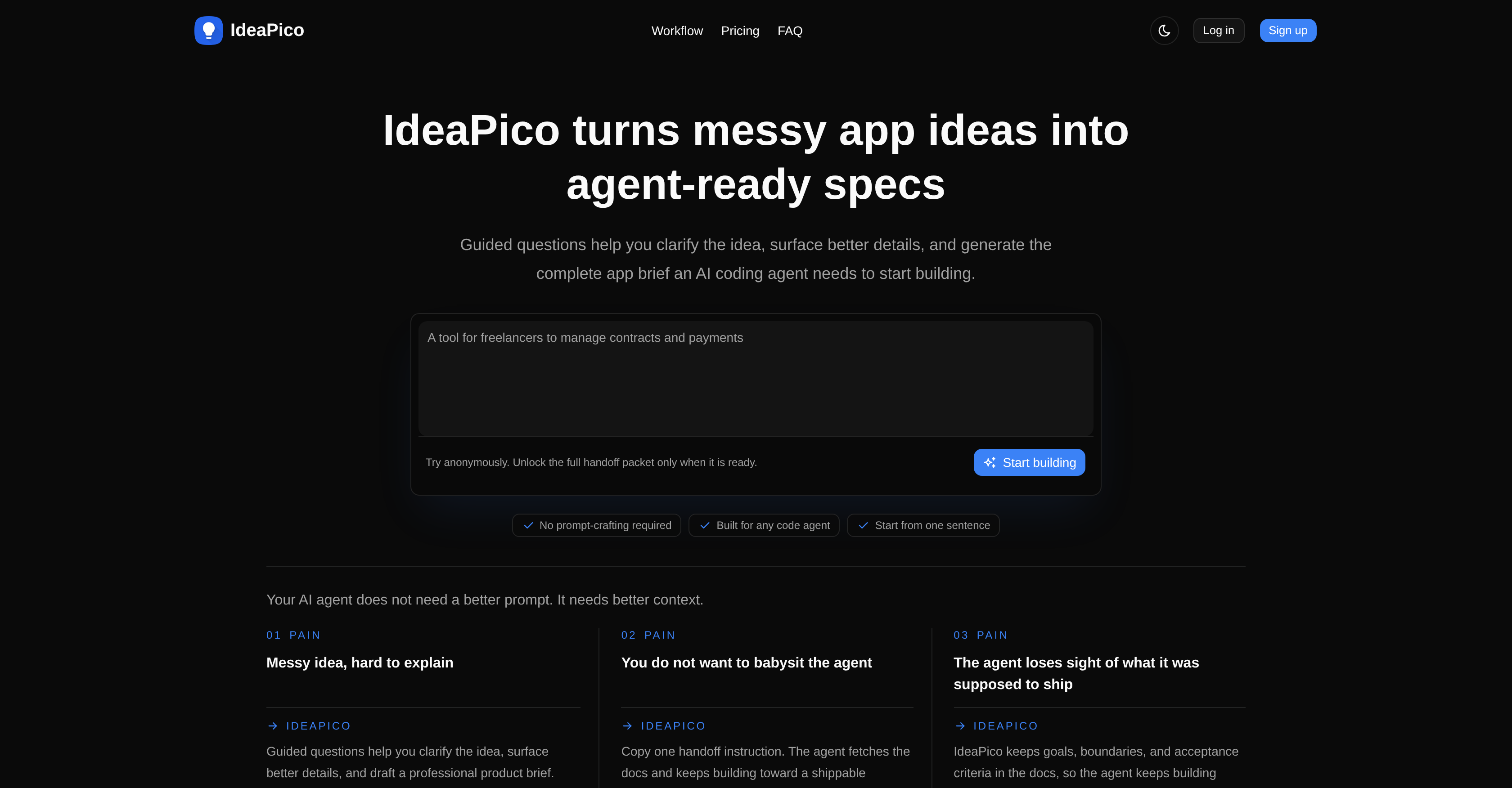
- Go from a single sentence to a complete handoff packet for AI coding agents, eliminating the need for manual prompt crafting
- Capture every critical detail through guided interviews covering product scope, user journeys, edge cases, and acceptance criteria before a single line of code is written
- Ship a fully documented PRD including technical architecture, data model, APIs, and design system rules that any AI agent can execute immediately
- Eliminate mid-build interruptions by collecting all key decisions upfront, so your coding agent never stops to ask for clarification
- Reduce guesswork and misconceptions during development with structured risk assessment and UI design documentation built into every handoff packet
- Deliver a single instruction that any AI coding agent—Codex, Cursor, Claude Code, or v0—can fetch and start building from, with zero additional context
Pros & Cons
Pros
- Generates comprehensive briefs
- Built-in guided questions
- Simplifies handoff process
- Reduces mid-build interruptions
- Offers interview-like process
- Generates app development specs
- Generates technical architecture
- Generates design system
- Helps identify edge cases
- Assesses product risk
- Supports Codex, Cursor, Claude Code, v0
- Provides user journey details
- Details product scope
- Identifies acceptance criteria
- Details APIs
- Details screen rules
- Includes release checklist
- Initial assessment to avoid interruptions
- Creates separate contracts for product, engineering, interface, and delivery
- No need for manual document moving
- One-click handoff instruction copying
- Auto-fetches documents by agent
- Assists in avoiding vague requirements
- Affordable project packages available
- Generates in minutes
- No subscription required
Cons
- Limited customization
- No collaboration features
- No version control
- Limited UI design capabilities
- Not suitable for complex applications
- No real-time editing
- No security features mentioned
- Does not generate code
- No API documentation support
- No offline mode
Reviews
Rate this tool
Loading reviews...
❓ Frequently Asked Questions
IdeaPico is designed to transform rough app ideas into precise technical, design, and product documents for AI coding agents. Its purpose is to assist AI agents in having better context and clarity for building and maintaining the sight of the final product.
IdeaPico transforms app ideas into usable product documents by utilising guided questions, which help users articulate their ideas more clearly. This process generates a comprehensive brief, providing the necessary context and information needed by the AI coding agents to start building.
IdeaPico assists AI coding agents like Codex, Cursor, Claude Code, or v0 by providing comprehensive, easy-to-understand briefs or handoffs from the users' ideas. These handoffs include all the necessary context, thus reducing the chances of missteps and mid-build interruptions. As a result, the AI coding agent can work in a more systematic, organized manner.
The role of guided questions in IdeaPico is to help users articulate their app ideas more clearly by covering critical areas such as product scope, user journeys, edge cases, and acceptance criteria. By answering these guided questions, users are able to provide AI coding agents with all the necessary information they would need to start building.
IdeaPico's handoff process entails generating a comprehensive and organized package for AI coding agents. Once completed, the process requires only one instruction for the AI agent to fetch, which allows them to continue building the product based on the provided handoff package.
Common features of IdeaPico include its interview-like process where it collects necessary decisions before the AI coding agent begins. It facilitates the creation of product context documents such as the product scope, user journeys, edge cases, and acceptance criteria.
IdeaPico generates product context documents which include the product scope, user journeys, edge cases, and acceptance criteria. It also generates the technical architecture, data model, APIs, design system, screen rules, and a release checklist for a full app brief.
IdeaPico enhances the quality and reduces missteps of applications by providing AI coding agents with the complete context right from the start of the build. The systematic process and organised output from IdeaPico ensure AI coding agents have an execution focus, reducing the likelihood of mistakes and increasing the overall quality of the application.
Through its comprehensive approach of generating agent-ready specs, IdeaPico assists in problem-solving and project management in app development. It helps ensure that key decisions are made before the coding agent ventures into implementation, preventing mid-build interruptions and ensuring a smoother app development process.
IdeaPico's interview-like process is a method of asking guided questions to the user to get a clear understanding of the app idea. This helps the AI coding agents to start with a full context, without having to decode vague and confusing aspects of implementation.
Yes, IdeaPico ensures that your AI coding agent has complete context of the task. It does this by creating comprehensive product context documents that encompass product scope, user journeys, edge cases, acceptance criteria, technical architecture, data model, APIs, the design system, screen rules, and a release checklist.
The IdeaPico AI agent needs the comprehensive brief generated from IdeaPico's guided questions to fetch and continue building the product. This brief provides the complete context for the product build, including clarity on the final product and detailed technical and design specifications.
IdeaPico handles product scope, user journeys, edge cases, and acceptance criteria by integrating them as part of the comprehensive brief produced from the guided interview process. These elements are essential to provide the AI coding agent with a clear and precise outline of what the final product should look like.
In the app development process, IdeaPico controls numerous technical details, such as the technical architecture, data model, APIs, design system, screen rules, and even the release checklist. These details provide a roadmap for AI coding agents to effectively perform their tasks.
IdeaPico has a user-friendly interface that begins with the user inputting a crude idea of their desired app. The platform guides the user through a series of questions to gather all necessary details. Once the full context is created, a single instruction is then used for AI coding agents to fetch the information and start building.
IdeaPico simplifies the app development handoff process by providing a single, comprehensive instruction that allows the AI coding agents to fetch the documents and context they need to start building and executing the product development.
Yes, IdeaPico guarantees fewer mid-build interruptions. It designs the interview process to collect all necessary decisions upfront, thereby removing the possibility of confusions and uncertainties during the build process.
IdeaPico contributes to task transparency and execution focus in app development by providing clear, organised output and comprehensive briefs for AI coding agents. This approach reduces stress on the agents, allowing them to focus on execution rather than untangling confusing aspects of the task.
Yes, IdeaPico can indeed help you create a full app brief from a half-formed idea. It uses a series of guided questions to fill in any missing pieces of information and generates a comprehensive, complete context that AI coding agents can use to start building.
The cost associated with using IdeaPico varies based on the user's needs. One complete agent handoff packet is priced at $49 per project. They also offer credit packs for multiple projects; a 3-pack credit pack costs $129 (~$43 per project), while a 10-pack credit pack costs $399 (~$39.90 per project).
IdeaPico is an AI-powered Product Requirement Document (PRD) Generator. Its primary function is to transform app ideas, whether clear or vague, into precise documents encompassing technical, product, and design details. By providing these comprehensive app briefs to AI coding agents, they are better equipped to start building the app users envision. IdeaPico ensures that coding agents receive complete context and maintain clarity throughout the build process, thereby reducing stalls and maintaining a high quality of the final product.
IdeaPico operates through an interview-like process where users begin by inputting a simple sentence or rough concept of their app idea. Guided by IdeaPico's intelligent questioning, the user further articulates their idea by providing details related to product, workflow, data, risk, and UI components, amongst others. These inputs contribute to a comprehensive assessment which is then turned into a complete handoff packet by IdeaPico.
IdeaPico's outputs can be utilized by several AI coding agents. These include, but are not limited to, Codex, Cursor, Claude Code, and v0. By providing a detailed handoff packet, IdeaPico ensures that these coding agents can start building the app with complete context.
IdeaPico generates four types of documents that create a handoff packet - product.md, tech.md, design.md, and ship.md. These documents comprise product scope, user journeys, edge cases, acceptance criteria, technical architecture, data model, APIs, design system, screen rules, and a release checklist. Together, these documents act as a comprehensive guide for AI coding agents to build an app.
IdeaPico conducts its interview-like process by guiding users with numerous questions centered on the key elements of an app. These include product, workflow, data, risk, and UI queries. By answering these questions, users provide IdeaPico with the necessary details that AI coding agents require for a seamless build process.
Using IdeaPico offers various benefits. It simplifies and systemizes the process of transforming vague or messy app ideas into detailed technical, design, and product documents. It allows for a smooth and interruption-free build process by providing AI coding agents with clear, necessary context upfront. Similarly, it improves the quality and relevance of the final application by reducing guesswork and misconceptions during the coding phase.
No, users do not need to create conventional prompts if they use IdeaPico. Its method of generating context-rich instructions eliminates the need for traditional prompt crafting.
In its PRD generation, IdeaPico covers various areas that are critical for app development. These include product scope, user journeys, edge cases, acceptance criteria, technical architecture, data modeling, API specifications, design system, screen rules, risk assessment, UI design, and a release checklist.
Yes, IdeaPico is capable of generating technical architecture and data models. This is part of the comprehensive information pack that IdeaPico provides to ensure AI coding agents have complete and relevant context.
The handoff packet from IdeaPico includes four primary documents that cover different aspects of app development. These documents detail the product scope, user journeys, edge cases, acceptance criteria, technical architecture, data model, APIs, design system, screen rules, components, and a release checklist.
The specific time it takes to get the final output from IdeaPico is not stated explicitly on their website. However, it is suggested that the output is delivered in a timely manner.
The primary difference between a regular prompt and IdeaPico's output is the level of context provided. While a typical prompt simply instructs the AI agent on what to do, IdeaPico's handoff packet provides detailed context, scope, and verification criteria. It reduces ambiguity, focusing more on the delivery target and less on guesswork.
Yes, IdeaPico is designed to accommodate vague or half-formed ideas. Users can start by providing a loosely formed concept or a single sentence about their app. IdeaPico will then guide them through an in-depth questioning process to surface and clarify all necessary details.
IdeaPico helps in avoiding project interruptions by ensuring that all necessary decisions and crucial context are collected before the AI coding agent begins implementation. This thorough initial assessment minimizes the need for interruptions during the build process, enabling a smooth and efficient delivery.
Yes, IdeaPico does offer risk assessment and UI design documentation in its packet. The generated documentation includes product positioning, user flows, architecture, APIs, design direction, deployment, and delivery steps.
Yes, IdeaPico is indeed a suitable tool for beginners in app development. Its entire process is designed to convert vague ideas into comprehensive, ready-to-build specs which can then be used by AI coding agents. As such, users do not need to have deep technical knowledge or experience in prompt crafting.
IdeaPico provides a better context for AI coding agents by generating an exhaustive PRD containing all necessary information required for a smooth coding process. By answering IdeaPico's guided questions, users furnish the details which IdeaPico transforms into a clear and comprehensive brief for AI agents.
IdeaPico's process is more systematic and organized than other PRD generators due to its interview-style questioning that targets crucial aspects of app development. Additionally, it processes this information to produce a handoff packet that splits product, tech, design and shipping aspects into separate documents, making it easy for AI agents to understand and execute the project.
IdeaPico facilitates the handoff process to AI agents by creating a detailed handoff packet from the user's idea. This packet contains all relevant details, categorized into separate documents for product, engineering, interface, and delivery aspects. The user simply needs to copy and send a final instruction to their coding agent, eliminating the need for manual document moving.
Yes, the handoff package generated by IdeaPico can be sent to multiple AI coding agents at once. It only requires the user to copy and paste the final instruction to their chosen agents like Codex, Cursor, Claude Code, v0, or others.
Pricing
Pricing model
Paid
Paid options from
$49
Billing frequency
One-time