
Overview
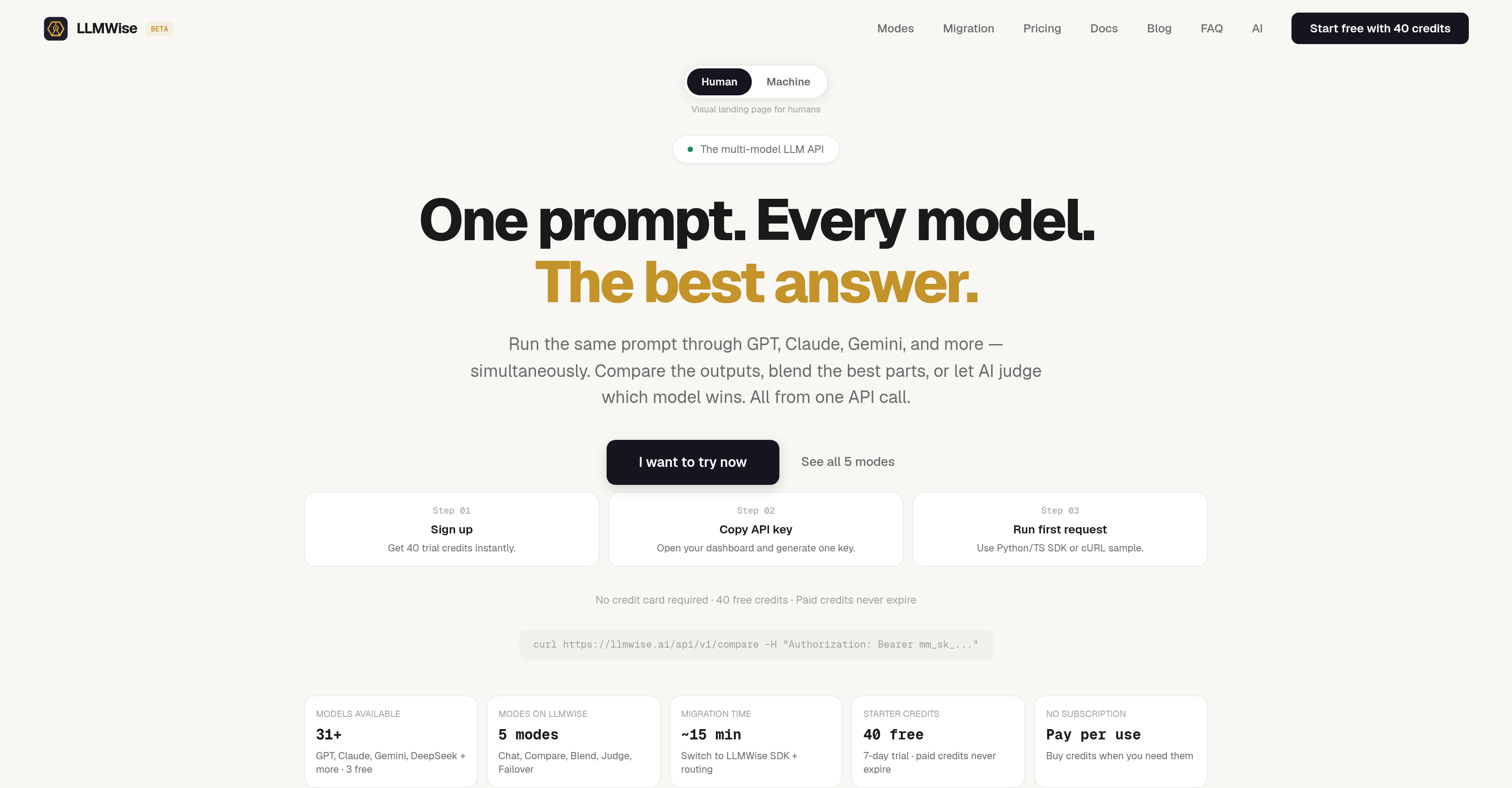
- Instantly compare outputs from GPT-5.2, Claude, Gemini, and other top models side-by-side with a single API call, identifying the best performer for your specific task.
- Create superior responses by blending the best components from multiple AI model outputs, combining their unique strengths into one optimized result.
- Automatically route each request to the most suitable AI model using smart routing, ensuring optimal performance without manual selection.
- Maintain production reliability with circuit-breaker failover that detects and skips unhealthy models, preventing system-wide failures.
- Protect sensitive data with zero-retention mode where prompts and responses are never stored or used for training.
- Pay only for what you use with a flexible pay-per-use credit system and no subscriptions, with initial free credits that never expire.
- Integrate in minutes with a low-friction migration process estimated at 15 minutes, swapping your existing client to the LLMWise SDK.
- Receive real-time, streamed responses with detailed per-model metrics on latency, token counts, and cost for full transparency.
Pros & Cons
Pros
- Multi-model API
- Model comparison, blending, routing
- Run single prompt through multiple models
- Smart model selection
- Low-friction migration process
- Zero-retention mode (data security)
- Pay-per-use pricing
- Initial free credits
- Non-expiring credits
- Side-by-side responses
- Latency, tokens, cost metrics
- Circuit-breaker failover
- Real-time responses
- Simultaneous hits
- Supports POST requests
- Real-Time SSE Streaming
- No subscription needed
- GPT-5.2, Claude, Gemini, DeepSeek supported
- Single API Call integration
- Automatic best model selection
- Same prompt, multiple model responses
- Failover for production reliability
- Facilitates orchestrated modes
- Single API for accessing models
- Real-time responses with performance metrics
- Latency, token counts and cost metrics
- API Integration with pay-as-you-go system
- Zero-retention for data security
- Supports circuit breaker failover
- Supports various modes for operation
- Provides SDK for quickstart
- Supports Python and TypeScript
- Credit-based pay-per-use
- Zero-retention mode (no data training)
- Bring-your-own-keys (BYOK supported)
- Audit-ready logging
- Enterprise-grade security defaults
- Real-time streaming with SSE
- Starts with 40 free trial credits
- Flexible orchestration modes
- Total API compatibility
- Supports 31 models across providers
- Budget controls per request
- Rating limit with instant failover
- Automatic cost saving
- Circuit breaker for production reliability
- Full data purge facility
Cons
- Limited free credits
- Pay-per-use basis
- Requires API management
- Dependency on response speed
- 3rd-party provider dependency
- No subscription model
- Low data retention
- Over-reliance on smart routing
- Not fully open-source
- Limited to available models
Reviews
Rate this tool
Loading reviews...
❓ Frequently Asked Questions
LLMWise is an API designed to streamline the use of multiple AI models through a single interface. It offers the ability to compare, blend, and route between multiple AI models simultaneously. It also provides data security through a zero-retention mode, works on a pay-per-use basis, gives initial free credits, and provides detailed results including latency, tokens, and cost metrics for each model.
LLMWise enables users to run a single prompt through multiple AI models at the same time, compare their outputs, blend the best parts of these outputs or let the AI select the most suitable model. This is all achievable through a single API call. It also offers smart routing, choosing the best model for a specific request based on a set of measures.
LLMWise gives users access to several AI models including GPT-5.2, Claude, Gemini, DeepSeek, and Llama, among others.
LLMWise's comparison feature enables users to run a single prompt through multiple AI models simultaneously. The responses from each model are provided side by side, with detailed metrics such as latency, token counts, and cost for each model. This allows users to compare and determine which model performs the best for their specific prompt.
The blending feature in LLMWise allows users to combine the best parts of outputs from multiple AI models. The output from each model is compared and the highest value inputs are selected to create a blended response, enhancing the quality and completeness of the final output.
Smart routing in LLMWise is an AI-driven feature that selects the best model for a specific request based on a set of predefined measures. This ensures optimal results for the users' requests without manual intervention.
In LLMWise, the low-friction migration process allows users to switch from their existing solution to LLMWise quickly and smoothly. It is estimated to take around 15 minutes, and involves swapping the client’s existing client to the LLMWise SDK and setting the API key.
LLMWise uses a zero-retention mode to ensure data security. In this mode, users' prompts and responses are never stored or used for any kind of training, providing a secure layer that safeguards client data.
LLMWise operates on a pay-per-use system, meaning users only pay for the service as and when they use it. The platform does not demand a subscription, and initial free credits are provided which can be used to utilize the platform. Additional credits can be purchased as needed.
The initial free credits provided by LLMWise can be used by users to utilize the platform and its services. These credits can be used to facilitate comparison, blending, and routing of AI models and to get a feel for all the other features LLMWise provides.
In LLMWise, the credits provided do not have any expiry date. Both the initial free credits and the additional credits purchased later can be used by the user at any time they require.
LLMWise renders side-by-side responses in one API call by simultaneously running the same prompt through multiple AI models and streaming back their responses in real-time. This gives users the opportunity to compare the outputs of each model, their latency, token counts, and cost on a single screen.
LLMWise can be used for efficient data management across different AI models by leveraging its multi-model support. Users can simultaneously process and manage data from various models in one platform, compare their outputs and choose or blend the best results. All these can be done through a single API call which simplifies and streamlines data management.
LLMWise determines the best model for a specific request through its smart routing feature. This feature selects the most suitable model based on a predetermined set of measures. This decision-making process is driven by AI and helps to optimize the results for users' specific requests.
The latency, tokens, and cost metrics in LLMWise is a feature that provides detailed information about each AI model's performance for a specific prompt. Latency refers to the model's response time, tokens refer to the number of units of information the model processed, and cost refers to the overall cost for using the model – all of which are provided for each model per request.
LLMWise becomes a consolidated platform for multiple AI models through its ability to facilitate the usage, comparison, blending, and routing of different AI models via a single interface. It also offers the convenience of a pay-per-use pricing structure, zero-retention mode for data security, and in-depth results detailing latency, tokens, and cost metrics per model. All this aids in efficient management and utilization of various AI models.
Yes, LLMWise can route all AI model requests through a single API call. Users can run the same prompt through multiple AI models simultaneously, obtain their outputs, compare them, and blend the best parts or let AI decide the most suitable model all in a single API call.
LLMWise supports both comparison and blending of AI model responses through its multi-model interface. Users can provide a single prompt that is simultaneously processed by several models, and the responses are compared side by side. In terms of blending, LLMWise allows to merge the best parts of these responses from different models into a single output.
LLMWise provides a quick and efficient low-friction migration process which is estimated to take around 15 minutes. This involves swapping an existing client to the LLMWise SDK, setting an API key, defining cost, latency, and reliability policies, and testing and validation before final rollout.
LLMWise selects the most suitable model to run a single prompt through its AI-driven smart routing feature. This feature assesses each model performance against a set of measures and chooses the most suitable one for each specific prompt.
LLMWise's multi-model API allows users to run a single prompt through multiple AI models at once, compare the outputs, blend the best parts, or let AI decide which model's output is the best. It also provides smart routing to select the most suitable AI model based on specific measures, and supports real-time responses with metrics on latency, token counts, and cost. In addition, users can enjoy data security with its zero-retention mode feature.
LLMWise provides access to a broad range of AI models which include, but are not limited to, GPT-5.2, Claude, Gemini, DeepSeek, Llama, and Grok.
Users of LLMWise can run a single prompt through various AI models simultaneously by simply inputting the prompt in the provided interface. The models are then hit with the same prompt at once and the responses are returned in real time.
LLMWise's 'smart routing' feature is its ability to intelligently select and use the best AI model for a given request. This selection is based on an internal set of parameters and measures, ensuring the most suitable model handles the task, thereby increasing efficiency and robustness.
LLMWise ensures data security through its zero-retention mode. In this mode, user prompts and responses are never stored or used for any type of training. This feature offers a layer of privacy and security, assuring that user's data are not repurposed.
According to LLMWise, their migration process is low-friction and takes roughly around 15 minutes. This simplifies the process of switching to their platform.
LLMWise operates on a pay-per-use pricing model. It offers users a certain number of initial free credits that never expire, and additional credits can be purchased as needed. There are no subscription tiers.
No, LLMWise does not have a subscription feature. It operates on a pay-per-use cost structure, which eliminates the need for monthly or annual subscriptions. Users can buy credits as needed, and these credits never expire.
Yes, LLMWise has functionality to compare different AI model outputs. The same prompt is run through different models simultaneously, and the responses can be compared side by side. This provides a more holistic picture of the different model outputs, helping users to make informed decisions.
Yes, LLMWise can blend outputs from different AI models. Users can blend the best parts of each model's output to produce an optimised response. This feature allows for the combining of strengths of each AI model for a more accurate and comprehensive result.
LLMWise provides side-by-side responses in a single API call. It produces metrics containing information about latency, token counts, and cost for each model. The summary report includes the fastest, longest, and cheapest model for a clearer and comparative overview.
In LLMWise, latency represents the time taken by a model to return results. It measures the delay between the prompt input and output, and this metric is given for each model in the comparison summary results.
For production reliability, LLMWise uses a circuit-breaker failover mechanism. It detects unhealthy models and proactively skips them. This helps to maintain a consistent and reliable flow of operations, ensuring seamless service and preventing the entire system from failing.
LLMWise's side-by-side model comparison feature works by running the same prompt through multiple models simultaneously and delivering the responses in real-time. Users can then compare the responses, latency, token counts, and cost of each model at a glance, all in one API call.
LLMWise's circuit-breaker failover feature safeguards against system failures by detecting unhealthy AI models and skipping them proactively. This ensures that a glitch in one model does not affect the entire operation, maintaining consistent service delivery.
Yes, LLMWise provides real-time responses. The API hits multiple models simultaneously with the same prompt, and the responses are then streamed back to the user in real-time.
Token count in LLMWise refers to the number of tokens used by a model in addressing a prompt. This metric is part of the per-model data returned by the system, alongside latency and cost. It gives users an insight into the model's processing depth.
The API integration process with LLMWise is straightforward and is estimated to take around 15 minutes. It involves a simple POST request with real-time SSE streaming, with LLMWise offering official Python/TS SDKs for easier integration.
LLMWise supports a range of APIs within its multi-model platform. Some of these include GPT-5.2, Claude, Gemini, DeepSeek, and many others. The tool enables access, comparison, blending, and routing among these different AI models through a single API call.
Pricing
Pricing model
Free Trial
Paid options from
$10/unit
Billing frequency
Pay-as-you-go
Refund policy
No Refunds