

Overview
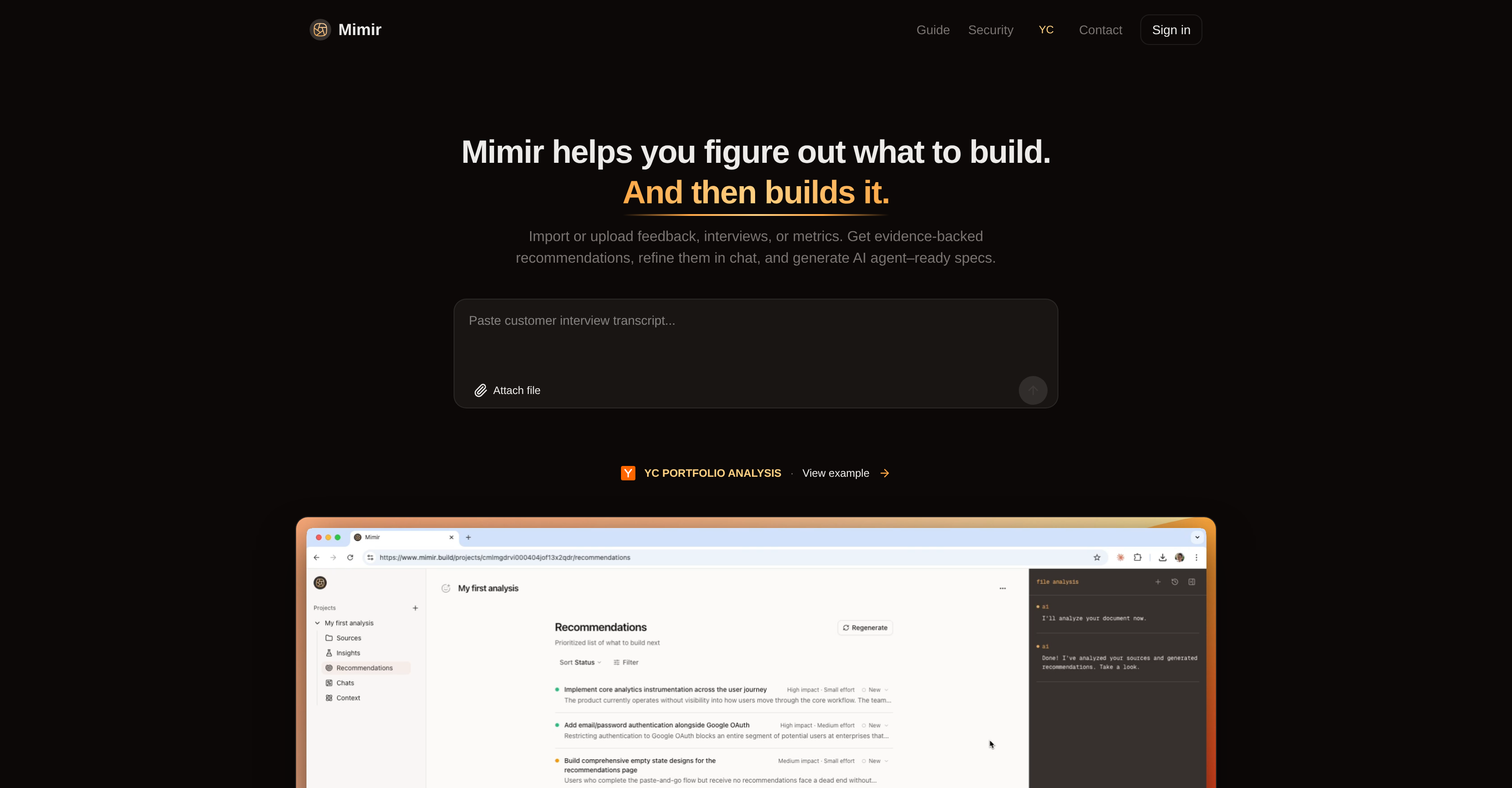
- Transform scattered customer feedback into a clear product roadmap using a structured pipeline that extracts and categorizes pain points, feature requests, and metrics.
- Identify your most severe and recurring problems by uncovering hidden patterns across dozens of data sources with hierarchical analysis that clusters insights into themes.
- Get ranked, evidence-backed recommendations for what to build next, each with impact projections and effort estimates tied directly to your original data.
- Accelerate development by turning recommendations into ready-to-build specs and GitHub issues that integrate directly with AI coding agents.
- Refine every AI-generated insight through an interactive chat to tailor recommendations to your specific business context and goals.
Pros & Cons
Pros
- Transforms feedback into decisions
- Generates evidence-supported recommendations
- Built-in interactive chat
- Automates detailed specifications creation
- Integrates with GitHub
- Facilitates efficient feature development
- Draws structured insights
- Categorizes important data points
- Clusters data into themes
- Identifies severe and recurrent problems
- Generates ranked recommendations
- Considers business context and best practices
- Projections of impact included
- Effort estimates included
- Clear rationale for recommendations
- Adaptive learning feature
- Aligns to business-specific context
- Turns metrics into actionable insights
- Built-in refinement features for recommendations
- Extracts structured data from user feedback
- Groups insights into prioritized themes
- Weights data based on relevance
- Sources are linked back to data
- Analyzes large-scale data patterns
- Complete specs and GitHub issues
- Facilitates rapid feature development
- Adapts recommendations to specific needs
Cons
- Limited third-party integrations
- Relies heavily on good data
- Closed proprietary algorithm
- No real-time analysis
- Possible bias in hierarchical analysis
- No manual data categorization
- No user customization
- Dependency on GitHub for tasks
- No direct customer interaction
Reviews
Rate this tool
Loading reviews...
❓ Frequently Asked Questions
Mimir is an AI-native product management tool. Its purpose is to aid companies in determining their next steps in product development and implementation. By leveraging customer interviews, feedback, and usage data, Mimir provides evidence-based product decisions. It enables users to import or upload feedback or metrics and offers evidence-supported recommendations, which are further honed by Mimir's interactive chat. Importantly, instead of merely suggesting what to build, Mimir automates the process of creating specifications and tasks for implementation which can then be seamlessly integrated with GitHub and other AI coding agents.
Mimir leverages AI to turn customer feedback, interviews and usage data into actionable, evidence-supported product decisions. It automates the process of creating detailed specifications and tasks for implementation, enabling the efficient development of software features. The AI also clusters data into themes using hierarchical analysis. This helps in recognizing the most pressing and recurring issues and their interconnections. It also generates ranked recommendations based on the business context, synthesized themes and product management best practices.
Mimir processes various forms of user input data. The inputs can be customer interviews, feedback, metrics, or any other relevant information uploaded or imported by the user. The tool can handle a variety of data types, making it versatile for different business scenarios.
Mimir processes customer feedback and usage data through a dedicated pipeline purpose-built for extracting structured insights, clustering them into themes, and generating prioritized recommendations. It reads through the source material, identifies and categorizes essential components such as pain points, feature requests, observations, competitive signals, and metrics. These points are weighted by importance and traced back to their original source.
As part of its specification and task automation feature, Mimir can integrate recommendations directly with GitHub. It can generate complete specs and implementation tasks as GitHub issues. This feature accommodates quick integration into AI coding agents such as Claude Code, Cursor, along with others, enabling rapid and efficient feature development.
Mimir's interactive chat allows users to refine the evidence-backed recommendations that the AI provides. It serves as a user-friendly interface for users to give feedback, providing a space in which the recommendations generated by the AI can be modified and finetuned according to the user's requirements or preferences.
Mimir uses AI to automate the creation of specifications and tasks for implementation. The AI parses and processes the uploaded or imported information, then uses this to generate comprehensive specs and tasks that align with the user’s business context and best practices in product management. These detailed specifications and tasks can then be integrated with GitHub and other AI coding agents, thus facilitating quicker feature development.
Mimir extracts and categorizes data by reading through user-provided sources and identifying crucial points like pain points, feature requests, observations, competitive signals, and metrics. It categorizes each of these data points and assigns weights based on importance. Each data point is then traced back to its original source for context and evidence, providing a clear rationale for recommendations.
Mimir's hierarchical analysis is a feature that clusters extracted data into themes. It helps Mimir identify which problems are most severe, most recurrent, and how they interconnect, even across multiple data sources. This method allows for a comprehensive and organized examination of data.
Mimir identifies severe and recurrent problems by analyzing themes generated from structured insights. It uses hierarchical analysis to cluster data points, allowing it to discern which problems show up most frequently and which are most severe based on their recurrence and impact, respectively.
Mimir formulates its recommendations based on synthesized themes derived from the extracted data, the specific business context, and best practices in product management. Each recommendation includes impact projections, effort estimates, and a clear rationale tied back to the evidence from the data.
The learning function of Mimir comes into play as users continuously employ the tool. Mimir is designed to adapt over time to the business context of the user. The more the tool is used, the more effectively it aligns its recommendations with the ongoing metrics and business context of the said user's enterprise.
Mimir, over time, progressively aligns its recommendations to your business context. It learns from every source and conversation—the product, users, goals, competitive landscape, and key metrics. The more you interact with Mimir, the more it tailors its recommendations based on what actually matters to your business.
Mimir's impact projection is part of its recommendation mechanism. Each recommendation it generates includes a prediction of the expected or potential impact. These projections are based on the synthesized themes, business context, and product management best practices.
Mimir estimates effort by including a measure of the expected resources and time it would take to implement each recommendation. This provides users with a balanced and evidence-backed projection of what it would take to realize each recommended step.
Mimir's recommendations are influenced by product management best practices. The AI-nature of the tool enables its recommendations to be grounded in recognized effective methodologies. It synergizes these practices with the specific business context and synthesized themes from the data, offering solid, ranked recommendations.
Mimir turns feedback into buildable product specs by using AI to process the feedback, generate relevant insights and then automate detailed specifications and tasks for implementation. This entire process results in actionable specs that are ready for the development process and linked directly to the feedback obtained.
Yes, Mimir can analyze competitive signals and metrics. It is designed to extract and categorize key data points including pain points, feature requests, observations, competitive signals, and metrics. This helps in generating holistic and evidence-based recommendations.
Yes, Mimir can identify interconnections between problems. It clusters categorized data points into themes using hierarchical analysis. This enables it to determine how different problems connect, thereby providing a comprehensive understanding of the underlying issues and relationships.
Yes, you can refine Mimir's recommendations. The tool provides you with evidence-supported recommendations that can be modified via its interactive chat platform. This allows for a more tailored application of the AI tool, suited to the user’s specific preferences or requirements.
Mimir is an AI-native product management tool that helps companies determine their next steps in product development and implementation. It processes customer interviews, feedback, and usage data, turning them into evidence-based product decisions. Mimir provides users with recommendations supported by evidence, and these suggestions can be further refined via its interactive chat.
Mimir leverages AI to transform user feedback, customer interviews, and usage data into actionable product insights. Through a uniquely designed pipeline, it extracts and categorizes key data points such as pain points, feature requests, observations, competitive signals, and metrics. It employs hierarchical analysis for clustering these data points into themes to identify recurrent problems and their interconnections.
You can import or upload various types of data into Mimir, including user feedback, interviews, metrics, and customer usage data. Each piece of data is then processed and insights extracted for further actions.
Mimir transforms user feedback into actionable product insights through a specially designed pipeline. It extracts structured data and insights, groups them into themes using hierarchical analysis, and produces prioritized product recommendations. Every data point, be it a customer pain point, feature request, or a metric, is categorized and weighted based on its relevance and importance.
Mimir provides ranked recommendations that are based on the synthesized themes from the data, the ongoing business context, and product management best practices. Each recommendation includes impact projections, effort estimates and a clear rationale mapped back to the original data.
Yes, Mimir's recommendations can be refined. Users can do this through the tool's integrated chat feature, allowing them to have direct input into the guidance provided based on their data.
Yes, Mimir integrates with other tools, including GitHub. It can transform product recommendations into complete specifications and GitHub tasks, making for faster and more efficient feature development.
Yes, Mimir does automate the process of creating detailed specifications and tasks for implementation. This automation allows Mimir to integrate with platforms such as GitHub, enabling faster feature development with the help of AI coding agents.
Mimir draws insights from data by extracting and categorizing key data points such as pain points, feature requests, observations, competitive signals, and metrics. The data is then clustered into themes using hierarchical analysis, assisting Mimir in identifying the most pressing and recurrent problems along with their relationships.
Yes, Mimir can detect pain points and feature requests. The AI reads through the sources and pulls out these key pieces of information, which are then categorized and weighted according to their importance.
Mimir employs a hierarchical analysis to categorize and cluster data. This analysis allows it to identify patterns, the most severe or recurring problems, and how these problems interrelate, even across multiple sources.
Hierarchical analysis is a method of data analysis where the data is grouped based on similarity or dissimilarity. In the context of Mimir, it uses hierarchical analysis to cluster key data points, such as pain points, feature requests, observations, competitive signals, and metrics into themes. This is a crucial step in its identification of recurring problems and their relationships.
Mimir's recommendations are ranked based on synthesized themes from the data, business context, and best practices in product management. Each recommendation contains a clear rationale linked to the evidence.
Yes, Mimir's recommendations include impact projections and effort estimates. These elements help provide a full picture of each recommendation, leading to informed and evidence-based decisions.
Mimir learns from ongoing business context and metrics through its learning function. As it receives more data and becomes more familiar with the business context, its recommendations become more aligned with what matters to your business.
Mimir can be used for product strategy development by transforming customer feedback into shippable product features. As it identifies recurring problems and their interrelations, it recommends the most impactful steps to take next, allowing for the formation of a proactive and data-driven product strategy.
Each piece of data analyzed by Mimir is categorized, weighted based on its importance, and traced back to its original source. This means the relevance of each piece of data is considered in context, ensuring that the most impactful insights are drawn and prioritized in Mimir's recommendations.
Mimir identifies the most severe or recurring problems through hierarchical analysis, which enables pattern recognition across a vast swath of data. From this, it identifies which problems are most pressing and occur most frequently, even across dozens of sources.
Yes, Mimir can be used with AI coding agents. It creates GitHub issues from your recommendations complete with specs and tasks for implementation, which can then be used by AI coding agents to develop and deploy features in hours – not weeks.
Mimir caters to different business considerations and needs by aligning its recommendations with what actually matters to the business. As Mimir processes more data and learns more about the business context, its recommendations become more tailored and valuable to the user's specific business considerations.
Pricing
Pricing model
Pricing
Paid options from
N/A