
Momen.app
Overview
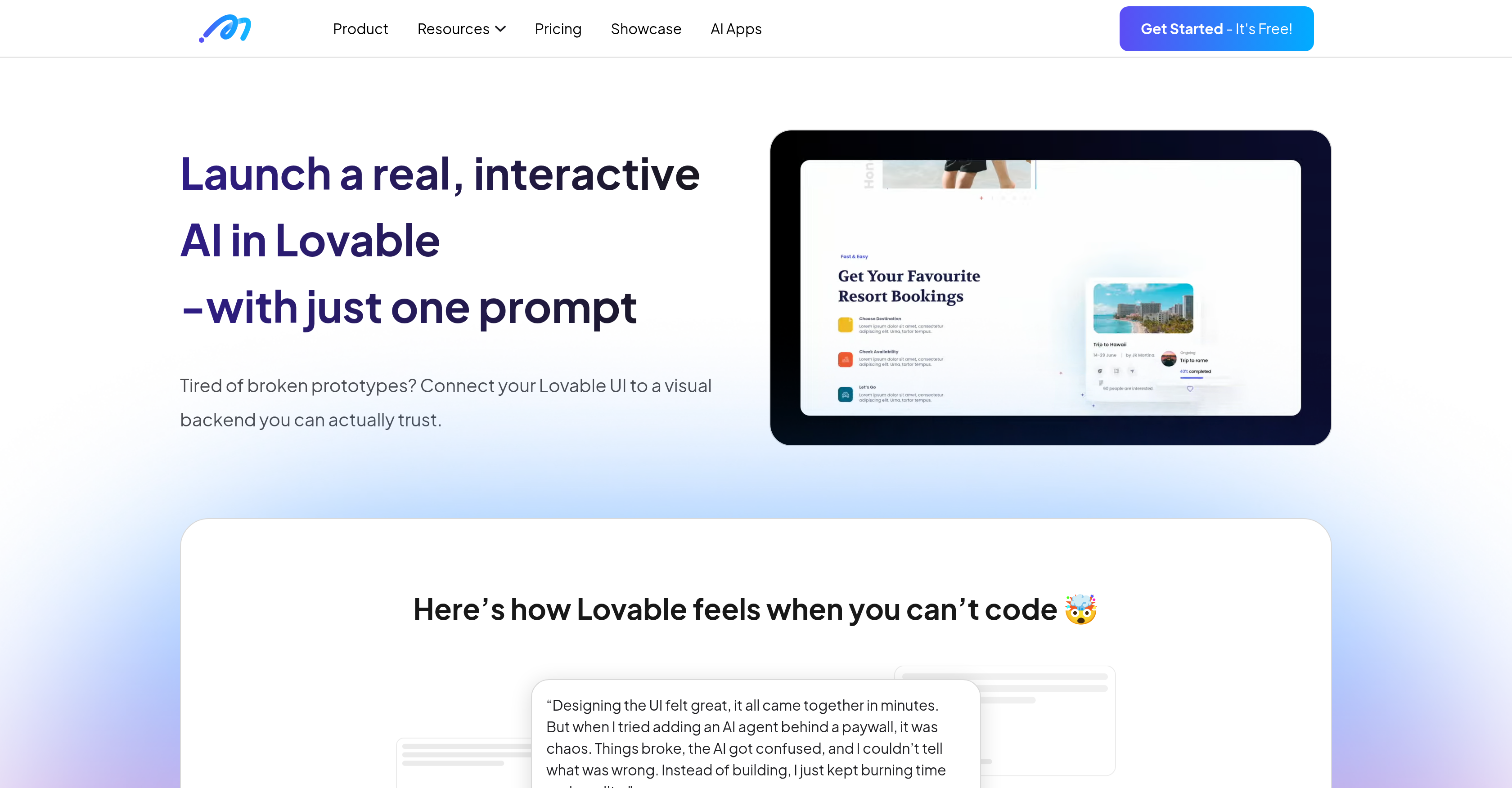
- Launch a functional app from your prototype in minutes, not months, by connecting your Lovable UI to a complete visual backend with a single prompt.
- Build with reliable, production-ready AI that interacts with your database and APIs without errors, using native agent builders and RAG for trustworthy performance.
- Monetize instantly with built-in Stripe payments and paywall functionality, eliminating the need for complex payment gateway integrations.
- Manage users securely with a production-grade user database you control, featuring secure sign-ups and full data ownership.
- Scale your app confidently by minimizing coding errors and broken prototypes, streamlining the entire creation and iteration process.
- Learn and build faster using pre-built app templates and comprehensive resources like documentation, videos, and a community forum.
Pros & Cons
Pros
- Prototypes to applications conversion
- Visual backend integration
- Operational business features integration
- Native agent builder
- User database management
- Stripe payments integration
- App monetization support
- Database, APIs, Actioflow connection
- Chain agents supporting feature
- Provided learning resources
- Pre-built app availability
- Reduces coding errors
- Minimizes prototype interruptions
- User interface connection
- Multiple apps development
- Productive for non-technical founders
- Simplified app scaling
- User Interface and Backend Development
- Business Features Integration
- API Integration
- Database Interaction
- Payment Integration
- Instructional Videos, User Forum
- User system you control
- Production-grade user database
- Secure sign-ups and management
- Monetize and grow functionality
- Availability of pre-built app
- Ease of setting up agents
- Data connection made easy
- Focus on user experience
- Prevents system confusion
- Reliable agent interaction
- Paywall functionality
- Hands-on forum support
- Ease of agent blueprint copying
- Blueprint paste-to-convert functionality
- Step-by-step project guidance
- Hands-on app launch support
- Backed by reputable firms
- Comparative assessment availability
- United States hosting
- Dedicated user system
- Agent blueprint conversion
- Ease of copying prompts
- Quick app creation
- Expert guidance
Cons
- Limited to Lovable platform
- Requires Momen dependency
- Only supports Stripe payments
- Reliability dependent on RAG tool
- No Multilanguage Support
- Limited database connectivity options
- Locked-in user database
- Relies on visual backend
- Monetization limited to paywalls
- No direct backend coding
Reviews
Rate this tool
Loading reviews...
❓ Frequently Asked Questions
Vibe Architect is a tool that empowers users to convert their prototypes, created on the Lovable platform, into fully functional applications through Momen. Users can design real, interactive AI quickly and effectively with just a single prompt.
Vibe Architect facilitates the conversion process through a single prompt that connects the user interface (UI) to a visual backend. It integrates crucial elements such as AI agents, operational business features, and the user system to form an efficient app, and reduces interruptions caused by broken prototypes or coding errors.
The single prompt in Vibe Architect enables the connection of the user interface to a visual backend, thus transforming the prototype into a functional application with AI capabilities. This feature bridges the gap between design and functionality, increasing the efficiency of the app creation process.
In Vibe Architect, AI agents are integral components that interact with various features such as the database, APIs, Actioflow, and chain agents. They are leveraged for effective design of real, interactive AI in the app creation process.
In Vibe Architect, the user system and operational business features are integrated in the app creation process to ensure efficient functioning of the application. A secure, production-grade database is used for managing the user system, while the process of setting up business features, like Stripe payments, is made easy for effectively running the business.
The native agent builder in Vibe Architect enables the AI to interact reliably with various features like the database, APIs, Actioflow, and chain agents. It serves as a crucial link that allows the AI to function seamlessly in interaction with other in-app components.
Vibe Architect handles database management through a secure, production-grade user database. This system allows for user system management, ensuring secure sign-ups and trustworthiness.
Vibe Architect simplifies the process of setting up Stripe payments. It helps users in monetizing their applications by facilitating easy integration of payment gateways, thus aiding in business growth.
Vibe Architect offers numerous learning resources for its users. These include guidance documents for step-by-step instruction, a community forum for support and interaction, and educational videos led by experts in the field.
The pre-built apps in Vibe Architect serve as ready references for users to understand the construction process. These pre-built examples allow users to view and learn the app build process in action, encouraging them to try building their own.
The process of integrating an AI agent into Lovable using Vibe Architect involves three steps: signing up, creating an AI agent with the native agent builder, and integrating the AI agent into Lovable.
Vibe Architect is most suited for non-technical founders or individuals aiming to build and scale their apps without necessitating an extensive knowledge of coding.
Vibe Architect offers UI/UX capabilities that allow users to convert their design prototypes from Lovable into fully functional, interactive AI apps. This is facilitated by a visual backend that the UI is connected to via a single prompt.
Vibe Architect minimizes coding errors by drastically reducing interruptions due to broken prototypes. By providing a seamless transformation of design prototypes into functioning applications, it ensures a smooth, error-free app creation process.
Vibe Architect facilitates app scaling by streamlining the app creation process, reducing coding errors, and thereby allowing for efficient scaling of applications. It aims to transform the way users create and scale their applications.
In Vibe Architect, the Actioflow feature enables efficient and reliable interaction of the AI with other in-app components. It forms a part of the system that allows the AI to interact with databases, APIs, and chain agents.
In Vibe Architect, chain agents are components that the AI can interact with effectively. They are part of the system that includes the database, APIs, as well as Actioflow - all meant for reliable AI operation within the app.
Vibe Architect connects to the Lovable platform through a single prompt that links the user interface to a visual backend. This allows for the transformation of prototypes created on Lovable into fully functional apps.
Vibe Architect implements a secure user database that serves as a production-grade system for managing users. It includes in-built secure sign-ups and management features, ensuring the reliability and security of user details.
AI created with Vibe Architect can possess functionalities related to interacting reliably with various features such as the database, APIs, Actioflow, and chain agents. They can also be used for setting up operational business features like Stripe payments, thereby enabling the apps to offer a comprehensive user experience.
Vibe Architect works with the Lovable platform by allowing users to connect their Lovable UI to a visual backend with just one prompt. This visual backend encompasses AI agents, a user system, and various business features.
Vibe Architect offers features such as AI agent integration, reliable interaction with databases and APIs, a secure user database, operational business feature integration, chain agents, Stripe payment integration, and the provision of pre-built app templates. In addition, it provides learning resources including guidance documentation, instructional videos, and a user forum.
The single prompt system operates by linking the user interface of a Lovable prototype to a visual backend using just one command. This effectively eliminates the need for extensive coding knowledge or advanced technical skills.
The visual backend refers to a system that integrates multiple features including AI agents, a user system, and diverse business features. This allows for the creation of full-fledged applications from a Lovable prototype.
Vibe Architect can integrate AI agents capable of interacting with databases, APIs, Actioflow, and other agents. These agents are vital in creating interactive applications.
Vibe Architect handles the user system by providing a production-grade user database that users control. This database allows for secure sign-ups and management.
Operational business features in Vibe Architect refer to elements like Stripe payments and other integrated services that help users monetize their applications.
Vibe Architect helps in creating real and interactive AIs by providing a platform where users can design AI agents, integrate them with a user system and operational business features, and then embed them into existing Lovable prototypes.
Using Vibe Architect provides advantages like speed, reliability, and ease of use. It requires only one prompt to create an interactive AI, reduces the possibility of errors, and doesn't necessitate advanced coding skills, making it suitable for non-technical users.
Vibe Architect reduces coding errors and broken prototypes by providing a reliable and intuitive platform that requires minimum coding knowledge. It also provides a robust platform for building AI agents that can interact with databases and APIs without causing disruptions.
The native agent builder in Vibe Architect is a feature that enables the creation and integration of AI agents. These agents can interact with databases, APIs, and other agents reliably.
The AI tool can interact with the database, APIs, Actioflow, and chain agents through its reliable agent interaction feature. This feature allows AI agents to effectively communicate with these components to function properly.
User data is managed within Vibe Architect's user database by allowing users to control a production-grade user database. This includes secure sign-ups and management.
Vibe Architect facilitates Stripe payment integration by providing a system that allows users to easily set up Stripe payments with a paywall. This aids in the monetization of apps, without requiring technical coding knowledge.
Vibe Architect offers learning resources such as documentation, instructional videos, and a hands-on user forum. These resources assist users in setting up agents, connecting data, and creating a functional AI.
The app template feature in Vibe Architect works by providing pre-built app templates that users can learn from or use to create their own AI apps.
Users can sign up and create an AI agent in Vibe Architect by signing up with Momen, creating their AI agent, and copying the blueprint of the agent.
Users can upload the AI agent blueprint into Lovable by pasting the copied AI agent blueprint from Momen into Lovable, converting the Lovable prototype into a full-featured, interactive application.
Yes, Vibe Architect can assist non-technical founders in scaling their apps. This is courtesy of its simplified design which requires minimum to no coding knowledge and its reliable platform that minimizes errors and disruptions.
Pricing
Pricing model
Freemium
Paid options from
$33/month
Billing frequency
Monthly
Refund policy
No Refunds