
Overview
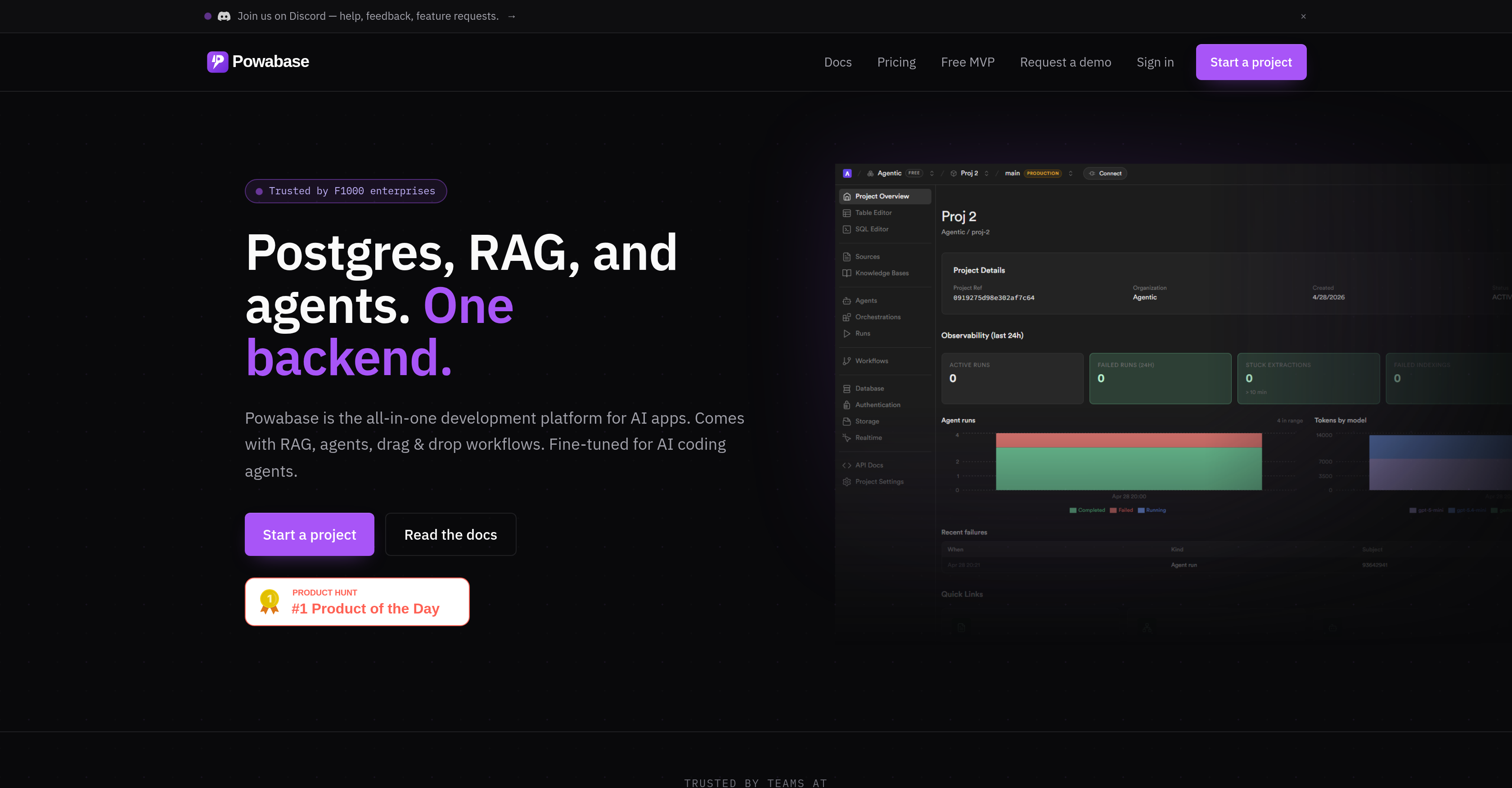
- Ship production AI apps in minutes by describing your requirements — Powabase autonomously wires up retrieval, agents, and workflows behind a single REST API.
- Eliminate glue code and orchestration overhead with native agents that run directly on the platform alongside your data, logic, and retrieval pipelines.
- Achieve accurate, grounded AI features instantly using out-of-the-box RAG with embeddings, vector search, and retrieval pipelines built as first-class citizens — not afterthoughts.
- Collaborate across teams with drag-and-drop visual workflows that let anyone connect triggers, conditions, and agents on a canvas without writing complex code.
- Reduce token waste and iteration cycles when using AI coding assistants — clean, predictable APIs plus agent skills and MCP server let agents generate correct backends with minimal prompts.
- Maintain data integrity and meet compliance standards like SOC 2 and HIPAA by default — each project runs on its own isolated stack with no shared logical databases.
- Deploy on your terms with flexible options: use the managed cloud, self-host the entire stack on your infrastructure, or run a hybrid model with your own LLM keys.
Pros & Cons
Pros
- Own Postgres per project
- Rich toolkit: storage, auth
- Realtime capabilities
- Out-of-the-box document extraction
- Embedding and indexing features
- HTTP or MCP agent calls
- Option for self-hosting
- Single REST API convenience
- Provides an auth service
- Offers object storage
- Robust backend system
- RAG for document retrieval
- Supports large language models
- Visual and callable workflows
- Isolated stack per project
- Compliant environment by default
- Flexible deployment options
- Supports multiple knowledge bases
- PDF, image and URL support
- Multimodal content indexing
- Web search and code execute
- Drag and connect workflow blocks
- No shared logical databases
- Cloud and personal infrastructure options
- Works with Claude Code Codex
- Customizable deployment options
- OCR with 91% accuracy
- RAG pipeline with 98.7% accuracy
- Realtime access through PostgREST
- Supports multiple LLMs
- Integrated track multi-turn state
- Efficient RAG payloads
- Supports Docker or Kubernetes
- Built-in SOC 2 / HIPAA compliance
Cons
- Few out-of-the-box agent tools
- Self hosting requires technical expertise
- Limited templates for prompts and example apps
- Requires database knowledge
- Not a "DIY AI chatbot builder"
- No direct voice integration
- Complex for beginners
- Requires coding knowledge
- Limited language support
- Limited third-party integrations
Reviews
Rate this tool
Loading reviews...
❓ Frequently Asked Questions
Powabase is a comprehensive development platform designed for AI applications. It provides each project with its own set of tools, such as Postgres, storage, authentication, realtime services, and an agent runtime. The platform not only supports complex, AI-based applications but also assists developers by simplifying the creation process. Powabase facilitates system descriptions, then wires up the retrieval, agents, and workflows behind a single REST API, significantly reducing the need for intricate code-writing.
Powabase employs its Retrieval, Agents, and Generators (RAG) pipeline for document extraction and indexing. Whenever a document is uploaded to Powabase, the RAG pipeline takes over and carries out a seamless extraction, embedding, and indexing of the document content. This feature automates the process, freeing up developers from manual extraction and indexing tasks.
RAG in Powabase stands for Retrieval, Agents, and Generators. It is a crucial part of the platform geared towards enhancing document handling and processing. The RAG pipeline is responsible for extracting, chunking, embedding, and indexing the uploaded content, which can vary from PDFs and images to office files and URLs.
Developers can create AI-native apps with Powabase by describing what they aim to achieve. The platform then autonomously wires up the retrieval, agents, and workflows behind a single REST API. It's geared towards enhancing ease of usage and providing an effortless development experience. The developers don't need to worry about the technicalities; they simply need to state their requirement, and Powabase constructs the necessary mechanisms behind the scenes.
Powabase offers a robust set of backend services to developers. These services encompass Postgres databases, object storage, and realtime services. Additionally, Powabase also provides a first-class authentication service accessible through PostgREST, achieving security and access management. All these services can either be directly accessed or through the REST/GraphQL-style API of Powabase.
To enhance document retrieval, Powabase uses its unique RAG pipeline, which performs the extraction, chunking, embedding, and indexing of uploaded content. It also has built-in retrieval events and tool calls that aid in swiftly locating and accessing stored information.
Powabase is capable of processing various types of content, including PDFs, images, office files, and URLs. It utilizes its RAG pipeline to extract, chunk, embed, and index these various formats into a readable and easily accessible structure.
Developers can define orchestrations with multiple Large Language Models (LLMs) in Powabase. They use ReAct orchestrations, which can bring together multiple LLMs, knowledge bases, and tools. These orchestrated setups drive the response to retrieval events, initiate tool calls, handle token deltas, and manage citations, generating efficient AI workflows.
The visual workflows in Powabase have multiple benefits. They enable developers to construct multi-step workflows by simply dragging and connecting different blocks comprising triggers, conditions, and agents. These workflows are not just visual but also callable, promoting easy understanding and convenient code-writing. They also empower developers to transform natural-language requirements into functional workflow blocks
An isolated stack in every Powabase project is allocated to guarantee data integrity and security. It confirms that there are no shared logical databases, eliminating potential risk situations. It also helps to default to various compliance standards, such as SOC 2 and HIPAA, enhancing the platform's safety and trustworthiness.
Powabase offers flexible deployment options. Users have the freedom to operate their projects on Powabase's cloud, or they can opt to run the entire stack on their own infrastructure. This flexibility means users can tailor the deployment to best suit their operational needs and preferences.
Yes, Powabase does support self-hosting. The platform allows for easy transfer between Powabase's services and independent hosting, giving freedom to the developers to maintain and manage their own infrastructure.
Powabase provides object storage as part of its platform offering. This storage is exclusive to each project, ensuring data isolation and minimizing cross-interference risks. The storage can be accessed directly or via the REST/GraphQL-style API provided by Powabase.
Yes, Powabase provides an authentication service. This service presents a secure way of managing access to the platform's resources. The auth service supports a security-first approach and can easily be accessed through PostgREST, ensuring that platform resources remain accessible only to authenticated users.
Powabase agents are a critical part of the platform's operation. They are responsive to HTTP and MCP calls and can either be self-hosted or used via Powabase's services. These agents interact with the tools in the response to retrieval events, participating in tool calls, managing token deltas, and overseeing citations. They thus form a fundamental part of the platform's data processing and managing mechanisms.
Powabase supports multiple Large Language Models (LLMs) by allowing developers to define orchestrations that incorporate multiple LLMs, along with knowledge bases and tools. These orchestrations drive the platform's response to retrieval events, tool calls, token deltas, and citations, helping create highly efficient AI workflows.
Triggers, conditions, and agents are critical elements in Powabase's visual workflows. Developers can create sophisticated workflows by dragging and connecting these building blocks. While triggers initiate a workflow, conditions define the criteria under which specific workflows or tasks are carried out, and agents manage the necessary steps or actions. This structured arrangement of operations provides developers with a visual, easy-to-understand, and simplified interface for creating complex workflows.
Content in Powabase can be uploaded for processing in multiple formats like PDFs, images, office files, or URLs. This flexibility allows for a wide range of data types to be ingested and utilized in the platform.
Developers can use Powabase to develop AI-native apps by merely describing what they want the app to do. Powabase, with its advanced backend mechanisms, will then wire up the necessary retrievals, agents, and workflows behind a single REST API, allowing developers to focus more on the app's functionality rather than intricate backend details.
Yes, Powabase allows on-premises deployment. It enables users to run the entire stack on their own infrastructure, thereby giving them control over their systems while still availing themselves of all the platform's robust features.
Powabase is specifically designed as a comprehensive development platform for AI applications.
Every Powabase project is equipped with a unique set of tools, including Postgres, storage, auth, realtime, and an agent runtime.
Powabase comes out of the box with Retrieval, Agents, and Generators (RAG), plus, it has features for document extraction, embedding, and indexing upon upload.
Powabase utilizes its RAG pipeline to handle document extraction and embedding. When a user uploads a document, the system extracts, chunks, embeds, and indexes it automatically.
Powabase agents can be used to call tools over HTTP or MCP. These agents can easily be self-hosted or used via the platform's services.
The specialty of Powabase AI coding agents lies in their ability to natively interact with the platform. Once the Powabase skill is installed, these AI coding agents can directly set up retrieval, agents, and workflows based on described needs.
Powabase supports the creation of AI-native apps by allowing developers to describe what they want upon which the platform automatically wires up essential components like retrieval, agents, and workflows behind a single REST API.
Powabase's robust backend provides necessary support for your apps by offering a full suite including a Postgres with RLS, a high-grade auth service, object storage, and real-time access.
Powabase supports a variety of content forms for upload including PDFs, images, office files, and URLs.
Developers can define orchestrations with Powabase by using multiple Large Language Models (LLMs), knowledge bases, and tools with built-in retrieval events, tool calls, token deltas, and citations.
Powabase's retrieval events are logged during the run of ReAct orchestrations. As multiple LLMs, knowledge bases, and tools run over SSE, all retrieval events, tool calls, token deltas, and citations get fully logged.
With Powabase, multi-step workflows can be built by dragging and connecting blocks such as triggers, conditions, and agents. The workflow design also supports a natural language copilot.
Powabase ensures project data isolation by providing each project with its own isolated stack. This ensures no shared logical databases and default compliance.
Powabase provides flexible deployment options, including running projects on Powabase's cloud or on users' own infrastructure.
The benefits of using Powabase for AI development include reduced build costs, faster process from zero to a working product, native support for AI apps, streamlined workflows, compliance by default, and optimized agent setups.
Powabase uses its RAG pipeline to manage object storage and indexing for uploaded files. As part of the process, the files are extracted, chunked, embedded, and then indexed on the platform to facilitate efficient retrieval and data handling.
Powabase's drag and drop interface for building agent workflows is highly versatile. Developers can build multi-step workflows by dragging and connecting blocks. It is also assisted by a natural language copilot for more user-friendly design.
Powabase handles compliance issues by providing an isolated backend for each project. This prevents any shared logical databases, minimizes the risk of data interference, and ensures compliance with standards such as SOC 2, ISO 27001, and HIPAA.
Powabase can be used in three different modes: as a fully-managed cloud solution, run it as a self-hosted solution on your own infrastructure, or a hybrid model where you can use Powabase cloud while bringing your own LLM keys for cost and compliance control.
Pricing
Pricing model
Freemium
Paid options from
Free tier available
Billing frequency
Pay-as-you-go
Related Videos
Welcome to Powabase (Early Access)
Powabase•157 views•May 13, 2026