

Overview
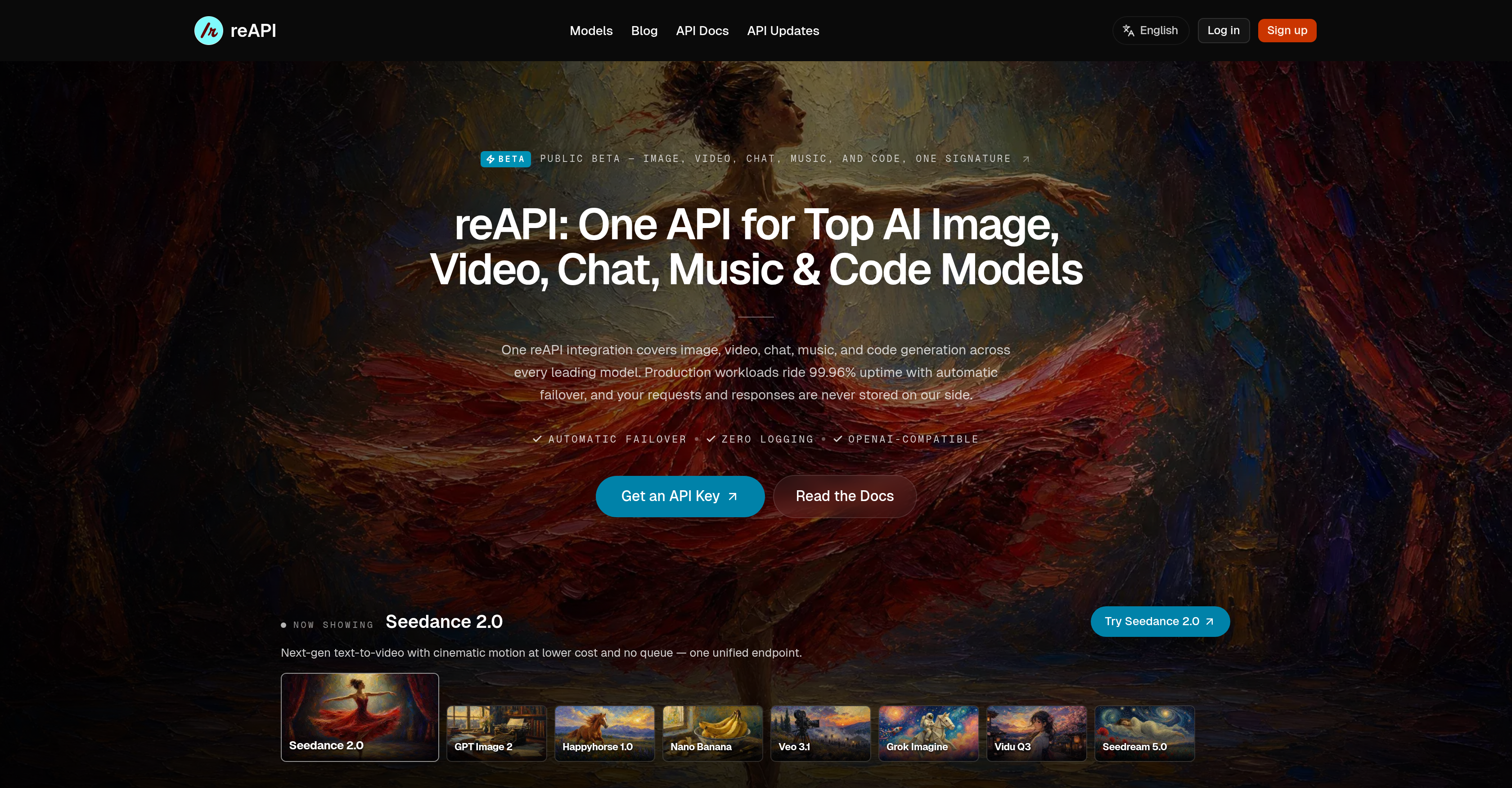
- Ship AI-powered features faster by integrating one unified API endpoint that connects to GPT-5.5, Claude 4.7, Gemini 2.5, and dozens more models for image generation, video generation, chat, music generation, and code generation
- Eliminate vendor lock-in and service interruptions with automatic failover that seamlessly switches between models like Veo, Kling, Flux Pro, and Suno without any code changes
- Keep user data completely confidential through zero request logging—no prompts, responses, or interaction data are ever stored or logged
- Maintain production-grade reliability with a 99.96% uptime guarantee, backed by infrastructure designed to prevent single points of failure
- Switch between AI models on the fly by simply changing the model name in your request, while the API handles vendor selection, routing, and failover automatically
- Generate high-definition video clips using Veo, Seedance, Kling, or Runway through a single integration, without managing separate SDKs or credentials
- Produce style-rich images with high editorial fidelity using models like Flux Pro, GPT Image 2, and Seedream 5.0, with full control over in-painting and styling
- Refactor bot code and generate complex codebases using GPT-5.5, DeepSeek-V3, or Claude 4.7 through the same OpenAI-compatible endpoint you already use
- Compose full music tracks including vocals, instrumentals, and mixes using advanced AI models like Suno, all routed through your existing API key
Pros & Cons
Pros
- Single API endpoint
- High availability
- Automatic failover
- Zero request logging
- Vendor-agnostic
- Unified endpoint
- Easy integration
- Model switching
- Privacy and security
- Multifunctional
- Explicit uptime value
- Vendor selection
- Failover handling
- Routing capabilities
- Video rendering
- Image styling
- Music generation
- Straightforward integration
- Uninterrupted development
- Wide domain coverage
- Switch language option
- Handles vendor selection
- Synced audio and reference-image conditioning
- Cinema-quality video generation
- Long natural-language briefs understanding
- Photoreal portraits generation
- Product shots generation
- Reasoning abilities
- Structured outputs
- Full tracks music generation
- Bot refactoring
- Review agents
- Inline copilots
- Model name changing without disruption
- Streaming and retry on 503
- Per-key spend caps
- Server-sent events
- Function calling
- Image and audio inputs
- Region pinning
- Audit-only logging
- Idempotent retries
Cons
- Doesn't support language selection
- Lack of detailed analytics
- Limited API error handling
- No real-time API monitoring
- No model customization
- Potential latency in failover
- Closed source
- Vendor unavailability not transparent
- Service provider dependency
Reviews
Rate this tool
Loading reviews...
❓ Frequently Asked Questions
reAPI is a unified artificial intelligence tool. It provides a single API endpoint that integrates with various top AI models. It's designed with high availability, automatic failover, and ensures that no user request is logged for privacy. It enables AI integration across various domains like image generation, video generation, chat, music generation, and code generation. reAPI's coverage spans popular AI models for various media generation alongside models for chat and code generation. It's noted for its vendor-agnostic approach, handling vendor selection, failover and routing.
reAPI ensures high availability by having an infrastructure designed to prevent single points of failure. This includes automatic failover mechanisms which are in place to switch operations to backup systems in case of any system failures, minimizing downtime.
The zero request logging feature of reAPI means that none of the user requests are logged or stored. This is an important measure for maintaining user privacy since no interaction data is stored, ensuring the confidentiality and privacy of user data.
reAPI supports a multitude of top AI models. For video generation, it supports popular AI models like Veo, Seedance, Kling, and Runway. For image generation, it employs models like Flux Pro, Nano Banana, GPT Image 2, and Seedream 5.0. For chat functionality, it integrates with AI models like GPT-5.5, Claude 4.7, Gemini 2.5, and Kimi K2. It also incorporates other models for music and code generation.
Yes, reAPI can be used for both image and video generation. The tool seamlessly integrates with top AI models for image generation, like Flux Pro, Nano Banana, GPT Image 2, and Seedream 5.0. For video generation, it uses AI tools like Veo, Seedance, Kling, and Runway. This range of models allows for the generation of high-definition clips and style-rich images, meeting diverse user requirements.
reAPI handles failover management by seamlessly transitioning between vendors in case of any issues. This involves a vendor-agnostic approach where vendor selection, failover and routing are automatically managed, ensuring that there's no downtime or loss in services whenever an issue arises with a specific vendor.
The purpose of a vendor-agnostic approach in reAPI is to provide smooth and uninterrupted access to AI services regardless of the underlying vendor. It handles vendor selection, failover, and routing seamlessly, ensuring that vendor-specific issues do not interfere with accessibility and function.
reAPI allows for comprehensive bot code refactoring. This is facilitated by its ability to integrate with versatile AI models that are trained and capable of code generation. Users can leverage these capabilities to refactor bot code effectively and efficiently.
reAPI is entirely compatible with OpenAI. Every functionality provided by OpenAI's models can be accessed through reAPI's single API endpoint, making it a flexible tool even for those already operating within OpenAI frameworks.
Switching between models with reAPI is designed to be seamlessly straightforward. Since the functionality of all integrated models is reachable through one unified API endpoint, users can switch between models without having to alter their codebase significantly.
reAPI guarantees an uptime of 99.96%. This high level of uptime ensures that the services offered by reAPI are almost always available, providing reliable access to AI integrations.
Yes, reAPI is suitable for music generation AI. It integrates with advanced music generation AI models, offering the capability to generate full tracks including vocals, instrumental, or a full mix.
To generate an API key for reAPI, you need to create an account and sign in to the reAPI dashboard. From there, you can generate an API key that gives you access to all the models in reAPI's catalog.
Yes, it is possible to generate style-rich images with reAPI. It integrates with top AI models for image generation, including Flux Pro, Nano Banana, GPT Image 2, and Seedream 5.0.
reAPI handles vendor selection and routing through its vendor-agnostic management. It seamlessly manages these aspects, automatically selecting the best-fit vendor for the request and directing the request accordingly. This helps maintain high availability and failover management.
Yes, reAPI can unify different AI models like Veo, Seedance, Kling, and Runway for video generation. This is part of reAPI's functionality as a unified AI tool. It offers the flexibility of alternating or choosing different AI models as per the user's preference or requirements, without the need for infrastructure or coding alterations.
Yes, reAPI can be used for code-generation purposes. It integrates with several AI models that are capable of generating and refactoring code, thereby facilitating easy and efficient code-generation, even under complex conditions.
reAPI's multi-model compatibility means end-users can access and work with multiple AI models through a single API integration. This simplifies the process of integrating and switching between different AI models depending upon end-user requirements, streamlining workflows, and reducing compatibility or integration issues.
reAPI ensures that user requests and responses are never stored by incorporating a zero request logging policy. This policy enforces privacy by not retaining or storing any user interaction data, thereby ensuring content remains confidential and private.
The benefits of using reAPI's unified endpoint for AI integration are numerous. It simplifies the AI integration process by offering a single point of access to a multitude of top AI models. It also allows for seamless switching between models without interfering with an existing codebase and handles vendor selection, failover, and routing. Furthermore, it guarantees high availability and user privacy with zero request logging.
reAPI is an integrated artificial intelligence tool that provides a unified API endpoint for integrating with multiple top AI models. The functions it performs include high availability and automatic failover, zero request logging for user privacy, AI integration in various domains such as image generation, video generation, chat, music generation, and code generation.
reAPI works with different AI models by providing a single API endpoint. This means it acts as a gateway between the user or system and the AI models, routing requests and responses. It handles vendor selection, failover, and routing so that work can progress without interruptions.
reAPI integrates with a multitude of leading AI models. For video generation, some models include Veo, Seedance, Kling, and Runway. For image generation, it works with models like Flux Pro, Nano Banana, GPT Image 2, and Seedream 5.0. Chat generation AI models include GPT-5.5, Claude 4.7, Gemini 2.5, and Kimi K2. It also works with other models for music and code generation.
reAPI ensures high availability and automatic failover through its design and architecture. If a vendor becomes unavailable or a service interruption occurs, reAPI automatically routes requests to another vendor or service, ensuring that the endpoint remains available for use. It monitors the performance of the integrated AI models in real-time and can switch models for a user without disrupting the service.
Zero request logging for user privacy means that reAPI does not store any data about the requests that users send to AI models through its endpoint. It does not keep a record of the content of the queries or the responses, ensuring complete user privacy and data security.
reAPI's vendor-agnostic handling means it can work with any AI model regardless of the vendor. It handles failover by automatically switching to a different model if the initial model faces an issue, ensuring uninterrupted service. reAPI also effectively handles routing, directing the client's request to the appropriate AI model.
Yes, reAPI is designed to allow for easy switching between models without disrupting the codebase. The system can simply change the model name while keeping the rest intact and request routing to the new model is handled seamlessly by reAPI.
reAPI is designed to be straightforward for integration by exposing a single API endpoint that can be used to tap into various AI models. By handling vendor selection, failover, and routing, it reduces the effort developers would have to otherwise put into dealing with these aspects individually for every model.
OpenAI compatibility means that the APIs provided by reAPI follow the standards set by OpenAI, which is a leading authority on AI models. This ensures that switching to or incorporating reAPI into systems that already use OpenAI models is simple and seamless.
The image generation AI models that reAPI can work with include Flux Pro, Nano Banana, GPT Image 2, and Seedream 5.0.
The video generation AI models reAPI integrates with include Veo, Seedance, Kling, and Runway.
The chat generation AI models that can be used with reAPI include GPT-5.5, Claude 4.7, Gemini 2.5, and Kimi K2.
For music generation, reAPI works with an array of models, including those created by Suno.
In terms of code generation, reAPI integrates with models such as GPT-5.5, Claude 4.7, Gemini 2.5, Kimi K2, and DeepSeek-V3.
As a unified entry point, reAPI provides access to a range of top AI models. It creates a single point of entry for various AI functions, simplifying the integration and intercommunication of multiple AI solutions hence acting as a one-stop-shop for top AI models.
reAPI can handle a diversity of data types in line with its wide range of functions. This includes images, videos, chat, music, and code.
reAPI ensures nearly absolute reliable uptime with its automatic failover feature, which kicks in if a service interruption occurs. It can automatically switch to another model or vendor without the user having to intervene, ensuring constant availability for user requests.
reAPI can assist in rendering high-definition video clips or producing style-rich images through its integration with top AI models in those domains. Depending on the model used, users can render polished clips, produce images with high editorial fidelity, and control in-painting.
With reAPI, AI chatting, music generation, and coding become more accessible tasks. It connects with state-of-the-art AI models in these domains to provide features like reasoning and long-context stability for chat, full track generation for music, and smart code refactoring capabilities for coding.
The integration of reAPI into an existing codebase is simplified by its design. To begin using reAPI, one needs to generate a reAPI key, set their base URL to be the reAPI endpoint, and then set the model field to their chosen AI model. The code change required to use reAPI is minimal and hence easily integrated into the existing code base.
Pricing
Pricing model
Free Trial
Paid options from
Free Trial
Related Videos
Instantly Generate Realistic API Examples with ReAPI AI - A Complete Guide
Glubean•239 views•Jan 14, 2024