
Overview
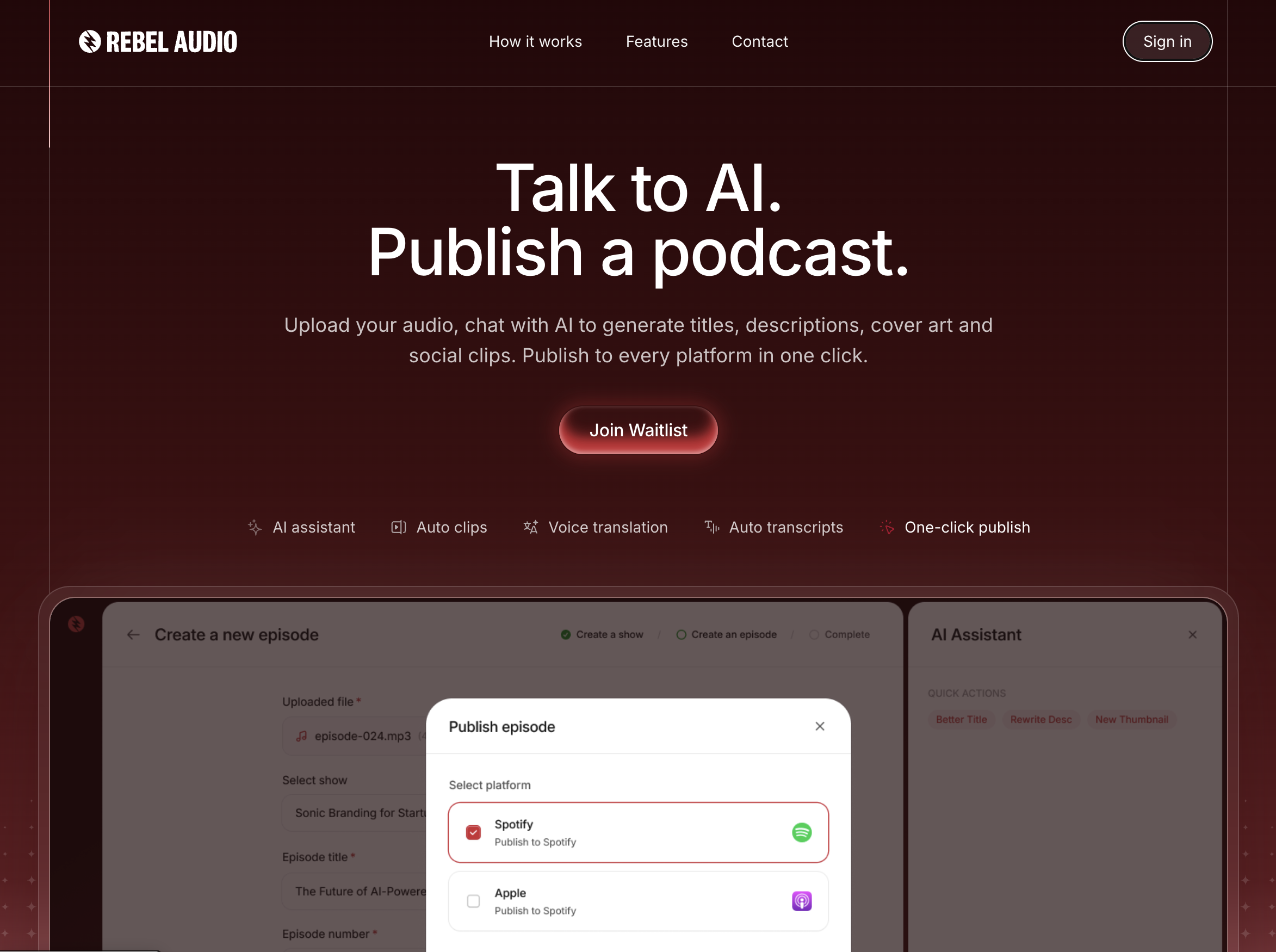
- Launch podcasts faster by automating show notes, titles, and tags through a simple chat with the AI Voice Agent
- Create professional cover art for every episode without any design skills, based directly on your content
- Turn raw audio into viral social clips automatically as AI spots the most engaging moments for you
- Reach a global audience by translating full episodes with a cloned version of your own voice
- Get searchable, editable transcripts instantly with accurate speaker detection for easy content repurposing
- Track listener growth and performance across all platforms from a single, unified analytics dashboard
- Publish to Spotify, Apple Podcasts, and YouTube simultaneously with one click for streamlined distribution
Pros & Cons
Pros
- Generates titles automatically
- Auto-generates descriptions
- Creates cover art
- Produces clips automatically
- Auto-generates tags
- Creates artwork from content
- Identifies viral moments
- Automatic social clips generation
- Language translation feature
- Cloned voices for translation
- Automatic transcription
- Includes speaker detection
- Instant search within transcripts
- Allows text editing
- Transcript export feature
- Unified analytics dashboard
- Performance tracking
- Listener monitoring
- Growth tracking
- Publishes to multiple platforms
- Single-click content distribution
- Designed for modern podcasters
- Automates podcast publishing
- No design skills required
- Episode creation through chat
- Spotlights viral content
- International audience reach
- Instant transcription
- Automated podcast editing
- Transforms episodes into social content
- Produces viral social content
- Auto-covers episode artwork
- Integrates with Spotify, Apple, YouTube
Cons
- Lacks video editing features
- Limited to podcast content
- No personal voice cloning
- No support for live podcasting
- No multi-user collaboration features
- Lack of advanced analytics
- Limited language translation options
- Unverified audio quality
- Lacks extensive platform integrations
Reviews
Rate this tool
Loading reviews...
❓ Frequently Asked Questions
The AI Voice Agent in Rebel Audio enables users to create podcast episodes through chat. This feature allows the user to generate titles, descriptions, and tags instantly, simplifying the podcast creation process.
Rebel Audio's AI processes the uploaded audio or video file and, through a simple conversation with the user, generates relevant titles, descriptions, and tags.
Yes, Rebel Audio is capable of creating episode artwork. Rebel Audio can generate cover art based on your episode content, which does not require any design skills from the user.
Rebel Audio uses AI to spot viral moments within your content. It can automatically identify and generate social clips from these moments, potentially increasing the social reach of your podcast.
Rebel Audio aids in reaching an international audience through its language translation feature. The platform is able to translate podcast episodes using a cloned voice of the original speaker, breaking language boundaries and enabling content to reach global audiences.
Rebel Audio possesses an automatic transcription feature that includes speaker detection. This means that it can transcribe audio content while accurately pinpointing and noting who is speaking. Moreover, this feature allows users to search, edit, and export the transcribed text instantly.
Rebel Audio's unified analytics dashboard provides comprehensive performance tracking. This allows users to monitor listeners and track growth effectively, offering crucial insight into their audience and podcast's performance.
Yes, with Rebel Audio, publishing a podcast to multiple platforms at once is possible. With just a single click, users can publish their content to Spotify, Apple Podcasts, YouTube and more, thereby streamlining content distribution.
Rebel Audio simplifies the podcasting process through its AI functionality. From processing an uploaded audio or video file, generating titles, descriptions, and cover art, to identifying viral moments and producing social clips, all these tasks are automated. In addition, it is equipped with a one-click publishing feature, further simplifying content distribution.
Rebel Audio employs its AI capabilities to turn podcast episodes into viral social content automatically. The system is capable of spotting viral moments in the content, from which it generates social clips. These social clips can then be disseminated across various platforms, increasing the potential viral reach of your podcast.
Yes, Rebel Audio can be used to translate podcasts. Through Rebel Audio's language translation feature, episodes can be translated using a cloned voice of the original speaker, allowing the content to reach a global audience in the language of their preference.
The main features of the Rebel Audio platform include the AI Voice Agent, automatic generation of titles, descriptions and tags, generation of cover art based on episode content, automatic detection of viral moments for social clips creation, language translation of episodes using cloned voices, automatic transcription with speaker detection, a unified analytics dashboard for monitoring listener growth and performance, and single-click distribution to multiple platforms.
Rebel Audio processes the uploaded audio or video file by parsing it to understand its content. Through this understanding, it is able to perform a range of automated tasks including generating titles, descriptions, tags, and cover arts, identifying viral moments to create social clips, transcribing the audio and even translating it if required.
Rebel Audio does provide tools for podcast editing through features like automatic transcription with speaker detection, and by identifying viral moments within the content which can be turned into social clips. This does not involve traditional audio editing but still enables users to utilise their content in a more strategic way.
Using Rebel Audio, you can publish your podcasts on several major platforms with just one click. This includes Spotify, Apple Podcasts, YouTube, and many others, thus significantly easing and broadening your content distribution process.
Yes, Rebel Audio can detect speakers in its automatic transcriptions. This capability not only provides transcription but also identifies who is speaking, thus enabling more comprehensive and reliable transcriptions.
Yes, Rebel Audio has a voice cloning feature for the translation of podcast episodes. This feature enables the platform to translate episodes using a cloned voice of the original speaker, maintaining consistency and listener familiarity even in different languages.
Rebel Audio uses AI to identify viral moments within your content and automatically generates social clips from these instances. This automatic production of clips significantly increases the potential social reach of your podcast.
Yes, Rebel Audio allows for monitoring listener growth and performance. The platform's unified analytics dashboard provides performance tracking for efficient monitoring of listener growth, enabling users to gauge their podcast's success and growth.
No, it is not required to have design skills to generate cover art with Rebel Audio. The platform has a feature where the AI can create artwork based on the content of your episode, removing the need for the user to possess design skills.
Pricing
Pricing model
No Pricing