

Rerun
Spot detail-level issues in robotics and sensor datasets fast with multimodal data visualization and custom views built for every stage of your physical AI pipeline
Listing not yet reviewed by our editors · How we check
Overview
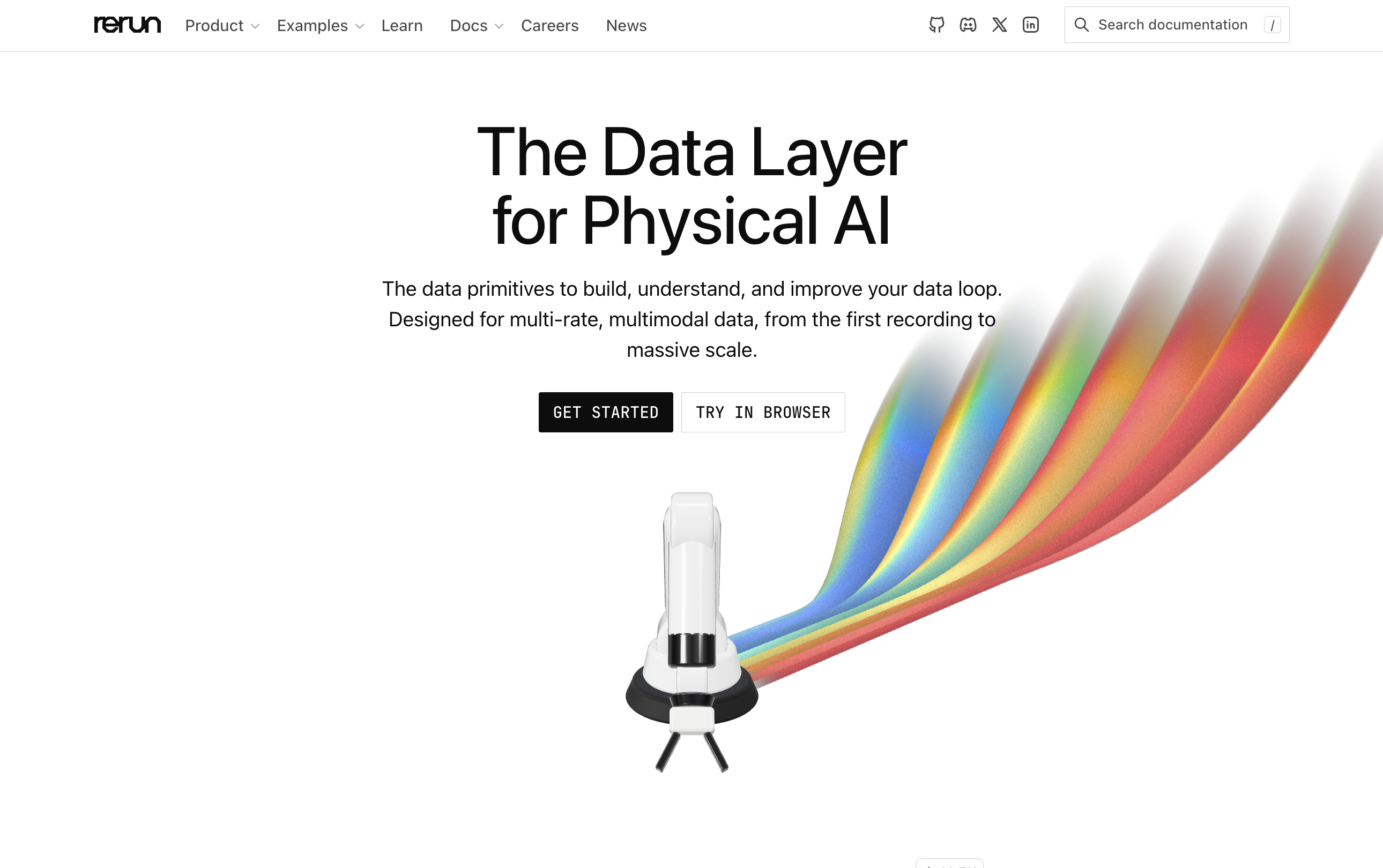
- Spot detail-level issues in robotics and sensor datasets fast with multimodal data visualization and custom views built for every stage of your physical AI pipeline
- Get answers from raw recordings without hunting through files by running SQL or dataframe queries across a catalog of your existing object stores
- Pull only the slices of data you need, not whole files, through byte-range indexing and streamable retrieval
- Keep storage costs and version sprawl in check by refining data without creating copies, adding derived columns and evolving schemas without breaking history
- Train models straight from recordings with no export step by expressing a dataset mix as a query and streaming it to GPUs through a column-aware, video-codec-aware dataloader
- Eliminate conflicting data versions across your team with a unified foundation where everyone works from the same source data
- Scale from your first sensor recording to massive datasets on one system purpose-built for multi-rate, multimodal data
- Drop logging, transformation, and visualization into existing C++ and Python codebases using a flexible open-source SDK instead of a rigid platform
- Diagnose why a model underperforms by inspecting and debugging training runs with the same visualization tooling used by leading physical AI teams
Pros & Cons
From the listing; not yet checked by our editors.
Pros
- Handles multimodal data
- Multi-rate data management
- Supports large-scale data
- Open-source SDK provided
- Efficient data logging
- Data transformation capabilities
- Powerful data querying
- Effective data visualization
- Supports data training
- C++ and Python support
- Structured data cataloguing
- Byte-range indexing enabled
- Efficient data retrieval
- Transforms object stores
- Supports SQL queries
- Dataframe query support
- Data refinement without copies
- No extra export for training
- Promotes uniform data usage
- Active in open-source contribution
- Known for visualization capabilities
- Supports debugging training runs
Cons
- Limited language support
- No real-time support
- No mobile support
- No data security features
- Lack of direct support
- No predefined templates
- No cross-platform compatibility
- Potential for large workflows
- No versioning
- Heavy memory usage
Alternatives to Rerun
Tools that share the most tags with Rerun.
- Infograph.app
Transform complex data into clear visuals instantly using AI that analyzes any text or raw numbers
Free
Not listed
Not yet checked
- VibeChart
Create charts instantly using plain English instead of complex software with the Text-to-Chart interface
Free trial · from $20/month
$20/month
Not yet checked
- Infografix
Transform simple text prompts into professional infographics instantly without any design skills required using AI-powered generation
Free
Not listed
Not yet checked
- ChartGen.ai
Create presentation-ready charts in seconds without design skills by describing your goal in plain English and uploading a CSV or Excel file.
Not listed
Not listed
Not yet checked
- Columns.ai
Instantly understand complex web data by transforming any highlighted text or table into interactive charts with the Magic Vizion feature
Not listed
Not listed
Not yet checked
- AI Infographic Generator
Transform complex data into clear visual stories instantly using simple text prompts, eliminating the need for design expertise
Freemium · from $10/month
$10/month
Not yet checked
Reviews
Rate this tool
Loading reviews...
Frequently asked questions
What is Rerun?
Rerun is a data layer tailored for physical AI. It supports a multitude of data handling operations at different scales, from initial recordings to large scale data. Rerun features an open-source SDK for logging, transformation, querying, visualization, and training on multi-rate, multimodal data. It supports languages like C++ and Python.
How is Rerun designed for physical AI?
Rerun is designed for physical AI by being specifically equipped to handle multimodal, multi-rate data at varying scales. From initial recordings to large scale data, Rerun provides functionalities for logging, transforming, querying, visualizing, and training on this type of data using its open-source SDK.
What are the primary responsibilities of Rerun?
Rerun's primary responsibilities are to enable building, understanding and improving your data loop. It powers the data loop by providing infrastructure for cataloguing, byte-range indexing, and data retrieval. It converts object stores into a queryable, streamable foundation, facilitating SQL and dataframe queries across a catalog.
What types of data does Rerun handle?
Rerun is crafted to handle multi-rate and multimodal data. It can deal with data at various scales, from the first recording to massive scale.
What languages does Rerun support?
Rerun supports programming languages such as C++ and Python.
What is Rerun's open-source SDK?
Rerun's open-source SDK is a toolchain designed to log, transform, query, visualize, and train on multi-rate, multimodal data. It provides a flexible framework for working with data rather than a rigid platform, making it easier to integrate into existing processes and systems.
What are the visualization capabilities of Rerun?
Rerun offers robust visualization capabilities. Its toolchain allows developers to log, transform, query, view, and train on multi-rate, multimodal data. This translates into enhanced capabilities for reviewing datasets, debugging detail-level issues, and extended flexibility to create own views and tools for different stages of the pipeline.
What does Rerun's catalogue feature entail?
Rerun's cataloguing feature encompasses the cataloging of data instances in the system. This makes it easier for users to conduct SQL or dataframe queries across a catalog. It essentially turns object stores into a queryable, streamable foundation.