

Short Film Script Doctor
Overview
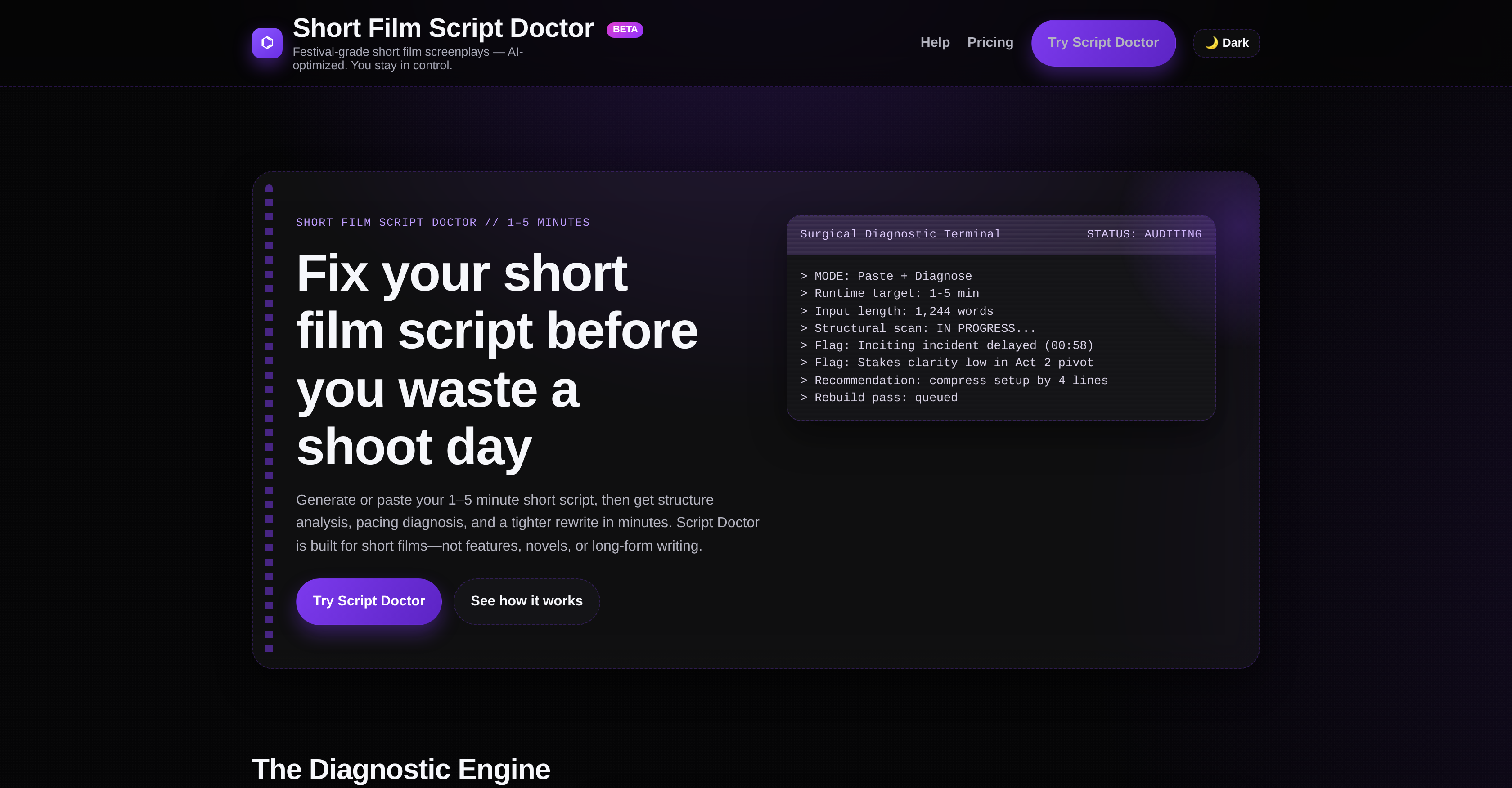
- Eliminate structural rot before you hit record with a rule-based analysis that enforces tight pacing and escalates stakes for short films.
- Transform vague ideas into a compressed first draft by entering your logline, genre, and target runtime for instant structure generation.
- Identify and fix slow openings, late turns, and overloaded scenes with targeted diagnostics on beat order and pacing pressure.
- Sharpen dialogue by cutting exposition and tightening lines to ensure performability and save screen time.
- Clarify fuzzy character motivations and unclear outcomes with built-in stakes and clarity checks for a strong ending.
- Iterate to a shootable draft through analysis-driven rewrite loops, applying specific fixes until your script is locked.
Pros & Cons
Pros
- Designed specifically for short films
- Detailed structural script analysis
- Pacing diagnosis and rewrites
- Identifies slow openings and late turns
- Points out overloaded scenes
- Clears fuzzy motivations
- Enforces short-film storytelling structures
- Ensures shootable momentum
Cons
- Only for short films
- Limited to ~2000 words
- Not for long-form writing
- No feature film analysis
- Only English language support
Reviews
Rate this tool
Loading reviews...
❓ Frequently Asked Questions
The main purpose of Script Doctor is to aid filmmakers with the construction and rectification of short film scripts. It offers structural script analysis, pacing diagnosis, and rewrites to enhance scripts, ensuring they are readable and production-friendly. This tool is designed to improve story quality by identifying and addressing structural issues.
The Diagnostic Engine of Script Doctor works by identifying structural issues within short film scripts. It checks for various elements such as inciting moments, escalation rises, and final beat resolutions. The engine's brutally honest feedback helps users to improve the quality of their story without losing its essence.
Yes, Script Doctor provides extensive feedback on script strengths, weaknesses, and offers suggestions for improvement. This feedback can cover everything from pacing and structure to line-level clarity and dialogue tightness.
Script Doctor is designed specifically for short film scripts. Users can start from scratch or diagnose existing scripts, as long as they are not longer than approximately 2000 words. This tool is not suitable for feature films, novels, or long-form writing.
Yes, Script Doctor helps identify and rectify overloaded scenes and unclear outcomes in short-film scripts. The tool offers features for iterative analysis and rewrites to achieve a tighter, more focused draft. It will highlight problems, including slow openings, late turns, and more.
Yes, Script Doctor has built-in stakes and clarity checks. It pinpoints fuzzy motivations and unclear outcomes that might weaken endings. It also ensures the script is aligned with the requirements of short-film storytelling.
Yes, Script Doctor features a dialogue tightening component. It suggests how dialogue can be cut down and sharpened to maintain its performability while adhering to the script's pace and structure.
Script Doctor provides checks for performability primarily through its dialogue tightening feature. This functionality helps ensure that dialogue remains realistic, concise, clear, and suitable for performance within the context of the script.
No, Script Doctor is designed exclusively for short film scripts, focusing primarily on scripts with a runtime of up to 15 minutes. It is not intended or suitable for feature film scripts.
Future enhancements for Script Doctor include a structural score that represents structure, pacing, and clarity; a beat breakdown visualization; a commercial viability indicator; and checks for dialogue density.
Script Doctor assists in script diagnosis based on pacing by identifying and highlighting issues such as slow openings, late turns, overloaded scenes, and unclear outcome. Through iterative analysis and rewrites, the tool helps to enhance the pacing in a script, providing a tighter and more focused draft.
Script Doctor enforces practical clarity in scripts for effective translation to set by focusing on clean, easy to comprehend storytelling. It checks for clarity and practicality of the script’s elements, ensuring they can be successfully translated into production.
The Structural Score is a future feature being considered for Script Doctor that would represent the structure, pacing, and clarity of a script. This would provide a broad, holistic evaluation of the overall script quality.
The commercial viability indicator is a future feature under consideration for Script Doctor. Though specific details about this feature are not provided, it seems it would provide a quick assessment of the script's suitability and potential success in the commercial marketplace.
Users can start a script from scratch or diagnose an existing script, as long as it doesn't exceed roughly 2000 words. Script Doctor provides flexible options, encapsulating the stages of creation and rectification.
Dialogue density checks are a planned feature for Script Doctor. This would help users to detect sections of excessive dialogue (overtalking) and rebalance the action versus dialogue split in their scripts.
Script Doctor assists in checking stakes in a film script by identifying low stake situations and providing feedback on the same. It flags weak stakes, unclear goals, and structural gaps early in the script creation or diagnosis process.
Yes, Script Doctor allows for iterative analysis and rewrites. The tool provides this functionality to facilitate a consistent improvement process, guiding the user to progressively create a tighter, more focused short film draft.
Script Doctor has several features that cater specifically to short-film scriptwriting. Some key features include: short-film structure enforcement, iterative analysis and rewrite loop, beat and pacing diagnosis, stakes and clarity checks, dialogue tightening suggestions, and a production-ready, shootable focus.
Yes, Script Doctor is capable of diagnosing inciting moments and escalation rises. Its Diagnostic Engine checks for these key elements, providing feedback on strengths, weaknesses, and offering suggestions for improvements.
Script Doctor supports scripts up to approximately 2000 words for analysis.
The 'Generate + Refine Loop' mode in Script Doctor allows users to enter genre, tone, target runtime and logline to generate a first short-film draft with compressed structure. The user can then run an analysis for beat order, pacing pressure, and emotional turns, apply rewrite fixes and iterate on these steps until a satisfactory result is achieved.
The 'Paste + Diagnose' mode in Script Doctor allows users to paste their existing short script up to ~2000 words. It provides diagnostics on structure, pacing, stakes, and clarity. The user can then review targeted notes and tell the app exactly what they want changed, resulting in an auto-rewrite for a tighter, more shootable short-film draft.
No, Script Doctor does not work with feature film scripts, novels or long-form writings. It is specifically designed to assist with short film scripts ranging from 1-5 minutes.
Script Doctor checks for various elements when analyzing a script, such as inciting moments, escalation rises, final beat resolutions, weak stakes, unclear goals, structure gaps, and dialogue density. It provides feedback on strengths, weaknesses, and suggestions for improvements.
Yes, Script Doctor is suitable for beginners in script writing. It's designed to guide users with structure-first feedback even if they've never written a short script before.
Yes, you can edit the analyzed script and then re-analyze it using Script Doctor. After pasting your updated version, you can run an analysis again to get a new diagnosis and rewrite.
Script Doctor uses its built-in rules to diagnose issues in pacing and structure. It checks for elements such as slow openings, late turns, overloaded scenes, vague character stakes, and unclear outcomes. It then provides actionable feedback to address these issues for a tighter more focused short-film draft.
Yes, the script you generate or diagnose with Script Doctor is treated as private input for generating your result. The scripts are not published or used for public examples and other users cannot access your scripts or prompts through the product.
Future features that Script Doctor plans to incorporate include a structural score that represents structure, pacing, and clarity, a beat breakdown visualization, a runtime pacing map, a commercial viability indicator, an emotional arc graph, and a dialogue density check optimized for short-films.
Yes, with Script Doctor, users can either create new scripts or input and diagnose their existing short scripts up to approximately 2000 words.
Script Doctor provides dialogue tightening suggestions to help with dialogue enhancement in your script. It cuts exposition, sharpens intent, and ensures that lines are performable for a better readability and production-friendly usage.
Script Doctor works best with high-clarity shorts in genres like thriller, sci-fi, horror, comedy, drama. Experimental formats may need more manual shaping.
No, Script Doctor is not limited to one specific length of short films. It supports short film scripts that range from 1-5 minutes.
Currently, Script Doctor does not provide dialogue density checks. However, this feature is on the roadmap for future updates.
Script Doctor enforces built-in rules to maintain short-film storytelling structures. These rules help keep your script aligned to compressed 3-act beats plus modified Hero's Journey logic specifically designed for short films.
In its current version, Script Doctor does not provide a structural score for the analyzed script. However, a structural score is part of the future features being considered for incorporation.
Yes, Script Doctor offers iterative analysis→rewrite loops. Users can run multiple analysis and fix cycles before locking their shooting draft, for a tighter, more focused and shootable short-film script.
Yes, you maintain ownership over the scripts you generate or analyze with Script Doctor. Script Doctor does not claim copyright or ownership over anything you generate through it.
Presently, Script Doctor does not provide a commercial viability indicator for scripts. However, a commercial viability indicator is part of the future features being considered for incorporation.
Pricing
Pricing model
Freemium
Paid options from
$7/month
Billing frequency
Monthly
Refund policy
No Refunds