

Overview
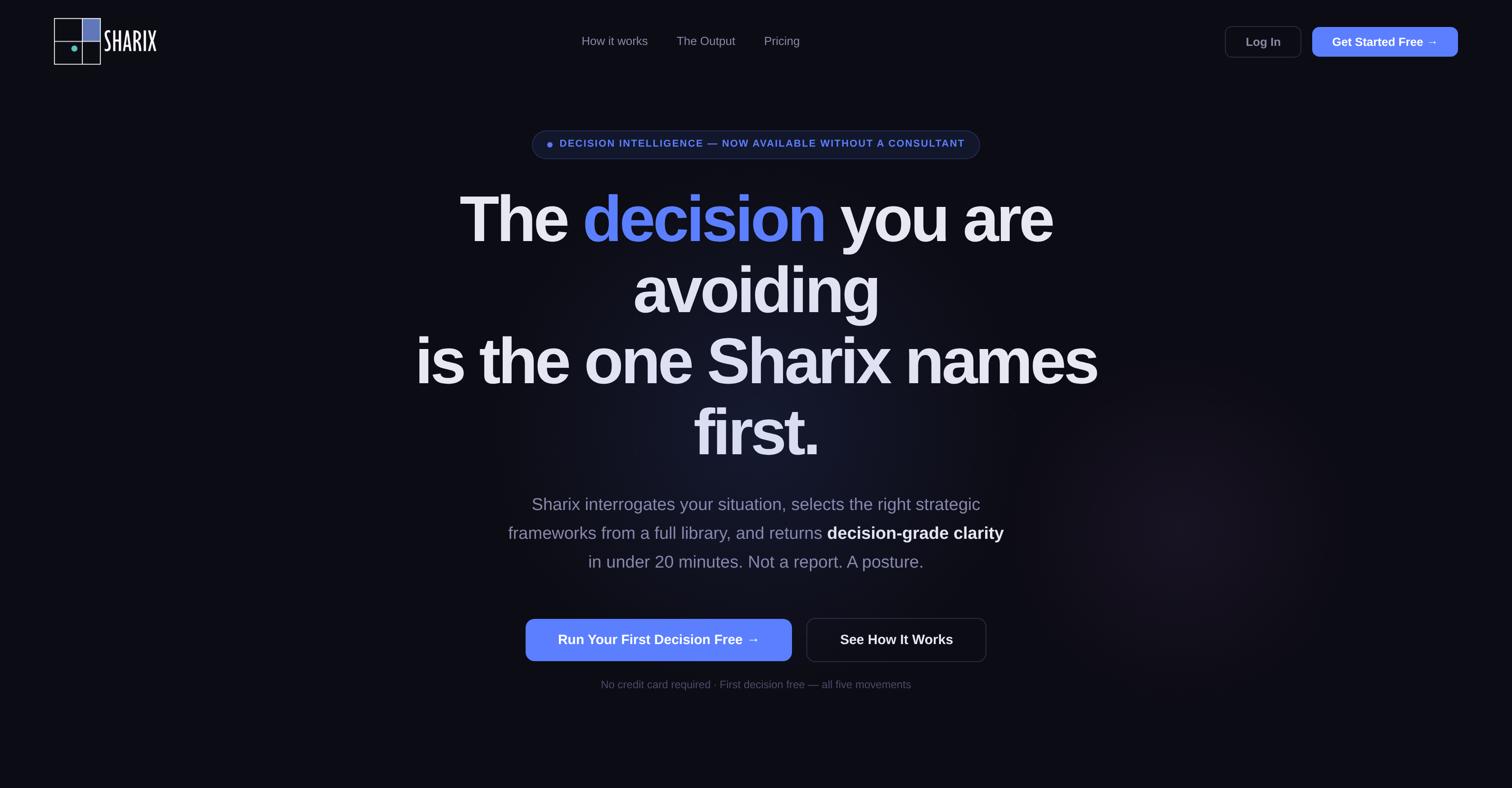
- Uncover the real decision hidden by organizational noise and sunk costs through AI-powered interrogation that classifies your situation into one of six typologies
- Identify specific, plausible failure modes you're overlooking with the Inversion movement, providing forensic risk assessment based on structural conditions
- Audit and replace flawed success metrics using the Goodhart movement, ensuring you measure the right signal for strategic alignment
- Receive a decisive orientation, not just a report, that makes the right action self-evident through the final Decision Posture movement
- Apply role-specific strategic frameworks calibrated for founders, executives, or advisors with personalized Framework Packs
- Achieve consultant-grade analysis in minutes instead of weeks, with the first movement (The Excavation) completely free to start
Pros & Cons
Pros
- Fast decision-making
- User submission based
- Real decision identification
- Decision categorization
- Organizational noise negation
- Sunk costs consideration
- 24 strategic frameworks
- 5 analytic outputs
- First analysis - free
- Under 20 minutes results
- Framework packs
- Role-based personalized decision-making
- Failure point identification
- Decision posture offering
- Context-aware selection
- Risk assessment
- Measurement metrics
- Market decisions context
- Typology classification approach
- Clarifies obscured aspects
- Executes without human consultant
- Scales down problem to core
- Evaluate success metric integrity
- Provides decision orientation
- Additional packs for investment
- Brand and market decisions
- Executives handling organizational complexity
- Professional, solo, team pricing
- PDF export option
- Version history record
- Shareable links with expiry
- Priority generation queue
- Standalone framework declaration share
- Client-ready PDF formatting
- Team plan available
Cons
- Paid subscription for full analysis
- No offline functionality
- No integrated collaboration tools
- Limited to six decision categories
- Can't select preferred frameworks
- Limited strategic frameworks library
- Doesn't provide recommendations
- No API for integrations
- Locked version history for lower-tier
- No free usage beyond first decision
Reviews
Rate this tool
Loading reviews...
❓ Frequently Asked Questions
Sharix is a decision intelligence tool that critically interrogates user-submitted information about a situation to enable clarity and enhance decision making. It uncovers the real decision obscured by different factors and classifies it into one of six categories. Utilizing a library of 24 strategic frameworks, Sharix applies the most relevant ones to the given situation, providing insights not explicitly presented by the user.
Sharix classifies decisions based on user-submitted information pertaining to the situation at hand. This classification sorts the decision into one of six categories - 'Clarity', 'Risk', 'Measurement', 'Commitment', 'Organizational', or 'Market'. This system helps offer a clearer understanding of the situation.
Sharix uses a five-step process termed as 'The Excavation', 'The Occam Pass', 'Inversion', 'Goodhart', and 'The Decision Posture'. This process involves interrogating the provided situation, removing unnecessary complexities, imagining potential failure modes, and auditing the stated success metric. It culminates in providing a decision posture, an orientation that helps comprehend the right action.
The five movements in Sharix are: 'The Excavation' where Sharix names the real underlying decision, 'The Occam Pass' which strips the issue down to its core, 'Inversion' that illustrates potential failure modes, 'Goodhart' which audits the stated success metric and proposes a better signal, and 'The Decision Posture' that provides an orientation from where the right action becomes evident.
Sharix offers a tiered pricing structure. The first movement, 'The Excavation', is free. For full access to the process, users can subscribe to the Solo plan at $79/month or the Professional plan at $199/month. They also offer a Team plan for $799/month for up to five seats. Each plan offers increasing degrees of service, including full framework access, shareable links, and priority generation queue.
Decision-grade clarity, according to Sharix, is the enhanced understanding derived from critical interrogation of a decision. It is not a report but a posture, an orientation that sheds light on obscured or unaddressed aspects of the scenario, indicating a way of looking at the problem from which the right action becomes self-evident.
Sharix offers several benefits over a traditional consultant. It provides immediate insights rather than a report after weeks of waiting. By interrogating the user-submitted situation and selecting the right strategic frameworks, Sharix provides decision-grade clarity within minutes. It also uncovers obscured or unaddressed aspects of the decision, saving resources from being committed to the wrong question.
The first free movement in Sharix is called 'The Excavation'. In this stage, Sharix analyzes the user-submitted information and names the real decision - the one beneath the stated one. It calls out the precise issue, offering users an immediate understanding of what they are really dealing with.
Sharix's subscription service offers levels of access to its processes and tools based on the pricing tier chosen. The first movement is offered for free, while additional movements and services such as full library access, PDF exports, version history, shareable links with expiry, priority generation queue, and client-ready PDF formatting are accessible based on the plan - Solo at $79/month, Professional at $199/month or Team at $799/month for up to five seats.
Sharix enhances critical thinking by forcing users to interrogate the real issues behind their decisions. Through its five movements, it helps strip away irrelevancies, envisage potential failures, audit success metrics, and establish an orientation towards the decision. This rigorous process encourages a more thorough analysis of the situation, fostering critical thinking.
Yes, Sharix can assist with organizational decisions. It classifies decisions into six typologies, one of which is 'Organizational'. By interrogating the provided situation, it highlights obscured aspects pertaining to organizational structures or dynamics that may be influencing the decision at hand.
Sharix transforms user-submitted information into insights by applying a rigorous analytical process. It starts by interrogating the situation to identify the real decision, then applies relevant strategic frameworks to frame the problem. It also iterates through its five movements to strip the issue to its core, imagine failure modes, audit success metrics, and suggest an orientation towards the issue. The result is a precise, comprehensible output that uncovers not initially presented insights.
Yes, Sharix does offer free services. The first movement, 'The Excavation', is offered for free to all users. This movement provides an immediate understanding of the real decision underlying the scenario.
Sharix sets itself apart from other AI tools by not merely organizing user-submitted information but actively reading and understanding it. It interrogates the situation and uncovers obscured aspects, thus providing insights that the user might not initially present. It also refines decisions to their irreducible form, offering a level of clarity that's distinct from most AI tools.
'The Real Decision is Hidden' signifies Sharix's capacity to detect the actual problem behind a decision that is often obscured by organizational noise, sunk costs, or preconceived narratives. The AI tool reads the user-submitted information and reveals this underlying problem which represents the actual fork in the road.
Sharix helps with risk assessment by applying its 'Inversion' movement where potential failure modes are considered. It provides a forensic imagination of failure, identifying specific, plausible, and often unnoticed failure modes and their probability based on structural conditions in the situation.
The six decision typologies in Sharix are 'Clarity', 'Risk', 'Measurement', 'Commitment', 'Organizational', and 'Market'. These categories help classify and frame the decisions for a more applicable understanding of the situation.
Sharix reads and understands user-inputted information through an AI-based interrogation process. It classifies the decision into one of six categories and applies the most relevant frameworks from its library. It not only organizes the information but also actively understands and analyzes it for actionable insights.
Sharix possesses a library of 24 strategic frameworks. Some of them are Occam's Razor, Inversion, Goodhart's Law, Regret Minimization, Principal-Agent, Second-Order Thinking, First Principles, Pre-Mortem, Pareto Principle, and Reversibility Test among others. It selects the most relevant ones based on the specific decision situation.
Yes, Sharix can help with market analysis decisions. One of the decision categories it provides is 'Market'. By using strategic frameworks, Sharix can provide insights into the market dynamics that could be influencing a decision. This analytical approach can assist in understanding marketplace complexities.
Sharix helps users improve decision making by analyzing user-submitted information to identify the genuine decision that needs to be made, often obscured by multiple factors. It classifies the decision into one of six categories to provide a clear understanding of the situation. Using selected strategic frameworks, Sharix processes the information in five phases called 'movements' to provide a decision posture.
Sharix enhances decision making by breaking down the user's situation into a clear typology, removing noise, and unearthing hidden insights. It begins by interpreting the user's submitted information to determine the real decision at hand. It then applies strategic frameworks to analyze the situation. In a five-pronged process, Sharix simplifies the decision, identifies possible failure points, challenges measurement metrics, and offers an actionable 'decision posture' or orientation.
Sharix classifies decisions into six distinct typologies: 'Clarity,' 'Risk,' 'Measurement,' 'Commitment,' 'Organizational,' and 'Market'. These categories help in identifying the nature of the decision, allowing Sharix to apply the most relevant frameworks and methods.
Sharix analyses user-submitted information by assigning a decision typology to it, which helps to classify the decision into one of six categories. Based on this categorization, the tool selects the most diagnostically relevant strategic frameworks from its library to analyze the situation. It actively interprets the information to provide insights beyond what was directly shared by the user.
The five movements Sharix employs are 'The Excavation', 'The Strip', 'The Collapse', 'The Measure', and 'The Decision Posture'. These movements represent various phases of the decision-making process, from diagnosing the actual decision from the situation to providing a definitive posture for action.
'The Excavation' refers to identifying the actual underlying decision. 'The Strip' means reducing the decision to its core, removing all irrelevant noise. 'The Collapse' entails identifying potential failure points. 'The Measure' involves auditing the success metric being used and suggests a better, more reliable measure. Finally, 'The Decision Posture' provides an orientation that makes the right action evident.
The 'decision posture' refers to the final orientation Sharix delivers to the user based on the situation analysis. It is not a specific recommendation, but a view or perspective that should make the right path or course of action self-evident to the decision-maker.
Sharix offers a tiered pricing model. The first movement, 'The Excavation', is always free. There are three paid plans: Solo priced at $79/month, Professional at $199/month, and a Team plan at $799/month for up to 5 seats. Each plan offers additional features over the free usage.
Yes, you can use Sharix for free. The free version of Sharix offers one complete decision analysis involving all five movements. These decisions are saved permanently.
With Sharix's pro subscription, you get full access to all five movements and the complete framework library. You also get features like PDF exports, version history, shareable links with expiry control, priority in generation queue, and client-ready PDF formatting, based on the plan selected.
'Framework Packs' are additional features that offer personalized decision-making aids according to the user's role and situation. This feature allows the software to adjust its selection and weighting of strategic frameworks based on who the user is and their unique context.
Yes, Sharix can be personalized according to the user's role and situation. The tool's 'Framework Packs' feature adjusts the selection and weighting of strategic frameworks based on the decision patterns most relevant to the user's role and context.
Sharix helps in failure point identification during the 'Collapse' stage of its process. Here it identifies specific, plausible failure modes that are usually overlooked. It provides a forensic imagination of how the decision could fail and the underlying condition that makes it probable.
Sharix aids founders, executives, and advisors by applying relevant strategic frameworks targeting their unique decision-making challenges. For instance, it offers specific 'Framework Packs', like the Founder Pack or the Consultant Pack, calibrated to handle decisions typically faced in such roles.
'Sharix selects the most relevant frameworks' means that based on the classified decision category, Sharix chooses the applicable frameworks from its library of 24 for analyzing and interpreting the situation. These frameworks help diagnose the actual problem and provide strategic insights.
Sharix ensures speed and efficiency in decision-making by delivering results typically in under 20 minutes. Its systematic approach cuts through noise, eliminates unnecessary details, and identifies the exact decision-making point, thus saving time often wasted on vague considerations.
Sharix doesn't merely organize user-provided information. It applies strategic frameworks and an interrogative approach to actively understand and analyse the data. This process enables Sharix to surface hidden insights and provide a deeper, contextual understanding of the decision-making situation.
You can get started with Sharix by visiting their website. No credit card is required for initial use. The first decision is always free, giving you a chance to experience all five movements of the software's decision-making process.
Pricing
Pricing model
Free Trial
Paid options from
$79/month
Billing frequency
Monthly