
Overview
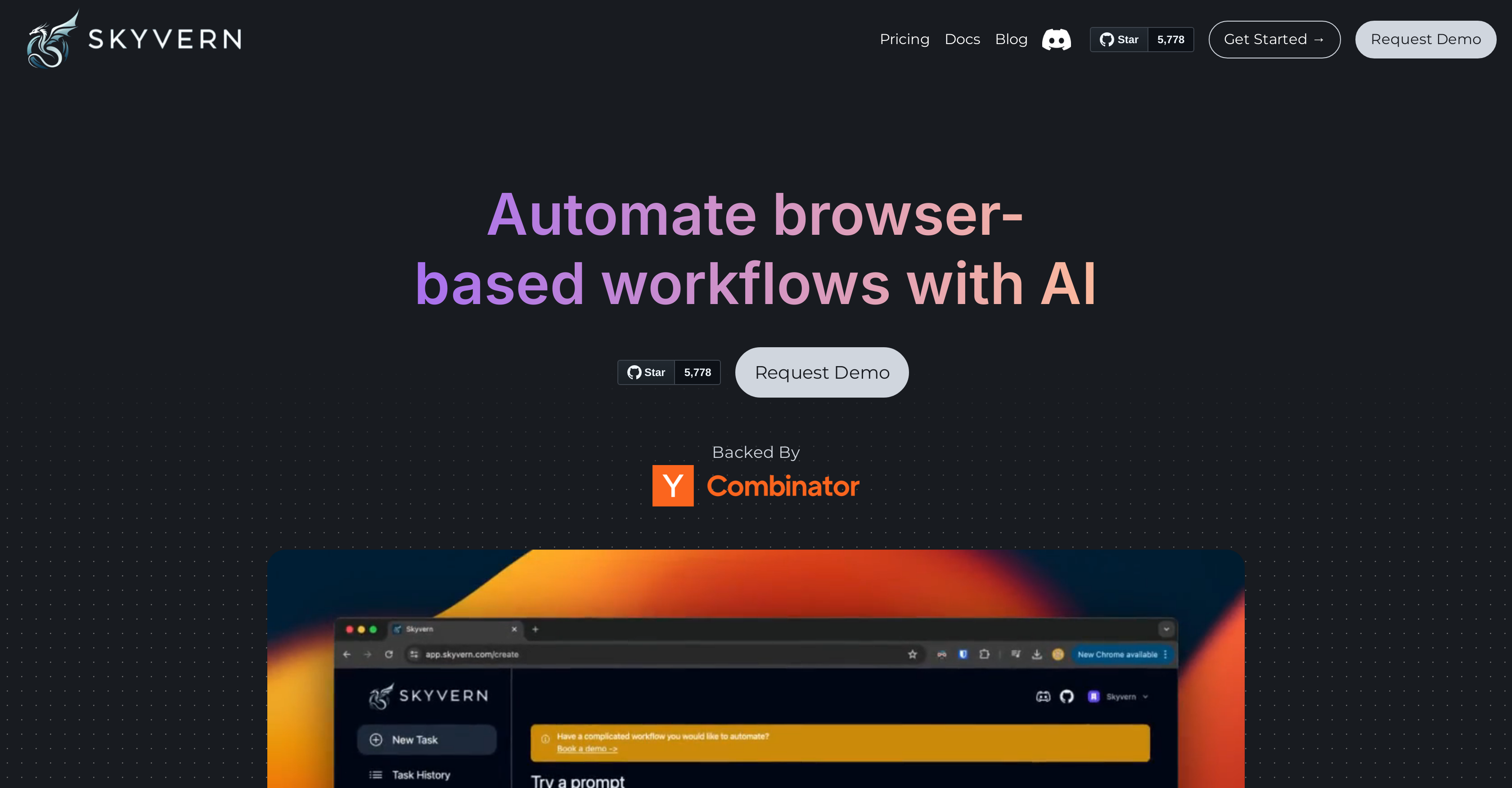
- Automate complex multi-step workflows on any website using simple English commands instead of complex code with natural language processing
- Extract structured data from any webpage or document directly into your preferred format like JSON or CSV for immediate analysis and integration
- Handle secure authentication seamlessly including two-factor authentication (2FA) to access user accounts and protected areas of websites
- Solve CAPTCHA challenges automatically and bypass geographic restrictions with precise proxy targeting at country, state, or zip code level
- Process invoices, forms, and multilingual websites with computer vision that understands content regardless of language or layout structure
- Scale automation infinitely by running hundreds of workflows simultaneously in the cloud through API-first architecture
- Understand every AI decision with transparent explanations and justifications for each action taken during automation processes
Pros & Cons
Pros
- API-first product
- Understands context on websites
- Natural language commands
- Near unlimited scalability
- Cloud-based workflow execution
- Transparency in operations
- Supports CSV and JSON formats
- Includes authentication support
- Supports two-factor authentication
- Solves CAPTCHAs
- Target proxies at various geographical levels
- Multi-language support
- Reliability in services
- Handles discrete online tasks
- Facilitates data extraction
- Supported by professionals and teams
- User-friendly instructions
- Preferred by professionals
- Automates browser-based workflows
- Works on any website
- Understands content on a webpage
- Executes complex tasks simply
- Justifies every action
- Supports precise zip-code level targeting
- Automates procurement pipelines
- Can fill dynamic and multi-step forms
- Fetches invoices from many vendors
- Capable of handling government forms
- Works in any language
- Generate engaging blog posts
- Revises content maintaining original meaning
- SEO-friendly product descriptions
- Innovative article ideas
- Clear summaries of lengthy articles
- Instant phrase and sentence generation
Cons
- Reliance on API calls
- No offline functionality
- Potential privacy issues
- Depends heavily on proxies
- Limited context misunderstanding
- Over-reliance on cloud execution
- Authentication security concerns
- CAPTCHA solving ethical concerns
- Potential scalability limits
- Vulnerability to website changes
Reviews
Rate this tool
Loading reviews...
❓ Frequently Asked Questions
Skyvern is an artificial intelligence-driven tool that offers automation services for various browser-based workflows. It is designed to automate complex tasks using API calls, enhancing efficiency and freeing up user time. Skyvern merges computer vision and AI to understand and interact with any website content. It can accept instructions in natural language and provides near infinite scalability by executing workflows on the cloud. It also offers features such as explainable AI decisions, data extraction in various schema, user account authentication support including two-factor authentication, CAPTCHA solving, and targeting proxies at various geographical levels. It can also scan invoices, forms, and websites in multiple languages.
Skyvern uses a combination of computer vision and AI to automate browser-based workflows. It understands and interacts with any website's content. Skyvern receives instructions in natural language, allowing it to perform complex tasks using simple, user-friendly commands. It handles vast scalability by executing workflows in the cloud, allowing it to run hundreds of workflows concurrently.
Being an API-first product means that Skyvern is built with the application programming interface (API) as the primary means of interaction. Users can automate complex tasks by invoking Skyvern through API calls, making integration with other systems easier and more effective. This approach allows users to integrate Skyvern's functionality directly into their existing systems or applications to enhance automation functions.
Skyvern uses computer vision and AI together to understand the content on any webpage. With computer vision, it can interpret the visual elements present on a webpage like images and layout structure, and with artificial intelligence, it can contextualize this information and perform tasks based on its understanding. This means it can adapt to any website and perform tasks efficiently, even on sites with complex structures or multifaceted visual information.
Natural language commands to Skyvern simplify the execution of complex objectives. Instead of having to use code or complex technical commands, users can give instructions in everyday language, making the tool user-friendly even for those without a technical background. This approach, facilitated by Natural Language Processing (NLP), enhances accessibility and ease-of-use for users while maintaining the tool's high capability.
Skyvern enhances productivity in several ways. It automates complex tasks freeing up users' time for other tasks. It provides near unlimited scalability by executing workflows in the cloud, which allows parallel execution of various workflows. This translates into completing more tasks in less time, which directly enhances productivity. Plus, its API-first approach makes it easy to integrate into existing systems, further eliminating manual effort.
Yes, Skyvern provides clear and comprehensive explanations of the AI decisions it makes. Each action accompanied by AI comes with built-in explanations that provide justifications and summaries. This transparency in operations helps users understand how the AI-driven tool arrived at a certain decision or action, promoting trust and understanding.
Skyvern extends the capability of data extraction from workflows. This feature allows users to pull information from their automated processes, which can then be analyzed, reported, or used to further refine their workflows. The data extraction can be implemented in any preferred schema.
Yes, Skyvern supports data extraction in various schema, including both CSV and JSON. The option for multiple formats allows users greater flexibility in how they use and analyze their extracted data.
Skyvern has support for authenticating into user accounts, which means it can access user-specific information and perform actions inside these secure areas of a website. This makes Skyvern more versatile in its applications as it can perform tasks that require user authentication.
Yes, Skyvern supports Two-Factor Authentication (2FA). This means that even when user accounts have an additional layer of security requiring two steps of verification, Skyvern can handle the process and access the account.
Yes, Skyvern has the capability to solve CAPTCHAs, which are often used by websites to verify that the user is not a robot. This enables Skyvern to complete complex workflows that may involve CAPTCHA challenges.
Skyvern supports targeting proxies at country, state, and even precise zip-code level, giving it comprehensive geographic coverage. This feature allows Skyvern to interact with web content that may be location-specific or have different content depending on the geographical location of the user.
Yes, Skyvern has the capability to scan invoices, forms, and websites in different languages. This enhances the tool's versatility and global applicability as it can understand and interact with content in multiple languages, thus not limited to English only websites.
Skyvern is trusted by professionals and teams who seek automation of discrete online tasks. The types of professionals using Skyvern are not specified on their website, but as an AI-powered automation tool for browser-based tasks, it covers a broad range of professions and industries.
Yes, by using a combination of AI and computer vision, Skyvern is able to understand and respond to the contexts found on any website. It can adapt to any layout or content structure, making it capable of performing tasks on virtually any site.
Yes, Skyvern supports data extraction in JSON format. This is one of the various schema that Skyvern can provide for data extraction, offering flexibility in how users analyze and use their extracted data.
While it is not specified how Skyvern fetches invoices from various vendors, its process for understanding and responding to content on any webpage using AI and computer vision would apply. This would involve identifying invoice-related information like vendor details, invoice numbers, dates, and costs, among other things, and extracting this data for the user. Skyvern's ability to authenticate into user-specific web accounts could also aid in accessing invoices that are in secured areas of a vendor's site.
Details are unspecified on their website on how Skyvern handles filling dynamic and multi-step forms. However, as it operates with AI and natural language processing, it can be inferred to interpret the requirements of a form, fill in the requisite information, and submit the forms. Given its broad capability, Skyvern may also handle changes in form structure or content and respond efficiently to multi-step forms that require sequential filling and interaction.
Their website does not provide specific on how Skyvern automates procurement pipelines. However, considering Skyvern's proposed capabilities it can most likely navigate vendor sites, identify required products, place them in a cart, and handle multi-step procurement actions. Skyvern can also likely interact with a variety of interfaces and product catalogs, identify specific SKUs, and perform appropriate procurement tasks.
Pricing
Pricing model
Freemium
Paid options from
$0.10/unit
Billing frequency
Pay-as-you-go
Related Videos
[Skyvern.com] Automate your Browser with AI
Andrew Shwetzer | Recruitment & Lead Gen AI•984 views•Apr 27, 2025