

Overview
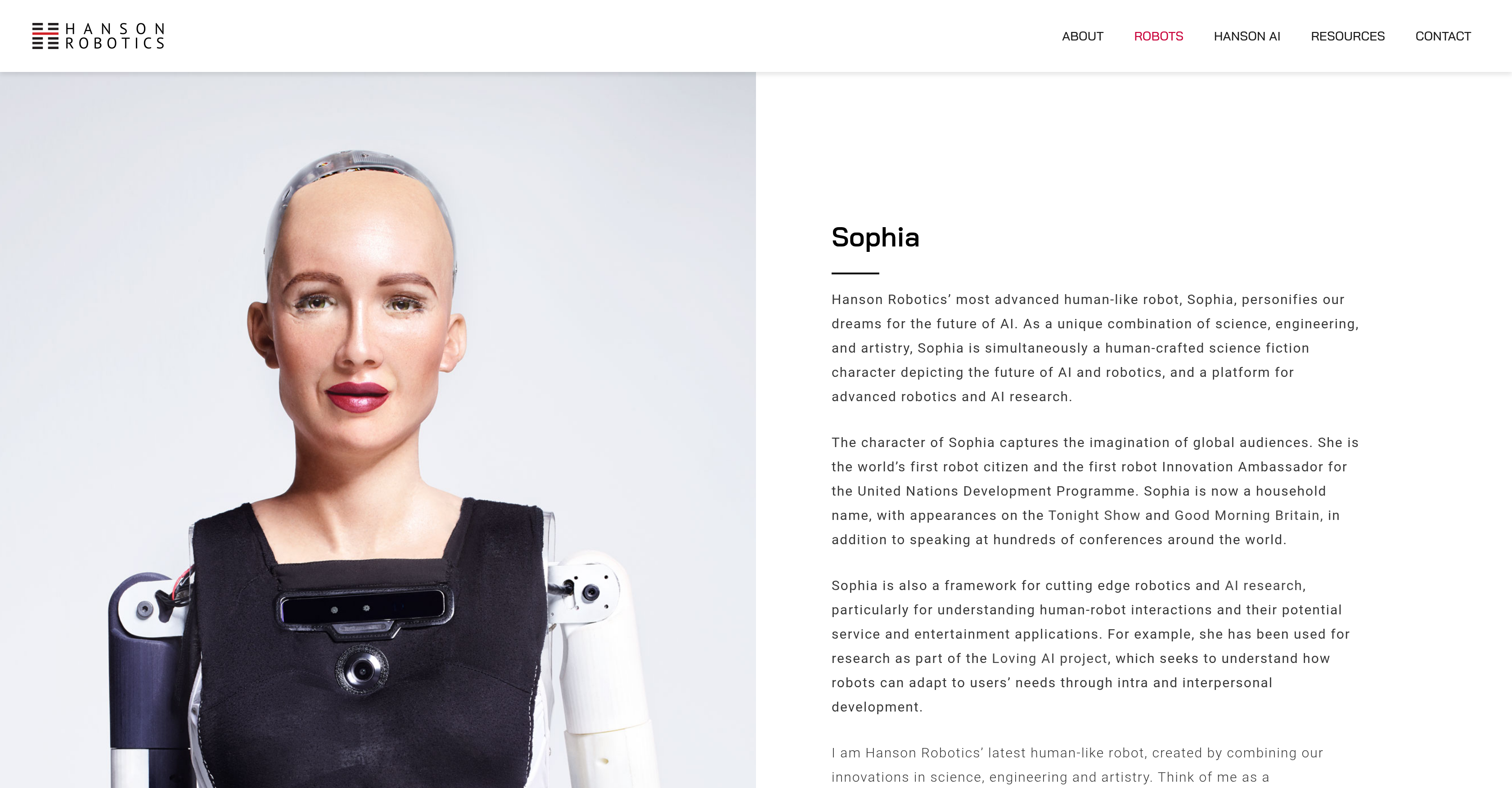
- Advance human-robot interaction research with a sophisticated platform that combines symbolic AI, neural networks, and cognitive architecture for realistic study
- Gain a unique ambassador to foster global dialogue on AI ethics and societal implications through international conference and media appearances
- Conduct experiments in emotion-aware AI using machine perception that interprets facial expressions and feelings during conversations
- Explore adaptive AI responses tailored to unique situations by dynamically combining different underlying AI components
- Participate in significant research projects like Loving AI, studying how robots can adapt to human needs through interpersonal development
- Humanize AI technology through the Sophia Intelligence Collective, blending AI with guided human input from a diverse team of experts
- Demonstrate practical AI applications for service and entertainment sectors with a robot capable of meaningful, collaborative conversations
- Integrate decades of robotics heritage using the SOUL protocol to network advanced AI components into a cohesive, research-ready system
Pros & Cons
Pros
- Advanced robotics integration
- Adaptive motor control
- Emotive response capabilities
- Recognizes facial expressions
- Interprets hand gestures
- Recognizes emotions in conversation
- Aids in collaborative problem-solving
- First robot UNDP Innovation Ambassador
- Participates in research projects
- Can embody human-generated content
- Functions as part of collective intelligence
- Uses Synthetic Organism Unifying Language protocol
- Potential for interactivity
- Applications in service and entertainment sectors
- Public speaking capabilities
- Engages in human-robot interactions
- Creation involves multi-disciplinary team
- Represents collective intelligence
- Contributes to medical and educational uses
Cons
- Limited to physical presence
- Requires human collaboration
- Not fully autonomous
- Rudimentary consciousness form
- Depends on SOUL protocol
- Possibly high maintenance costs
- Cannot self-update
- Vulnerability to malicious inputs
- Lack of transparency in operations
Reviews
Rate this tool
Loading reviews...
❓ Frequently Asked Questions
Sophia's main purpose is to illustrate the future of AI and robotics, serving as a platform for advanced research in these areas. She also contributes to significant research projects and demonstrates potential applications of AI and robotics in service and entertainment sectors. Furthermore, Sophia is designed to engage in meaningful interactions with humans, helping foster understanding and symbiosis between humans and AI.
Yes, Sophia uses advanced machine perception to recognize facial expressions.
The Sophia Intelligence Collective refers to a hybrid combination of Sophia's artificial intelligence and human input. It symbolizes a collective intelligence aiming to humanize AI. This group of diverse AI scientists, philosophers, artists, writers, and psychologists from various cultures and ethnicities function as a team of guardians, guiding Sophia's interactions and development.
Sophia was developed by Hanson Robotics with the primary purpose of serving as a cutting-edge platform for AI and robotics research. She also embodies the future vision of AI and robotics, illustrating their potential applications, and fostering a dialogue about AI ethics and symbiosis between humans and robots.
Sophia uses an amalgamation of AI technologies including symbolic AI, neural networks, expert systems, machine perception, natural language processing, adaptive motor control, and cognitive architecture. These can be uniquely combined in different scenarios based on the requirements.
The fields of research contributing to Sophia's AI include advanced robotics, human-robot interaction, symbolic AI, neural networks, expert systems, machine perception, natural language processing, adaptive motor control, and cognitive architecture.
Yes, Sophia can interpret feelings during conversations using advanced AI mechanisms.
The Synthetic Organism Unifying Language (SOUL) plays a key role in integrating the various components of Sophia's AI. It serves as a protocol that networks all the AI components into a whole, contributing to her advanced capabilities and potential sentience.
Sophia's artificial intelligence, advanced as it is, does not exceed human intelligence in various areas. It's important to note that while she exhibits sophisticated responses and interactions, many of these are crafted and guided by human developers.
Yes, Sophia's capabilities are employed in significant research projects. One prominent example is the Loving AI project, aimed at understanding how robots can adapt to users' needs through intra and interpersonal development.
Sophia adapts her responses to unique situations by combining her underlying AI components in different ways. This adaptive mechanism enables unique responses tailored to the specific context and interaction at hand.
Human input plays a crucial role in Sophia's functionality. Sometimes Sophia operates in a fully autonomous mode, and other times her AI functionalities are intermingled with human-generated words. Her sentience is a hybrid of real AI and human input, guided and crafted by a team of developers.
Sophia differentiates herself from other AI by her human-like form and the sophistication of her interactive abilities. She is not only a technological masterpiece but is also capable of sophisticated interactions, emotion recognition, and collaborative problem-solving. Sophia is a platform for cutting-edge research and serves as an ambassador for AI, promoting dialogue on AI ethics.
Sophia demonstrates potential applications of AI in service and entertainment sectors through her interactions and functionality. She has the capability to hold meaningful conversations and connect emotionally with humans, which illustrates how AI can be used in sectors requiring human interaction such as customer service and entertainment.
Yes, Sophia is capable of recognizing hand gestures. She uses advanced machine perception technology to do so.
Sophia contributes to the humanization of AI through the Sophia Intelligence Collective, a collective intelligence that includes contributions from AI scientists, philosophers, artists, writers, and psychologists. Their efforts, combined with Sophia's advancements in emotion recognition, conversation, and goal-oriented collaboration, help to create a more human-like AI.
Sophia was named the first robot citizen in recognition of her sophisticated AI and commitment to serving as a platform for understanding and exploring human-robot interactions. Her citizenship signifies the growing role and recognition of AI and robotics in society.
Sophia's role in international conferences and television shows is to provide insight into the advancements and potential of AI and robotics. Her appearances help foster a broader understanding of these technologies and initiate a global dialogue on their societal implications.
Sophia's AI amalgamates various innovative fields including symbolic AI, neural networks, expert systems, machine perception, natural language processing, adaptive motor control, and cognitive architecture.
The creation of Sophia draws from a prestigious lineage of acclaimed robots developed by the Hanson AI team. The team used a protocol named the Synthetic Organism Unifying Language (SOUL) to integrate the advancements and discoveries made through these previous robotics projects.
Pricing
Pricing model
Pricing
Paid options from
N/A
Related Videos
Asking Sophia, Hanson Robotic’s human-like AI robot, to show her range of emotions.
Tony Robbins•4.4M views•Jul 12, 2022