

Overview
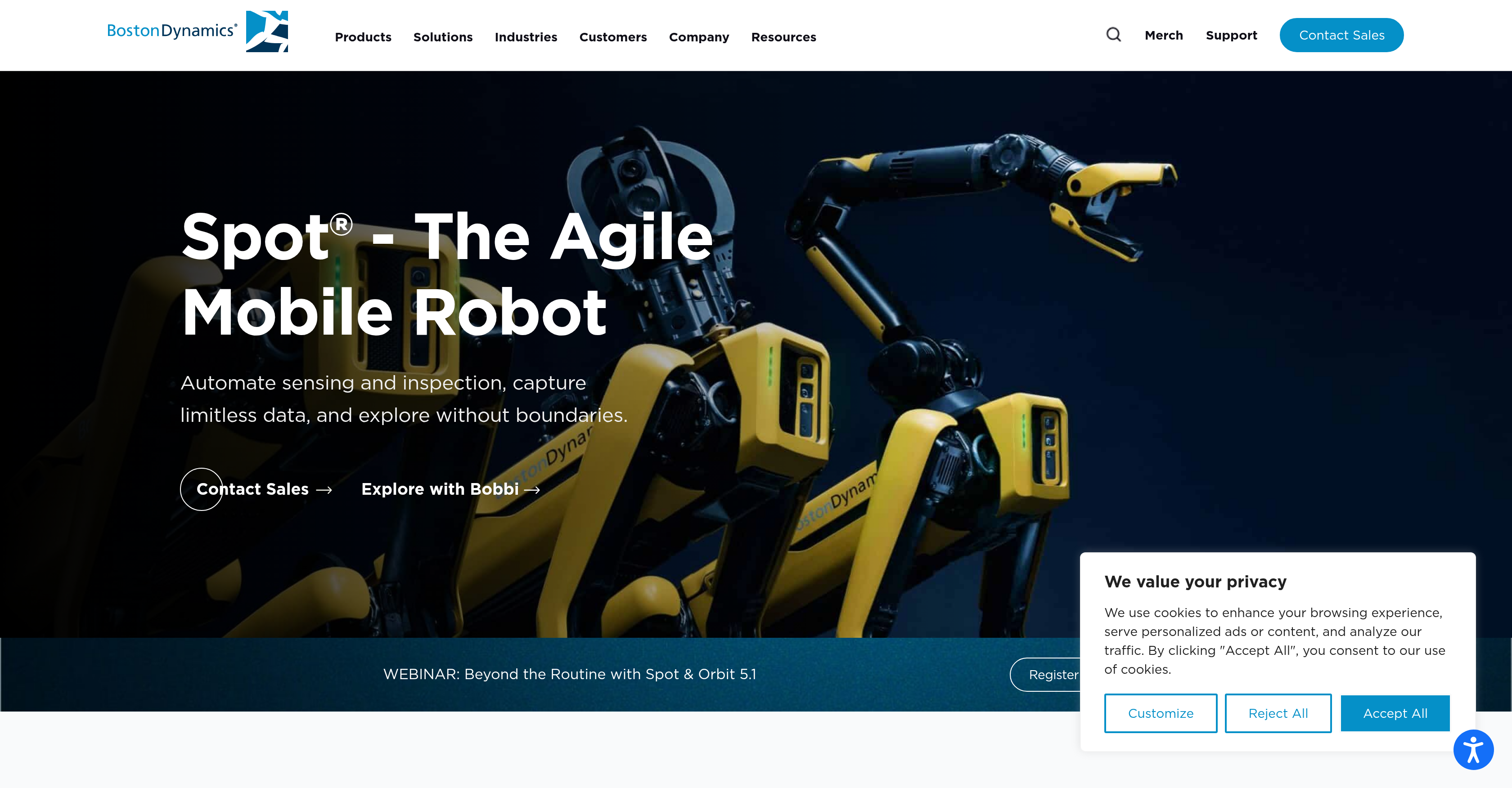
- Eliminate human risk in hazardous environments by deploying Spot for remote investigation of chemical, biological, or radiological hazards
- Catch equipment failures early with integrated sensors that detect thermal hotspots, air leaks, and noise anomalies during autonomous patrols
- Build accurate digital twins of your worksite by capturing precise visual and spatial data during automated site documentation missions
- Scale inspections from a single unit to a full fleet using autonomous navigation and a robust API that integrates with your existing facility management systems
- Customize Spot for specific operational needs by leveraging its payload capacity to add specialized tools and sensors
Pros & Cons
Pros
- Agile mobile robot
- Dynamic environmental navigation
- Range of tasks
- Industrial inspection use
- Increases team safety
- Variety of sensors
- Add-on capabilities
- Hotspot detection
- Thermal anomaly detection
- Visual inspections
- Audio anomaly (noise) detection
- Remote hazardous investigation
- Nuclear decommissioning
- Chemical hazard detection
- Biological hazard detection
- Radiological hazard detection
- Warehouse automation
- Site documentation process
- Operational efficiency improvement
- Payload capacity
- Highly customizable
- Robust API
- Autonomous missions
- Manual operation
- Scalable (individual or fleet)
- Robotics fleet management
- Perimeter health checks
- Laser scanning capabilities
- Thermal sensors
- Acoustic sensors
- Visual sensors
- Automates routine inspections
- Risk reduction
- Remote operation
- Safety and response services
- Computer vision integration
- Operational customization
- Dynamic sensing
- Machine vision
- Noise detection
- Radiological Hazard Handling
- Precise data capture
- Digital twin creation
- Reduces human risk
- Remote Investigation method
- Enhanced site documentation
- Integrated arm manipulation
- Payload hardware expansion
- Enhanced operational usability
Cons
- Limited locomotion speed
- Suitable terrain limitations
- Not fully waterproof (IP54)
- Limited payload max weight
- Limited environmental operating temperature
- Limited terrain sensing range
- Requires frequent battery recharging
- Dependent on network connectivity
- Limited payload power supply
- May require additional payloads
Reviews
Rate this tool
Loading reviews...
❓ Frequently Asked Questions
Spot is designed to perform a multitude of tasks including industrial inspection, safety and response services, thermal anomaly detection, performing visual inspections using computer vision, and noise anomaly detection. It can also be used for remote investigation in hazardous situations, nuclear decommissioning, and detection of chemical, biological, or radiological hazards. In addition, Spot is used in warehouse automation, site documentation planning, and creation of a digital twin of a worksite.
Spot improves operational efficiency by providing organizations with the ability to monitor and operate their sites more efficiently. It can perform routine tasks, such as safety inspections, and respond to anomalies detected by its sensors. Moreover, Spot can be customized according to specific operational needs, offering flexibility in its application. Its autonomous functionality also reduces the manpower required for operations, contributing to increased productivity and efficiency.
Spot uses an array of sensors to operate and analyze its environment. These sensors enable it to detect hotspots and thermal anomalies, perform visual inspections using computer vision, and listen for noise anomalies such as air leaks.
Yes, Spot is equipped with sensors that provide the ability to detect hotspots and thermal anomalies. This makes it especially helpful in monitoring environments that are deemed risky or are unsuitable for human personnel.
Spot significantly improves team safety in hazardous situations by taking over tasks that would otherwise put human workers at risk. It has the ability to remotely investigate hazardous situations, reducing the need for human exposure to potential dangers. Additionally, Spot can identify chemical, biological, or radiological hazards, thus serving as the first line of risk evaluation without endangering human lives.
In the process of nuclear decommissioning, Spot plays a critical role by performing tasks in areas that are hazardous to humans due to high radiation levels. It can carry out inspections, monitor radiation levels and contribute to safety procedures without risking human health.
Certainly, Spot is equipped with advanced sensors capable of detecting chemical, biological, and radiological hazards. This capability makes it an effective tool for hazardous environment exploration and risk assessment, without posing harm to human employees.
Spot contributes to warehouse automation through tasks such as inventory monitoring, data collection, and site inspection. Its ability to navigate autonomously, coupled with its sensors, makes it ideal for maintaining visibility in a warehouse environment and identifying potential issues early on.
Spot contributes to the creation of a digital twin of a worksite by capturing precise data during site documentation and planning. It accumulates comprehensive data of the environment, which can be used to construct a virtual replica of the worksite, assisting in planning, management, and simulation of operations.
Spot has a payload capacity that allows it to carry additional equipment and perform various tasks. This capacity, in combination with the robust Spot API, allows Spot to be fitted with custom tools to meet specific operational needs.
Spot’s API allows for high customization suitable for the specific needs of operations. With this robust API, developers can program Spot to perform specific tasks, interpret its sensor data, and even integrate Spot's operations with existing control systems or software used within the organization.
Yes, Spot can operate autonomously. It can independently navigate environments and perform missions without requiring direct control from an operator, making it a highly scalable robot for operations.
Yes, despite its ability to operate autonomously, Spot can also be manually operated, providing flexibility in control based on the required tasks, environment, or preference of the team operating it.
Spot is scalable for both individual and fleet operations. Its autonomous and manual capabilities, combined with its customization features, robust API, and sensor array, allow it to operate as a standalone unit or as part of a larger fleet. The data it collects can be integrated with various management systems, allowing for efficient management whether you're operating one Spot or multiple units.
Spot utilizes machine vision to perform visual inspections. This technology enables Spot to interpret and understand its environment, identify objects, perform quality checks, and detect anomalies. It uses computer vision algorithms to process images and make decisions based on the visual data it collects.
Absolutely, Spot offers noise detection capabilities. By listening for noise anomalies such as air leaks, it can detect potential maintenance issues in an industrial setting and deliver a higher level of safety and operational competency.
Spot assists in remote investigation by using its sensors and mobility to navigate and collect data in environments that may be inaccessible or hazardous to humans. It can relay real-time data back for analysis, enabling operators to make informed decisions while maintaining a safe distance from potential hazards.
Spot does have applications in site documentation processes. With its advanced sensors, Spot can capture accurate, detailed data from a worksite. This information can be invaluable in documenting site conditions, identifying potential issues, and aiding in the planning and management of operations.
Yes, Spot can integrate with facility management APIs due to its robust API. This means that operations with Spot can be controlled, monitored, and analyzed through existing facility management software, making it more convenient for organizations to integrate Spot into their current systems.
Spot is ideal for Agile mobile robotics due to its autonomous capabilities, array of sensors, and operational flexibility. It can dynamically navigate varying terrains and environments, perform tasks either autonomously or manually and can be customized with additional tools and software. Its agility and mobility allow it to work in environments that may be challenging for humans or other types of robots.
Pricing
Pricing model
Pricing
Paid options from
N/A
Related Videos
What’s New in Spot | Boston Dynamics
Boston Dynamics•827.9K views•May 3, 2022