
The Academic Digest
Overview
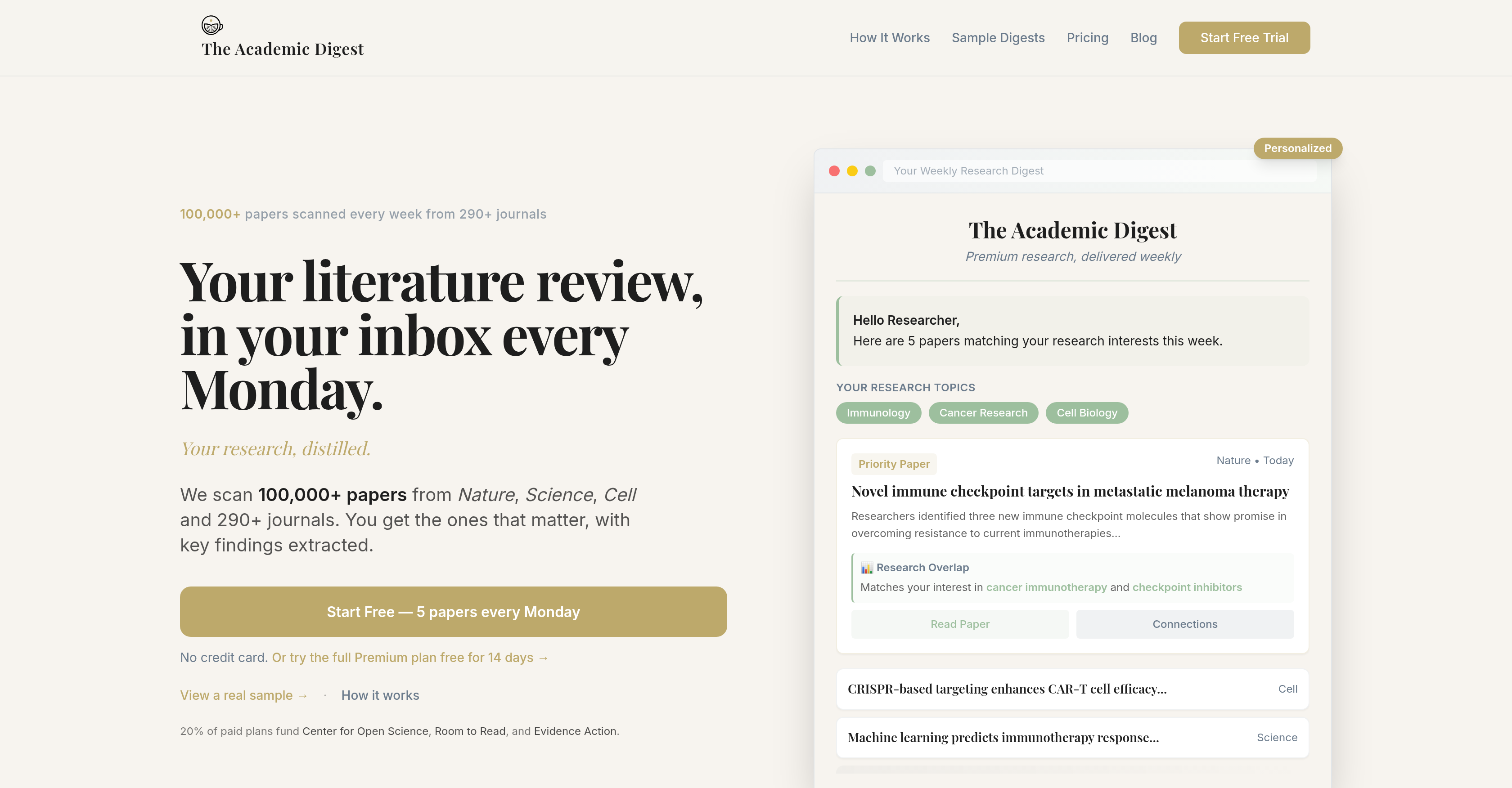
- Save hours of database searching every week by receiving a curated list of relevant papers from over 290 peer-reviewed journals delivered to your inbox every Monday, based on your specific research interests and keywords.
- Decide what to read in seconds with structured key findings extracted from each paper, summarizing methods, results, and conclusions.
- Discover breakthrough research months before publication by incorporating preprint papers from bioRxiv, medRxiv, and arXiv into your weekly digest.
- Track work across multiple research areas simultaneously by creating up to four separate projects, each with its own topics, keywords, and curated paper lists.
- Surface high-impact authors and their work effortlessly with author h-index ranking, which nudges papers by strong-h-index researchers higher in your digest.
- Trace the evolution of ideas in your field by linking every paper to its citation network, giving you a connected, comprehensive research perspective.
- Fine-tune your future digests with a single tap using the like button, which adjusts curation to match your preferences over time.
- Manage citations instantly with one-click Zotero save, eliminating manual entry for papers you decide to keep.
- Support open science and global literacy initiatives automatically, as 20% of subscription revenue goes to the Center for Open Science, Room to Read, and Evidence Action.
Pros & Cons
Pros
- Curates from 290+ journals
- Weekly email delivery
- Extracts structured key findings
- Supports cross-disciplinary research
- Includes preprint inclusion
- Offers keyword-based search
- Customizable research projects
- Summarizes research papers
- Subscriptions support charities
- Offers free and premium plans
- In-depth ranking for premium users
- Network of linked related papers
- Author h-index ranking
- Early alert system inclusions
- Delivers based on defined interests
- Separate projects for various interests
- Covers broad scientific publication range
- Premium plan includes smarter curation
- Personalized service for each user
- Enables tracking work across areas
- No requirement for time-consuming searches
- Promotes open science initiative
- Promotes important pre-peer-review research
- Eases literature review process
- Customizable with specific topics, keywords
- Funds global impact initiatives
- Effortless setup in under 2 minutes
- Structured presentation of methods, results
- Offers break from echo chambers
- Prevents daily noise with a calm weekly email
Cons
- Limited to email delivery
- Weekly, not daily updates
- Limited free features
- Restricted number of keywords
- Curation accuracy not guaranteed
- Doesn't support all journals
- No real-time updates
- Cannot influence suggestion algorithm
- Not all features in free plan
- Limited number of projects
Reviews
Rate this tool
Loading reviews...
❓ Frequently Asked Questions
The Academic Digest's research paper digest service includes over 290 peer-reviewed journals such as Nature, Science, Cell, NEJM, PNAS, bioRxiv, medRxiv, arXiv, among others.
The Academic Digest chooses papers relevant to your research by scanning over 100,000 papers every week based on your identified research interests and keywords.
The Academic Digest provides weekly research paper deliveries every Monday.
To set up a project with the Academic Digest, define your research interests, name your project and pick a topic, then add 5-7 specific keywords.
The Academic Digest offers two subscription plans: A free plan that includes a single research project and delivery of 5 curated papers every week, and a Premium plan offering up to 4 research projects, up to 40 papers, deeper ranking, smarter curation and a related papers network.
Yes, with the Academic Digest, you can define your research interests and keywords as per your requirement.
The Academic Digest's feature of key findings extraction works by summarizing 3-5 findings per paper, including methods, results, and conclusions, allowing you to decide what to read in seconds.
The Academic Digest supports the Center for Open Science, Room to Read and Evidence Action with the revenues from paid subscriptions.
For premium users, the Academic Digest offers additional features such as deeper ranking, smarter curation, a related papers network, author h-index ranking and the ability to fine-tune your digest with a like button.
The Academic Digest incorporates preprint papers from bioRxiv, medRxiv, and arXiv. This allows subscribers to catch important work ahead of peer review, months before publication.
Yes, the Academic Digest allows users to separate their investigation into different projects, each with its own topics, keywords, and curated papers.
The format for email deliveries from the Academic Digest is a compact and organized email digest sent every Monday, containing papers ranked by relevance to your research, along with extracted key findings.
Yes, the Academic Digest does offer a service for curation of related papers. This feature is available for premium subscribers where every paper links to its citation network.
Yes, the Academic Digest offers advanced ranking for premium users. Papers are nudged up in ranking when authored by researchers with a strong h-index in the user's field.
Yes, with the Academic Digest, you can filter research papers based on keywords. It precisely matches papers to your specified keywords from over 290 peer-reviewed journals.
The benefits of Academic Digest's premium subscription plan include the delivery of up to 40 curated papers weekly, deeper ranking, smarter curation, a related papers network, and author h-index ranking. Functionalities like an interactive like button to fine-tune digests and one-click Zotero save option for easy citation management are also included.
Yes, as part of its research paper digest service, the Academic Digest includes papers from esteemed disciplines like Science, Nature, and Cell.
The difference between the free and premium plan offered by Academic Digest hinges on the number of research projects, number of papers delivered weekly, number of keywords capability, and additional functionalities. The free plan includes one research project, 5 curated papers weekly, while the premium plan offers up to 4 research projects, up to 40 papers weekly, and advanced features like a related network of papers and author h-index ranking.
Yes, the Academic Digest does curate and deliver papers from the broad field of Scientific Research covered in over 290 peer-reviewed journals.
The Academic Digest supports Open Science by donating 20% of the revenue from paid subscriptions to organizations like the Center for Open Science.
The Academic Digest is a research paper digest service that curates and delivers relevant research papers from over 290 peer-reviewed journals directly to your inbox every week. The service extracts and presents key findings for quick and insightful scanning. It also includes features for structured key findings, preprint inclusion, weekly email delivery and additional features for premium users.
To use The Academic Digest, you need to define your research interests. The AI will scan a plethora of papers from noteworthy academic journals and delivers the ones that are most aligned with your identified research interests and keywords. Apart from providing a list of papers, the service presents key findings for swiftly gleaning pertinent information.
The Academic Digest scans more than 290 peer-reviewed journals every week. It scans across significant scientific and academic journals like Nature, Science, Cell, NEJM, PNAS, bioRxiv, medRxiv, and arXiv, among others.
The Academic Digest utilizes advanced algorithms that rank each paper in relevance and scientific impact. The process is based on the user's defined research interests and keywords, making it a highly selective system focusing on delivering pertinent papers.
The Academic Digest offers a range of features including curated weekly delivery of research papers, the extraction and presentation of key findings from each paper, preprint inclusion, and structure key findings. Premium users enjoy additional features like deeper ranking, smarter curation, and the author h-index ranking.
The free plan of The Academic Digest includes one research project, delivery of five curated papers weekly, structured summaries with key findings, and a topic + 5 keywords. The premium plan includes up to four research projects, delivery of 10 papers per project (40 total), 5 topics + 15 keywords each, related papers network, author h-index ranking, and a like button for fine-tuning future digests with a single tap.
The Academic Digest contributes to the scientific community by allocating a portion of its subscription revenue to charitable organizations such as the Center for Open Science, Room to Read, and Evidence Action.
The premium features of The Academic Digest include deeper ranking, smarter curation, author h-index ranking, access to a related papers network, and the capacity to fine-tune future digests with the help of the 'like button'. These features enhance the user's research experience by surfacing high-impact authors and connecting relevant papers within the citation network.
The Academic Digest ensures the selected papers align with your research interests by using advanced algorithms. This system screens through academic papers using your specified research interests and keywords, providing you with a curated list of relevant materials every week.
When The Academic Digest scans a paper, it does not merely present the document's entirety. Instead, it structures its key findings, summarizing the methods, results, and conclusions. This feature allows users to grasp the significance of the study in seconds.
The citation network is a significant component of the premium features in The Academic Digest. Each paper links to its citation network, allowing you to trace the evolution of ideas and concepts in a field of research. It provides a connected, comprehensive perspective on your selected readings.
The Academic Digest offers an author h-index ranking in their premium feature set. Papers get additional ranking when authored by researchers with a strong h-index in your field. This helps surface high-impact authors and their work relevant to your research.
The Academic Digest delivers a curated list of research papers directly to your inbox every week, specifically every Monday.
The Academic Digest handles cross-disciplinary research by allowing its users to discover related work from various fields. This feature enables researchers to gain insight from different areas and can often prompt breakthroughs.
Setting up a project on The Academic Digest involves three steps. The first step is to name your project and pick a related topic. The second step is to add 5–7 specific terms as keywords. The third step is to wait for your digest, which will have papers ranked by relevance to your research, along with key findings every Monday.
A premium user can create up to four research projects on The Academic Digest. This allows them to track work across multiple areas simultaneously.
Yes, it is possible to cancel your Academic Digest subscription anytime. Their services offer a straightforward and user-friendly cancellation process, providing freedom and flexibility to the users.
The revenue from The Academic Digest subscriptions is used to support impactful organizations. The company allocates 20% of its revenue from subscriptions to organizations such as the Center for Open Science, Room to Read, and Evidence Action.
The pricing plans for The Academic Digest start as a free service. The most popular premium plan is €3.75/month (billed annually). It provides additional features such as author h-index ranking, related papers network, and up to 40 total papers across 4 different projects.
Yes, you can add specific keywords for your research project in The Academic Digest. On the free plan, you can add five keywords, but on the premium plan, you can add up to fifteen keywords per project.
Pricing
Pricing model
Freemium
Paid options from
$4.30/month
Billing frequency
Monthly
Refund policy
No Refunds