
The Profanity API
Overview
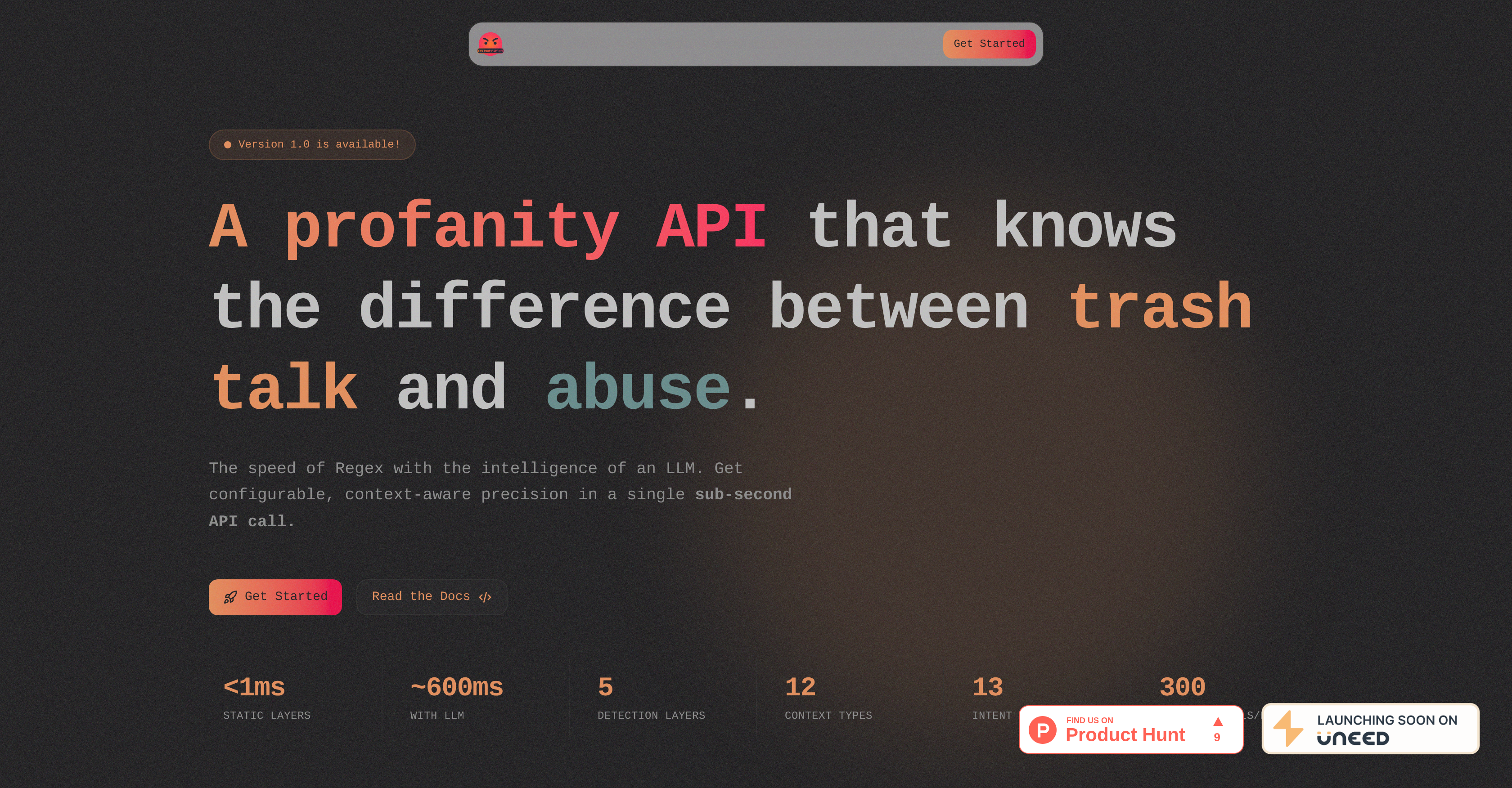
- Eliminate false positives from simple word filters with AI that analyzes the context and intent behind language, powered by a 5-layer analysis pipeline.
- Maintain platform safety and integrity by automatically blocking genuinely harmful or offensive content, even when it uses colloquial or regionally varied language.
- Scale moderation effortlessly for high-volume user-generated content like forums and social comments with an API built for seamless developer integration.
- Reduce moderation workload and complexity by automating nuanced detection across 13 intent categories and 12 context types, moving beyond basic blacklists.
Pros & Cons
Pros
- Advanced profanity detection system
- Understands and interprets context
- 5-layer analysis pipeline
- Wide spectrum of intent categories and context types
- Greater flexibility and power in content control
- Moves beyond simple word filters
- Enhances online safety with nuanced content management
- Context-aware functionality
- Prevents accessibility to offensive material
- Maintains user's online space integrity
- Enhances accuracy of content moderation
- Seamlessly integrates with coding practices
- Comprehends different aspects of language use
- Ideal for applications dealing with volumes of user-generated content
- More nuanced approach compared to 'blacklist' methods
- Considers colloquial language and regional speech variations
- Rigorous content analysis
- Detects and understands profanity within content context
- Intelligent approach to content filtering
- Built for developers with focus on content moderation
- Recognizes wide variety of intent categories and context types
Cons
- Lacks language translation capabilities
- No offline mode
- Doesn't support voice content
- Lacks predefined blacklist customization
- Complex multi-layer analysis pipeline
- May struggle with code-based contexts
- Limited to developers only
- Potential inaccuracies with colloquial language
- Overcomplicated for simple tasks
- No demonstration of response speed
Reviews
Rate this tool
Loading reviews...
❓ Frequently Asked Questions
The Profanity API differs from other content moderation tools by employing an advanced profanity detection system that understands not just the explicit language but also the context in which it is used. It offers a more nuanced content management that goes beyond simple word filters. It integrates seamlessly with coding practices and simplifies content moderation by enhancing accuracy.
The advanced profanity detection system employed by the Profanity API is capable of discerning explicit language within its context, facilitating a more precise moderation activity.
The understanding and interpretation of context by the Profanity API enables a more accurate identification of unsuitable content and prevents potentially offensive or harmful material from going through, thereby maintaining the integrity of the user's online space.
The Profanity API's 5-layer analysis pipeline is a sophisticated system designed to categorize and identify unsuitability within a wide range of intent categories and context types.
The Profanity API can detect a variety of intent categories and context types. The exact details of these categories and types are not specified on their website.
By understanding the context in which a word is used, the Profanity API offers a more nuanced content management than simple word filters that only look at select terms in isolation.
The Profanity API aids in limiting potentially harmful or offensive material by understanding and interpreting the context of language. This allows it to filter out unsuitable content within a wide spectrum of intents and contexts.
The Profanity API upholds the integrity of the user's online space by preventing potentially offensive or harmfully intent content from being displayed or accessed.
The Profanity API integrates with coding practices and processes by providing a seamless, developer-centric tool that simplifies the task of content moderation through automation and accuracy.
The Profanity API enhances the accuracy of content moderation through its advanced detection system that analyzes language not only for explicit terms but also interprets the context in which they are used.
Yes, the Profanity API is able to filter content based on specific context, providing a much more nuanced moderation compared to traditional keyword filters.
The Profanity API is better at identifying unsuitability within a wide spectrum of intent and context types due to its advanced profanity detection system and its capability to understand and interpret context.
The Profanity API manages the detection and filtering of explicit language through an advanced detection system that not only identifies potentially explicit language, but also understands and interprets the context in which it is being used.
The Profanity API's context-aware functionality works by understanding and interpreting the contextual use of language, allowing it to accurately identify unsuitable content.
The Profanity API can help maintain a cleaner, safer digital environment by preventing potentially harmful or offensive content from being displayed or accessed. This is achieved through the use of its advanced detection system which has the capability to understand and interpret the context of language use.
The Profanity API uses Natural Language Understanding for moderation by interpreting the context in which words or phrases are used, not just their explicit meaning. This ensures a more nuanced and accurate content moderation process.
The Profanity API is a sophisticated content moderation tool explicitly designed for developers. It utilizes modern AI methodologies to identify and understand inappropriate or profane content, moving past explicit language to comprehend the context in which it is used.
The Profanity API's 5-layer analysis pipeline adopts a comprehensive approach to analyze content. While specific mechanisms are not laid out explicitly, it likely encompasses elements such as basic profanity detection, deep linguistic analysis, context analysis, colloquial and regional language recognition, and intent analysis.
The Profanity API can identify a broad range of intent categories and context types, extending its functionality beyond mere verbatim detection. However, the specific nature of these categories and types is not disclosed on their website.
The Profanity API is designed to handle colloquial language and regional speech variations. It does this through a sophisticated linguistic model that likely understands and interprets regional speech patterns and local language slang, ensuring its relevance regardless of language or location-specific content.
Traditional blacklist methods filter content based solely on preset negative or explicit words. In contrast, Profanity API uses AI-driven analysis to go beyond simple word filtering—it considers context, colloquial language, regional variations, and nuances in communication, which allows for a more granular and accurate moderation.
While the precise accuracy rate is undisclosed, the Profanity API employs advanced methodologies like context-based understanding, multi-layered analysis, and regional speech recognition to ensure a high level of accuracy in content moderation and profanity detection.
Profanity API understands the context of language use through its advanced system that not only scans for explicit language but also discerns the context in which it is used. This means it can classify language based on colloquial use, regional speech variations, and the intent and context in which the language is employed.
Profanity API can help maintain a safe digital environment by rigorously analysing content for inappropriate or offensive material. Its context-aware capabilities can restrict potentially harmful or offensive content from being accessible, thereby ensuring the integrity of a user's digital space.
Profanity API aids developers by seamlessly integrating into coding practices and processes. It simplifies the task of content moderation by automating the process with advanced AI and providing a nuanced approach to understanding language and context.
Profanity API can moderate any user-generated content, recognizing a broad spectrum of intent and context. This suggests that it could be deployed in a wide variety of platforms where user-generated content is found, like online forums, social media platforms, or comment sections.
While precise details are not provided, Profanity API, as a developer-centric tool, is designed to fit seamlessly into the coding practices and processes of a developer. It likely offers easy-to-integrate API calls and compatibility with popular programming languages.
Yes, Profanity API makes use of natural language processing to understand and interpret language contextual nuances, colloquial variations, and regional speech idiosyncrasies effectively.
Yes, Profanity API's context-aware system allows it to detect and limit the accessibility of offensive or potentially harmful content, which helps to uphold the online space's integrity.
Profanity API is highly flexible in terms of content control. It utilizes a broad spectrum of intent categories and context types to effectively understand and moderate content, moving beyond traditional keyword-based filters.
Yes, Profanity API is designed to handle different aspects of language use. It can understand the intent and context of language and adapt to regional speech variations, colloquial language, and nuanced communication.
Yes, Profanity API is ideally suited for moderating large volumes of user-generated content. Its AI-driven, intelligent approach to content moderation enables it to process and moderate high volumes of content efficiently and accurately.
Unlike basic keyword recognition systems that solely detect specific words, Profanity API uses a multi-layered AI approach to understand the context and intent behind language usage. It can accommodate colloquial language, regional variations, and complex communication nuances, providing a more comprehensive and precise moderation.
Profanity API employs a sophisticated understanding of both explicit and implied language. By using a context-aware mechanism, it can understand the context in which words are used, enhancing the precision of its moderation activity.
Customizability is not explicitly mentioned on their website. However, as a developer tool, it would be expected that Profanity API offers some level of customization to fit the specific needs of different applications or platforms.
The Profanity API is designed to understand regional speech variations and colloquial language, which indicates a capability to accommodate a range of languages. However, there is no explicit mention of its ability to moderate content across all languages and cultures on their website.
Pricing
Pricing model
Freemium
Paid options from
$0.00/unit
Billing frequency
Pay-as-you-go