
Universal-3 Pro by AssemblyAI
Overview
- Achieve medical-grade accuracy for complex terminology by providing contextual prompts about topics and jargon before transcription.
- Capture the true structure of dialogues for conversation intelligence with automatic speaker role identification and labeling.
- Preserve the natural flow of bilingual meetings and support calls by accurately transcribing code-switching between languages like English and Spanish.
- Analyze authentic conversational dynamics by transcribing speech disfluencies, fillers, and informal speech patterns accurately.
- Enrich audio analysis with context-aware tagging of non-speech events like laughter or background noise.
Pros & Cons
Pros
- Promptable
- Quality transcriptions
- Contextual prompts
- Speaker role differentiation
- Transcribes speech disfluencies
- Accurate informal speech transcription
- Code-switching capability
- Context-aware audio tagging
- Complex language handling
- Enhances transcription value
- Specialized medical transcription
- Effective conversational analysis
- Learning from different contexts
- Handles accents
- Handles audio quality variations
- Supports background noise
- Transcribes key terminology
- Recognizes names
- Understands specific topics
- Handles speech formats
- Verbatim transcriptions
- Tags non-speech audio events
- Effective dialogue differentiation
- Caters to specific content needs
- Recognizes informal speech
- Handles bilingual conversations
- Handles speaker roles
- Can be used in contact centers
- Preserves natural transitions between languages
- Transcripts understand specific content
- Autonomously recognizes content
- Contextualizes transcription process
- Annotations for speaker roles
- Specifically promptable for complex scenarios
- Can transcribe specific key terms
- Role-specific transcription
- Flexibility in context prompting
- Integrates role labels into transcripts
- Natural conversation transcription
- Audio-event tagging
- Prompt specifies transcript format
- Offers domain-specific accuracy
- Retains original spoken language
- Preserves disfluencies within transcripts
- Conducts speech-to-text translation
- Handles high levels of conversational analysis
- Automated start-up process
- Optimized for real-world conversations
- Accurate pronunciation of proper names
- Low missed entity rates on real world audio
Cons
- Not suitable for real-time processing
- Requires context pre-setting
- Difficulty with rare languages
- May over-capture disfluencies
- Possible privacy concerns
- Intensive preparation for roles
- Learning curve for prompt engineering
- May need occasional manual corrections
- Susceptible to misinterpretation of informal speech
- Possible transcription inaccuracies
Reviews
Rate this tool
Loading reviews...
❓ Frequently Asked Questions
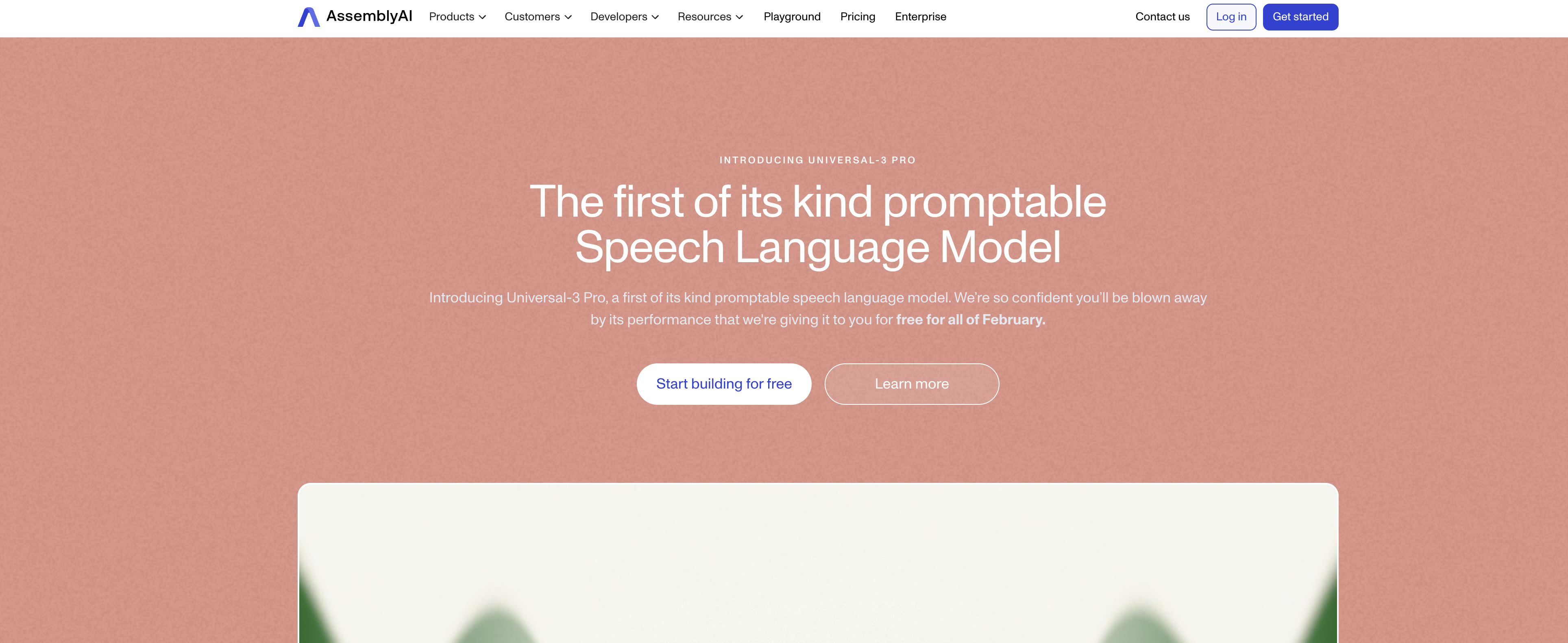
Universal-3 Pro by AssemblyAI is a first of its kind promptable speech language model. This model is designed to deliver transcriptions that understand and reflect the specific content being communicated. It offers features that enhance the quality and value of transcriptions, enabling better interpretation and representation of spoken information.
Universal-3 Pro processes content by taking context about names, terminology, topics, and formats before processing. It uses this context to generate transcriptions that closely mirror the specific content of the conversation or speech being transcribed, ensuring that important details and nuances are captured accurately.
Yes, Universal-3 Pro can identify speaker roles. It offers role-specific prompts to guide the transcription process, and each speaker's role is correctly captured and labelled in the resulting transcription. This feature ensures that the dialogue structure is maintained and the roles of the speakers are clear in the transcript.
Universal-3 Pro handles speech disfluencies by accurately transcribing content that includes elements like stutters and informal speech. This capability ensures that the transcription retains the natural rhythm, flow, and other significant data from the conversation. This includes capturing fillers, repetitions, restarts, stutters and informal speech, preserving them accurately in the transcript.
Yes, Universal-3 Pro is capable of transcribing bilingual conversations. It is adept at handling language code-switching and preserves natural transitions between languages in bilingual conversations. This means it can smoothly switch between different languages while transcribing, mirroring the natural flow of bilingual dialogue.
Context-aware audio tagging in Universal-3 Pro enhances its ability to interpret non-speech audio events. This means that the model is capable of identifying and labeling specific non-speech sounds or events in the audio it is processing. This can be particularly useful for identifying significant non-verbal elements in an audio file, such as laughter or background noise.
Universal-3 Pro is particularly beneficial for applications such as medical transcription. It's capable of understanding and processing complex or technical language, including medical terminology, to ensure accurate transcriptions. This makes it a valuable tool for environments like healthcare where correct understanding and transcription of specialized terminology are critical.
Universal-3 Pro is indeed useful for conversational analysis. Its ability to capture and label disfluencies, interpret non-speech audio events and maintain the original rhythm and flow of a conversation makes it ideal for analyzing dialogues. It can help understand the complete structure, dynamics, and content of a conversation, making it valuable for conversational analytics.
Universal-3 Pro is a model for voice language. It minds the context about names, terminology, topics, and formats before processing which results in comprehensive transcriptions that reflect the specifics of the spoken content.
A promptable language model like Universal-3 Pro can be given context about desired specifics before it begins the transcription process. This context can include names, terminology or topics that are expected to emerge in the audio content. This guides the model during the transcription process, enabling it to generate output that closely reflects the anticipated content.
Universal-3 Pro handles complex or technical language by leveraging its promptable nature. It can be given context about technical terminology or complex topics before it commences transcription. This enables it to accurately transcribe, recognize and output language that is highly domain-specific or complex in nature. It is particularly beneficial in environments involving technical language such as medical or legal transcription.
Universal-3 Pro performs audio transcription by guiding the process with role-specific prompts, understanding specific contexts, identifying speaker roles, handling speech disfluencies and managing language code-switching. These capabilities enable it to deliver a comprehensive and accurate transcription of the audio content.
Currently, there is no direct information available about the specific audio formats Universal-3 Pro can work with. However, given it's an advanced speech-to-text model, it's likely that it can work with popular audio formats commonly used for such processes.
Universal-3 Pro handles speech recognition by utilizing its promptable nature. Given the context about names, terminology, topics, and formats, the model is able to accurately recognize and transcribe spoken words and phrases that are specific to the provided context.
The domain-specific feature in Universal-3 Pro means it's designed to understand and process language that is specific to a particular field or industry, providing high accuracy in transcription. Whether it's medical, legal, or any other specialized domain, Universal-3 Pro is equipped to understand the terminology and context specific to these fields.
With Universal-3 Pro, role-specific prompts are used to guide the transcription process. By understanding the role of each speaker in a dialog, the model can accurately assign speech parts to corresponding roles in the transcript. This is useful in several scenarios where speaker role is significant, for instance in medical, legal, or customer service conversations.
Universal-3 Pro ensures quality in transcription by accurately capturing the specifics of the spoken content. Given the context about the content, it recognizes specific names, terms, topics, formats, etc. It identifies speaker roles, manages speech disfluencies, and interprets non-speech audio events. All these capabilities together enable Universal-3 Pro to deliver high-quality, detailed transcriptions.
Currently, there isn't any explicit information regarding Universal-3 Pro's ability to handle diverse accents and speech patterns. However, given the comprehensive features and capabilities of the model, it's likely it is equipped to understand and process a variety of accents and speech patterns.
In Universal-3 Pro, code-switching refers to its capability to retain natural transitions between languages within bilingual conversations. In a dialog involving two languages, the model can switch between transcribing the two languages as the speakers switch between them. This ensures the transcription of such bilingual conversations is as accurate as possible.
There is currently no specific mention of Universal-3 Pro's ability to work in real time. However, given the advanced nature of the model and standard features of similar speech-to-text models, it likely has the ability to provide real-time transcriptions.
Being a promptable speech language model, Universal-3 Pro can be given context about names, terminology, topics, and formats before transcribing. This pre-processing information guides the AI model to better understand and interpret the content being addressed, thereby enhancing the quality and specificity of the resulting transcriptions.
The main features of Universal-3 Pro include the ability to identify speaker roles, accurately transcribe speech disfluencies, handle complex or technical language, and manage language code-switching in bilingual conversations. It also has the ability to interpret non-speech audio events with context-aware audio tagging.
Universal-3 Pro identifies speaker roles by providing role-specific prompts that guide the process of transcription. Each speaker's role is correctly captured and labeled in the resulting transcription. This is especially useful in environments like contact centers or conversation intelligence where differentiating between the speakers is important.
Universal-3 Pro proves to be especially helpful in environments that involve complex or technical language. These include medical transcription, where the correct transcription of technical terminology and specific jargon is crucial, or conversational analysis, where understanding the nuances and roles in dialogue is important.
Universal-3 Pro is capable of accurately transcribing a wide range of language types. It can handle speech disfluencies, informal language, and complex terminology. It's particularly adept at handling language code-switching, making it suitable for transcribing bilingual conversations.
Universal-3 Pro caters to specific content needs by intelligently recognising and understanding spoken language. It recognises key aspects of speech like names, terminology, topics, and speech formats and modifies its output to align with the provided context. The aim is to enhance the outcome's accuracy and adaptability.
Yes, Universal-3 Pro can differentiate between speaker roles. It provides role-specific prompts to guide the transcription process, ensuring that each speaker's role is correctly captured and labelled in the resulting transcription.
Code-switching refers to the practice of alternating between two or more languages within a single conversation. Universal-3 Pro can handle language code-switching by preserving the natural transitions between languages in bilingual conversations. This allows it to maintain the natural flow of the dialogue being transcribed.
Yes, Universal-3 Pro has the capacity to transcribe non-speech audio events. With context-aware audio tagging, the model can interpret and transcribe sounds that aren't words, thereby enhancing the understanding and transcription of the overall auditory environment.
Universal-3 Pro separates from traditional automated speech recognition solutions by introducing context-aware transcriptions and adaptations. This model takes in contextual prompts before processing, which improves the accuracy of its transcriptions and understanding of spoken language. Unlike conventional models, it modifies its output according to differing contexts, enhancing the transcriptions' value and quality.
Yes, Universal-3 Pro supports multilingual inputs. It's adept at handling language code-switching and preserving the natural transitions between languages in bilingual conversations, for instance, between English and Spanish.
Universal-3 Pro can suit various applications but provides significant impact in areas like conversation intelligence, medical transcription, and contact centers. It's designed to capture nuanced speech components and uniquely adapts to the specific needs of any subject matter.
Universal-3 Pro can handle complex terminology efficiently. It's particularly useful in environments that involve complex or technical language, such as medical transcriptions or technical discussions. It can understand and accurately transcribe specific jargon, enhancing the accuracy and usability of the result.
Yes, Universal-3 Pro is capable of interpreting and transcribing informal speech. Besides standard spoken language, it can handle and accurately transcribe speech disfluencies like stutters and informal language. This makes it suitable for capturing realistic and spontaneous speech patterns.
Context is provided to Universal-3 Pro before transcription through prompts. These prompts give the model pre-processing information about names, terminology, topics, and formats. This way, the AI model better understands the content to be transcribed and refines its transcriptions accordingly.
Yes, Universal-3 Pro can handle medical transcription tasks. Its ability to process contexture prompts about specific terminology and formats before processing makes it particularly suited for environments that involve complex or technical language, such as medical transcription.
Pricing
Pricing model
Freemium
Paid options from
$0.15/unit
Billing frequency
Pay-as-you-go
Related Videos
Universal-3 Pro Technical Overview
AssemblyAI•149 views•Feb 3, 2026