

Wiki 2066
Overview
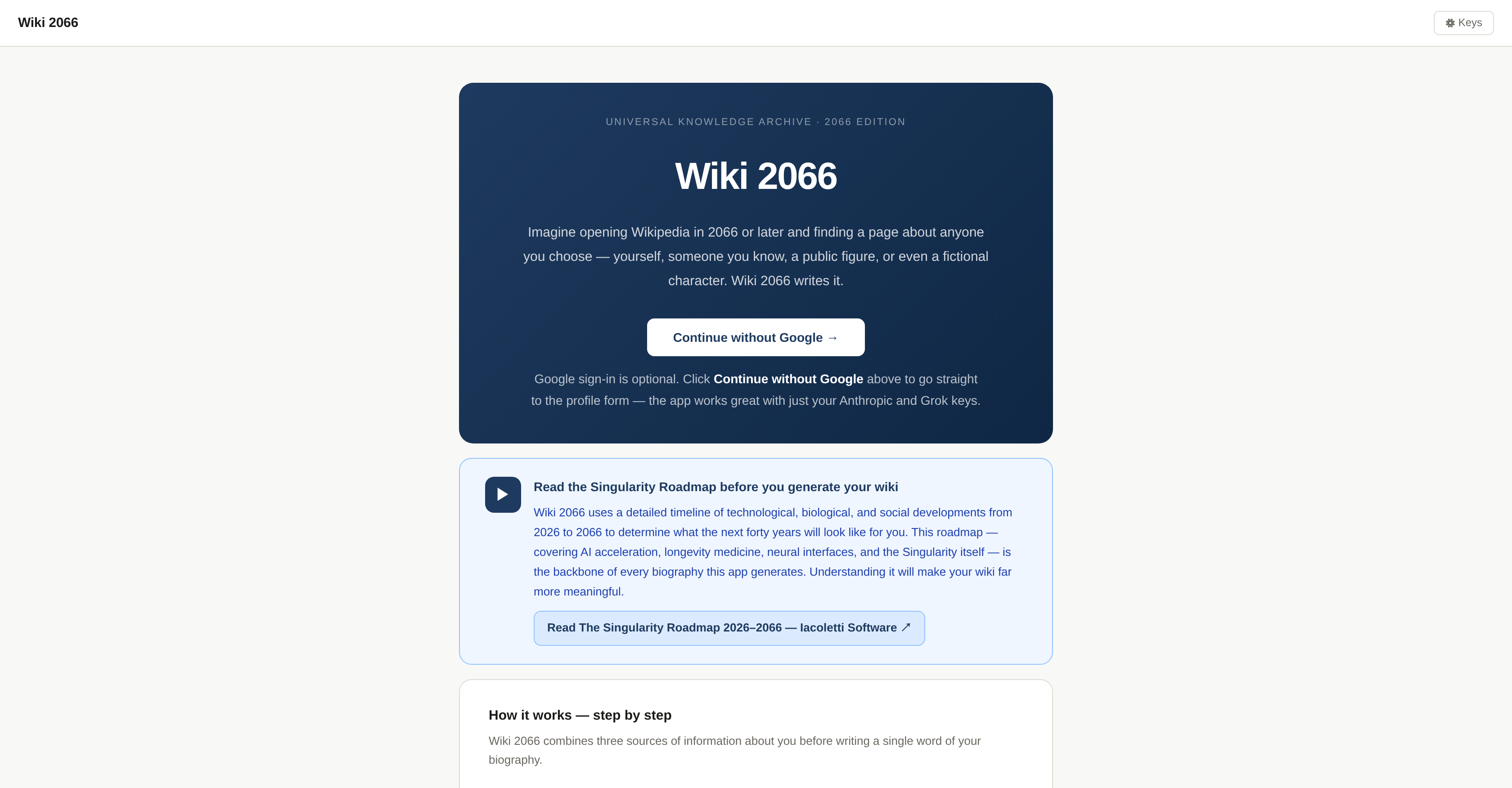
- Visualize potential futures for any topic or public figure with AI-generated Wikipedia entries from 2066, powered by algorithmic modeling of current data and trends.
- Uncover probable trends and field progressions for academic research and forecasting, using data extrapolation from a forward-looking encyclopedia.
- Spark creative discussions and educational content by exploring hypothetical future scenarios across diverse subjects in a futuristic context.
- Enhance strategic planning with simulated future scenarios that help adjust strategies based on extrapolated current trends and events.
- Generate entertaining and thought-provoking personal future Wikipedia profiles through speculative AI analysis of existing information.
Pros & Cons
Pros
- Generates hypothetical Wikipedia entries
- Forward-looking encyclopedia
- In-depth trend analysis
- Useful for academic research
- Assists in future planning
- Entertaining futuristic projections
- Non-reliance on historical data
- Insight into potential futures
- Educational for scenario planning
- Visualization of future events
- Futuristic data exploration
- Hypothetical scenarios creation
- Forecasting field progression
- Encourages discussion and exploration
- Bridge between present and future
- Generates content from potential futures
- Redefines interaction with data
- Provokes thought and discourse
- Useful for creators and educators
- Adds futuristic dimension to research
Cons
- Predictions are purely speculative
- Can't guarantee accuracy
- No historical data validation
- Potential for manipulated projections
- Limited to Wikipedia-like entries
- Lack of real-time updates
- No option to customize parameters
- Doesn't offer variable sensitivity analysis
- May not consider all variables
- Unknown error handling procedure
Reviews
Rate this tool
Loading reviews...
❓ Frequently Asked Questions
The Wiki 2066 is an AI tool designed to act as a forward-looking encyclopedia. It is equipped to provide users with simulated Wikipedia entry predictions from the year 2066 by extrapolating current data and trends into the future.
Wiki 2066 works by analyzing current data, trends, and events. It uses this information to generate hypothetical but probable Wikipedia entries for the year 2066. Its functioning is based on existing historical trends and algorithmic modeling.
Various individuals and groups can benefit from using Wiki 2066. This includes academicians and researchers for studies related to future projections and predictive analysis, future planners to understand potential futures and adjust strategies, and anyone interested in an engaging and creative application of AI for predicting personal or public figures' future Wikipedia entries.
The predictions from Wiki 2066 are considered theoretical because they’re based on current data, historical trends, and algorithmic modeling. While these elements provide a strong basis for extrapolation, the real future can also be affected by changing variables, unknown factors, and unforeseen events that Wiki 2066 might not account for.
While the Wiki 2066 can generate highly probable predictions, it's accuracy is not foolproof. Just like other predictive AI tools, it might not completely account for changing variables, unknown factors, and unpredictable events. Hence, the tool should not be solely relied upon for precision and accuracy in predicting future scenarios.
Wiki 2066 analyzes current data by using state-of-the-art algorithmic modeling. It assesses prevailing data, events, and trends, and extrapolates this information into the future to generate probable Wikipedia entries for the year 2066.
Researchers and academicians can use Wiki 2066 to engage in studies related to future projections and predictive analysis. With its potential to predict how current trends evolve in the future, it offers a fresh perspective for research and academic studies.
Yes, Wiki 2066 can be a valuable tool for future planners. It extrapolates present data to provide a glimpse into potential futures. This can assist planners in understanding how current trends might evolve and help them adjust their strategies accordingly.
While Wiki 2066 uses sophisticated algorithmic modeling to make predictions, the intrinsic unpredictability of future events means that it cannot always guarantee precision. Like other AI tools, it is susceptible to changing variables, unknown factors, and unprecedented events, and therefore, should not be the only tool relied upon for making precise predictions.
Wiki 2066 can be entertaining by providing users with a creative and amusing way to see possible future Wikipedia entries. Users can predict how personal or public figures' Wikipedia pages might evolve, making it a fun application of AI.
Wiki 2066 can predict various future scenarios based on current trends and events. This could include anything from public figures' future life events to how academic, societal or other areas might evolve by the year 2066.
While Wiki 2066 is designed to analyze and account for current known variables and factors, it may not fully consider or predict sudden changes in these variables or entirely unknown factors. This is common to any predictive system and is why its predictions are theoretical and not certain.
Yes, Wiki 2066 has the capacity to generate future Wikipedia entries for public figures. It can analyze current information about these figures and extrapolate that information into the future to offer a simulated view of their potential Wikipedia profiles.
Wiki 2066, like other AI predictive tools, does its best in extrapolating data considering existing trends. However, unpredictable and unprecedented events that deviate from these trends present a challenge, which may impact the accuracy of the prediction.
Yes, Wiki 2066 can be an effective tool for future scenario planning. It offers a unique approach to imagining possible futures. However, its predictions are hypothetical and should be considered as part of a broader array of forecasting tools and strategies.
The uniqueness of Wiki 2066 lies in its innovative application of artificial intelligence for creating simulated Wikipedia entries from the future. It combines predictive analysis, digital archiving, and scenario planning into an insightful, educational, and entertaining package.
In the context of Wiki 2066, digital archiving refers to the method by which it archives and utilizes existing data, trends, and information to project potential future scenarios. It essentially 'archives' the present to 'foresee' the future.
Wiki 2066 uses algorithmic modeling to structure and interpret current data, trends, and events. This process helps in extrapolating the data into future scenarios, resulting in the creation of probable Wikipedia entries for the year 2066.
Yes, Wiki 2066 can be an effective educational tool. It provides an accessible approach to understand data extrapolation, digital archiving, and predictive analysis. It could serve as a novel way to promote discussion, exploration, and learning about the potential of AI.
The power of Wiki 2066 can be leveraged for trend analysis by analyzing the current data, trends, and events it uses to make predictions. It provides a unique perspective on how current actions and activities might shape future outcomes, offering a valuable resource for anyone interested in observing, studying, or predicting trends.
The main function of Wiki 2066 is to generate hypothetical Wikipedia-like entries from the year 2066, interpreting current data and trends to visualize future probabilities.
Wiki 2066 utilizes sophisticated AI algorithms to analyze current data, trends, and events, enabling it to extrapolate them into the future and generate speculative Wikipedia entries for 2066.
The predictions from the Wiki 2066 are theoretical and rely on the AI's interpretation of current data and trends. While striving for a high degree of accuracy, they are not absolute guarantees of future events.
While Wiki 2066 provides insightful future projections that can be useful for future planning, they should not be wholly relied upon due uncertainties such as changing variables, unknown factors and unprecedented events.
For academic research, Wiki 2066 might be used for studying future projections and predictive analysis. Researchers could leverage this tool to understand potential trends and to generate discourses and theriocal assumption regarding future scenarios.
Wiki 2066 analyzes current data and trends to forecast future possibilities, using these factors as variables in its AI algorithms. It extrapolates known data into the future, while attempting to predict unknown variables.
Wiki 2066 is unique in its concept of a forward-looking encyclopedia, allowing users to leap into the future and providing a different perspective on digital archiving and predictive analysis.
Yes, Wiki 2066 can simulate personal Wikipedia entries from 2066. However, such predictions are hypothetical, based on the AI's understanding of current trends and data.
Wiki 2066 requires current data and trends to generate projected future Wikipedia entries. It utilizes these elements to make extrapolations into the year 2066.
Yes, Wiki 2066 may provide predicted entries for future public figures based on its analysis of current trends, data, and events.
Wiki 2066 can aid in forecasting and field progression studies by simulating potential future scenarios and uncovering likely trends based on current data and happenings.
Yes, Wiki 2066 allows exploration of a variety of subjects within a futuristic context, providing an opportunity for users to learn about potential developments across different fields.
Wiki 2066 acknowledges the phenomenon of changing variables, unknown factors, and unprecedented events, and these factors are incorporated into its algorithmic modeling to make as accurate predictions as possible.
Yes, educators and creators can use Wiki 2066 for teaching or for content generation. It can encourage thought and discourse around the trajectory of current trends toward the future, providing an interesting and futuristic base for learning and creativity.
Yes, it's important to understand these are hypothetical scenarios based on available data and trends. Changing variables, unknowns, and unprecedented events can affect the accuracy of the predictions. While enlightening and entertaining, the AI-generated content should not be considered as definitive predictions of future events.
Wiki 2066 can predict future trends as part of its function, using current data and trends to project potential growths and declines in various fields and topics.
The principle behind Wiki 2066's AI algorithms involves interpreting current data, trends, and events and utilizing this analysis to generate probable futures. These algorithms extrapolate known data into the future to generate hypothetical Wikipedia entries for the year 2066.
Wiki 2066 generates its future scenarios based on current data and trends, making allowances for changing variables and unknown factors. While perfectly predicting unprecedented scenarios isn't possible, the AI aims to provide as accurate a depiction of the hypothetical future as is feasible given available data.
Pricing
Pricing model
Free
Paid options from
Free